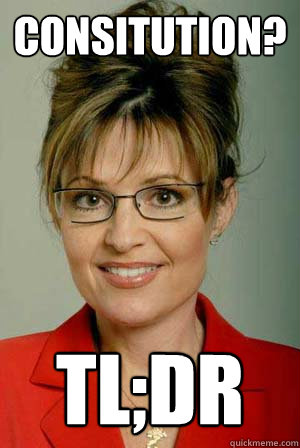
I do my best, at my advanced age, to come to grips with the apparent acceptability of such widely used words/expressions/abbreviations as lol/LOL, IMHO, AFAIK, etc. However, TLDR/tl;dr defeats me. According to several dictionaries (e.g., http://www.urbandictionary.com/define.php?term=tl%3Bdr) it means "too long; didn't read", but I have noticed people at EL&U and other StackExchange sites using it towards the end of their own answers to questions, often following it with a summary of what they have said before. I have assumed that it now means something like "If you found the above too long and complicated, here is, in a nutshell, what I meant to say"". Am I right?
Asked
Active
Viewed 5.5k times
93


-
ROTM. Or, of an apparently similar derivation, OK. – StoneyB on hiatus Nov 20 '14 at 22:38
-
2@StoneyB. I do begin to wonder whether either old farts like me or such abbreviations should be banned from the site. I had no idea when I saw your comment what ROTM meant. After a Google search, I am assuming it's 'Right on the mark'. – tunny Nov 20 '14 at 22:49
-
@tunny, I'm afraid OED has "right on the money" from 1962 onwards: New Yorker 10 Nov. 145 You've got to be right on the money when you set it [sc. an aeroplane] down. ;) – A E Nov 20 '14 at 22:52
-
2@tunny You and I are probably much of an age. I had to learn some of these (and how to look up the others!) in order to communicate with my son and his contemporaries. – StoneyB on hiatus Nov 20 '14 at 23:06
-
3I think TL:DR is acceptable, if OT, OP, se, and a host of other abbreviations are used. This is more of a meta question, though. I wouldn't use it in formal writing, but I hope we don't come to that here. – anongoodnurse Nov 20 '14 at 23:23
-
2I'm not sure how 'incomprehensible' those answers could've been, anyway, given that you correctly inferred the meaning from context. – Curtis H. Nov 21 '14 at 00:01
-
11@LRO ~ depending how 'word' is defined, the English language has between 250,000 and 1 million words. The average native speake has a vocabulary of 20,000 - 35,000 words. In broad terms, a native speaker knows only around 10% of the available words. That is why normal practice puts the onus on the writer to use a lexis the audience will understand, and your suggestion that tunny become a superhuman by learning every English word that exists, plus the 1,000 or so new ones per year, is silly. – Roaring Fish Nov 21 '14 at 03:57
-
1@RoaringFish, then how do you know for certain that all of your readership will understand such terms as 'lexis' and 'onus'? – A E Nov 21 '14 at 08:31
-
2@AE ~ it is a matter of knowing your audience. Posters in ELU (with one or two exceptions...) are educated and interested in language and/or linguistics (otherwise they wouldn't be here) and routinely use phrases like 'lexis' and 'onus'. In contrast, I would hope that my colleagues would understand 'LBH','ZPD', 'ES' or 'MMC' but for most posters in here I would write it out in full. – Roaring Fish Nov 21 '14 at 11:39
-
1@RoaringFish: posters, sure, that's likely. But readers? Surely many of them come here to learn things which they don't already know. Should we really try to cater to the lowest-common-denominator of reader knowledge? – A E Nov 21 '14 at 13:59
-
1Example of usage: http://meta.stackoverflow.com/questions/277149/help-vet-the-rules-for-a-possible-future-contest – user11153 Nov 21 '14 at 15:13
-
Also useful when dealing with people who only post youtube videos of morons making unsupported assertions as their arguments: "YT; DW" (YouTube, Didn't Watch) – Almo Nov 21 '14 at 15:23
-
For a meta aspect of this use on SE, I argued that the community on C.SE not use it. tl;dr? - that's just lazy and not "expert" Admittedly, at the time I thought people were using it in the traditional way saying they didn't really bother reading the question. But in one of the answers it points out that it does not improve over "summary" or "abstract" with the way SE users are using it. – Nov 21 '14 at 15:40
-
1That being said, this is a meta question, isn't it, because you are asking about use on this SE site, not necessarily on use throughout the English speakers of the Internet. – Nov 21 '14 at 15:42
-
A discussion of the meta issue is already open: http://meta.english.stackexchange.com/questions/5381/are-textspeak-abbreviations-acceptable-in-answers and that is (I think) the best place for comments about whether or not 'tl;dr' should be allowed on English.SE. – A E Nov 21 '14 at 16:15
-
Sadly comments can only be migrated if they're tacked onto posts. they cannot be migrated individually. – Matt E. Эллен Nov 21 '14 at 16:58
-
@AE... if those readers struggle with 'lexis' and 'onus' they should be in ELL instead of ELU. – Roaring Fish Nov 22 '14 at 06:30
-
@RoaringFish: suggest we discuss this on meta. – A E Nov 22 '14 at 07:38
-
4the first time I saw "tldr" I thought it was some mockery for "The Lord of Da Rings" :P hehehe – Purefan Nov 23 '14 at 10:34
-
See also http://meta.stackexchange.com/questions/137120/tldr-summaries-at-the-top-of-question – Barmar Nov 24 '14 at 19:37
-
That intro though – Kitanga Nday Nov 22 '17 at 13:16
5 Answers
127
It means "if you couldn't be bothered to read the preceding material because it looked too long (and possibly boring), here is a summary for you". The meaning is quite close to 'executive summary'.
tl;dr is used to call out another user on the length of their post. However, in cases of more courteous exchanges and serious discussions, tl;dr can be self-invoked by the original poster as a disclaimer to the readers. It is then paired with a brief summary of the longer original text.
KnowYourMeme: tl;dr
urbandictionary: tl;dr
Also useful to know:
Image macros of teal deers are sometimes used in place of tl;dr, due to it sounding close to “tee el dee are.”
The earlier usage ("used to call out a user on the length of their post") has a range of meaning from "please remember, brevity is the soul of wit" to "I find your loquacious verbosity exceptionally tedious. I have ignored your communication in its entirety! Haha!".
This usage can be considered trollish, particularly in the following scenario:
I (a troll) ask a seemingly-serious but reasonably complex question, or engage you in what seems to be a serious debate.
You respond at some length.
I immediately respond "tl;dr!", meaning I am amused that I have induced you to waste your time in composing a lengthy prose argument which is now worthless for want of an audience.
See also: 'Cool Story, Bro!':
A phrase sarcastically used to indicate one's disgust or indifference towards a tl;dr story.
urbandictionary: cool story bro
You might prefer a 'Joseph Ducreux' equivalent - expressing the same sentiment in terms which the writer considers archaic or excessively formal - one of which is:

(I've included the image here because it forms an intrinsic part of the meaning).
An online post which lacks brevity and is not formatted into clear paragraphs or sections could also be criticised as a 'Wall of Text' or 'wall'o'text', "a huge run-on paragraph that makes it difficult to recall the original point". Such a post might justifiably be criticised as being 'tl;dr' - too long (and badly formatted) to read.
It's also sometimes seen (in reference to videos) as 'tl;dw' - "too long; didn't watch".
If you can ignore its hackneyed over-use, then 'tl;dr' can actually be quite a clever riposte, in proportion to the excessive length of the text which it is used to rebut. You can choose to interpret it quite wittily, as "Your views are so marginal, your argument so poor and your writing so unnecessarily verbose that everything you write can be summarily dismissed as beneath my notice; and, in contrast to your rambling statement, I am choosing to demonstrate my intellectual superiority by making this dismissal in a post consisting of only five characters. (This rhetorical strategy is obviously most effective when the replying post consists solely of 'tl;dr').
Attempting to rebut an opponent in an online discussion with 'tl;dr' can backfire. Your thinking opponent will declare that their text is well-written and of appropriate length, and that you would easily have been able to read and understand it, if only your intelligence and literacy were not below par, as (the opponent can argue) is clearly demonstrated by your use of the (to them) ugly neologism 'tl;dr':
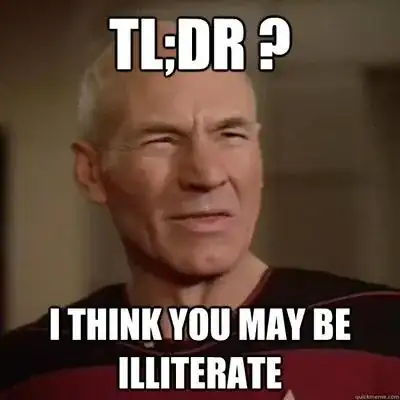
Again the image provides vital context for the meaning here: Sir Patrick Stewart's Royal Shakespeare Company training in elocution and his celebrity status, combined with the character Jean-Luc Picard's high status within the fictional world of Star Trek, show the writer attempting to place themselves in a position of intellectual authority; the writer portrays himself as the Captain Picard of usage, dismissing the juvenile prankster's neologism with a well-judged "Shut up, Wesley!".
'tl;dr' can also be used in politics. By projecting it as dialogue into the mouth of one's political opponent, one can imply that they are cavalierly (or through sheer stupidity) ignoring a text which, although it is lengthy and complicated, they should rightly consider extremely important.
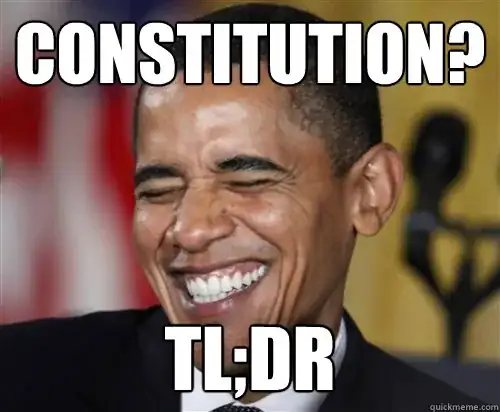
Although this particular example happens to feature President Obama, this kind of rhetorical attack is used against people right across the political spectrum, since it's essentially a very general attack on the merit of the political figure as a person, rather than a well-reasoned critique of their policies. In this example the exact same text is being used to attack Sarah Palin.
This technique is particularly effective where the material being ignored relates to the Internet, the very source of the phrase 'tl;dr':
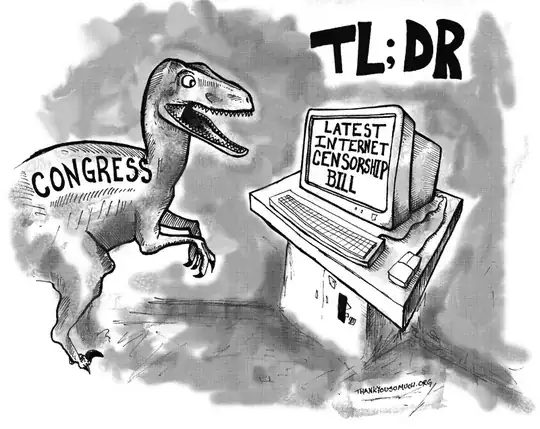
Editorial Cartoon: TL;DR Congress (licensed CC BY-3.0)
In a press release of 28 August 2013, Oxford Dictionaries Online (OUP) included 'TL;DR' on a list of words being added to ODO - interestingly though, it is the one 'new word' on the list in that press release which doesn't have an entry. The definition given in the press release is:
TL;DR, abbrev.: ‘too long didn’t read’: used as a dismissive response to a lengthy online post, or to introduce a summary of a lengthy post.
but the word does not have a proper entry of its own. Even more interestingly, the word seems to have had a definition at ODO, cited here ("early 21st century", click through for more antedating info) as of August 3013, which has now been removed. The OED has bupkis of course.
To clarify the likely intended meaning (in response to a question below):
if 'tl;dr' is a one-word reply to a lengthy post then it is likely to be intended as a riposte or at best a rebuke to the person who posted the lengthy text, whereas
if it is placed at the foot of a long post by that post's author together with a summary of that post then it is being used in the 'executive summary' sense, to forestall the possible criticism of excessive verbosity, and
if it is placed in the mouth of a political opponent then it implies the opponent's cavalier dismissal of (or failure to understand) an important text.
Here on Stack Exchange the 'riposte' or 'putting words in their mouth' meanings would likely fall foul of the SE network's 'be nice' policy. So if you see it here then it almost certainly means 'executive summary'.
tl;dr: Yes.

-
10
-
3
-
3
-
9OMG (!). I ask about TLDR, and the answers involve AGAIC and YMMV. .IAMJGTPTHPOMATAOAARTOBP (= I am just going to pull the plug on myself, admit to advanced old age, and retire to bed permanently in case you didn't know that one (ICYDKTO)). – tunny Nov 20 '14 at 22:58
-
2The odd thing is that you often see tl;dr without any lengthy preamble. This seems to have become more common than other uses, and appears to mean "I couldn't be bothered to write a detailed description, so you have to figure out what I mean from these few words." – Hot Licks Nov 20 '14 at 23:25
-
1
-
2@tunny you might be as surprised as I was to learn that OMG can apparently be traced back to 1917. – terdon Nov 21 '14 at 01:36
-
I don't understand why you'd put a tldr paragraph at the end of your post though, because how would anyone ever find the tldr paragraph if they stopped reading much earlier? – Sumyrda - remember Monica Nov 21 '14 at 08:23
-
@HotLicks, that is interesting. Perhaps it's intended to mean "if I were to go into this in detail then my post would be very lengthy and you would be bored - here is the summary version" ? – A E Nov 21 '14 at 08:49
-
1@Sumyrda usually the answer to a question is either found at the beginning of a post or at the end. The body will contain examples, explanations, data, pros and cons etc. When skimming through a particularly lengthy post it's quite natural to skip to the end, therein the tl;dr headline, which provides immediate relief from "readingstroke" plus the answer. – Mari-Lou A Nov 21 '14 at 08:51
-
@Sumyrda, I think the idea is that the eye has skipped over a large text block. – A E Nov 21 '14 at 08:57
-
15
-
2@AE. Your answer is particularly helpful to someone like me who genuinely did not now the meaning of tl:dr. However, the varieties of ways in which it can be interpreted makes it particularly unsuitable for answers, in my opinion. How do we know the user's intended meaning? I appreciate this is more of a meta question, and I have asked a question in EL&U Meta: http://meta.english.stackexchange.com/questions/5381/are-textspeak-abbreviations-acceptable-in-answers – tunny Nov 21 '14 at 12:12
-
1
-
1@tunny, I'm really glad it's been helpful! As you say, the issue of whether answers on ELU should be permitted to use slang terms or should be restricted to more formal usage is more properly debated on meta, thank you for opening it there. To clarify the likely meaning: if 'tl;dr' is as a one-word reply to a lengthy post then it is likely to be intended as a riposte or at best a rebuke to the person who posted the lengthy text; if it is placed at the foot of a long post by that post's author together with a summary of that post then it is being used in the 'executive summary' sense. – A E Nov 21 '14 at 12:16
-
Thank you @randal'thor, but Scimonster should really get the credit for that idea. – A E Nov 21 '14 at 12:19
-
1+1 for the tl;dr summary - I scrolled down a whole lot in the hope to find it - and I did :-) ... and it gives me the feeling that you wrote the rest of it solely to make the point of the final tl;dr. But unfortunately I can't upvote a second time. – chiccodoro Nov 21 '14 at 13:30
-
2I leave you alone for three hours and when I come back what do I see? You can't be trusted, can you? Possibly the longest, most comprehensive answer for the shortest expression (tl;dr) I have seen on EL&U. :) – Mari-Lou A Nov 21 '14 at 14:24
-
Thank you @Mari-LouA, that's very kind. :) I thought I could have covered the origins in more detail, but I'm leaving that for another day. I'm also *really* interested as to why the ODO added it then removed it! – A E Nov 21 '14 at 14:28
-
1I was a bit surprised at the multiple mentions of it being used by the author at the bottom of the post. I have seen it used (and only every use it) at the top of a post to very quickly summarise for example technical answers to yes/no questions on unix.stackexchange.com. – l0b0 Nov 21 '14 at 15:27
-
@l0b0, that's interesting. A Google search for "tl;dr top bottom" brings up a number of results discussing the issue. If I can find out roughly when it 'migrated' (I think the 'why' is pretty obvious) then I'll add that in. Some info at http://meta.stackexchange.com/questions/137120/tldr-summaries-at-the-top-of-question – A E Nov 21 '14 at 15:33
-
1To answer @Sumyrda's meta-question: a reader could/would find a TL;DR paragraph at the end of a post if he's scrolling down to read the comments (and to look for other answers). – Scott - Слава Україні Nov 21 '14 at 22:38
-
6
-
4Registered just to upvote this answer. Only read the last line though. – Niels Keurentjes Nov 23 '14 at 02:55
-
1
-
1This post needs an executive summary/TLDR section :) More seriously, I have seen about 10x more usage of TL;DR as a self-posted executive summary, compared to a snark comment on someone else's content. – DVK Dec 19 '16 at 16:32
22
The "summary" meaning has already been explained, but in a different usage (perhaps the original), it is meant as an insult.
User A: [long impassioned explanation of his views on a particular issue]
User B:
tl;dr
Here User B is saying to User A: "Your post was too long and I didn't read it". At best, this is a suggestion that User A is being too verbose and, for the convenience of other readers, should try to summarize his point more concisely. At worst, it suggests that B doesn't believe that anything written by A is worth reading at all, and B is specifically saying this to taunt him with the thought that his epic post is being ignored.
I believe the "summary" meaning grew out of this, as a way of saying: "To forestall those who would tell me tl;dr, here is a brief summary of what I have written."

Nate Eldredge
- 4,977
6
I have assumed that it now means something like “If you found the above too long and complicated, here is, in a nutshell, what I meant to say.”
Your interpretation as just quoted may be what some writers mean tl;dr to stand for, and is in accord with the explanation from knowyourmeme mentioned in a previous answer. But note that the knowyourmeme entry also says:
Due to its indiscriminate usage by many, tl;dr is frequently considered as spam or meaningless replies by both those unaware of the term and those who are familiar with the meaning.
Because concise, clear, and meaningful phrases¹ are available to use in place of tl;dr, I think there is no reason to use it in ELU answers. Readers who wish to skim an answer, or skip forward to its conclusions, will easily spot those phrases and recognize in a smooth and natural way that they introduce a summary. By contrast, having the words “too long; didn’t read” (or perhaps “too long; don’t read”, or perhaps “WTF?”) appear in one's mind is not a smooth and natural introduction to a summary.
¹ For example, in brief, in short, in summary
Edit: This answer is not intended to say which acronyms are ok and which aren't. Indeed, tl;dr seems ok as a riposte to long, verbose text or as a comment at the end of one's own lengthy text. But as an introduction to a summary, the words behind tl;dr just don't work.
In short, the text where a typical acronym appears still makes sense if words are substituted for the acronym. But that is not true of tl;dr when it is used as a “here is the summary” marker. Writers should avoid so using it.

James Waldby - jwpat7
- 66,660
-
3In my work environment, it is normally considered polite to put the TL;DR comment at the top of the email, leaving the details below for those who need to read it all. – Jonathan Leffler Nov 21 '14 at 07:00
-
2If "WTF" is ok but "tl;dr" isn't, then you're drawing the line at about the year 2000? – A E Nov 21 '14 at 08:25
-
-
@jwpat7, thank you for your clarification. :) It's probably better if we take this discussion to meta, where a question is already open: http://meta.english.stackexchange.com/questions/5381/are-textspeak-abbreviations-acceptable-in-answers – A E Nov 21 '14 at 16:04
-
@JonathanLeffler, in olde english, we used to use a convention called the "Abstract" :) – gbarry Nov 23 '14 at 19:16
-
As pointed out below, if you use it as a summary heading at the end of your text, the danger is it will be missed. Once someone knows the use of tl;dr as flagging a summary, it's a small-step to it making sense at the beginning. – matt freake Nov 24 '14 at 14:07
1
Your evaluation of what you saw is correct. The "too long; didn't read" abbreviation is now being used to mean, "Too long? Here's a summary". The irony here is that if the post is too long to read, the reader is likely to miss the "tl;dr" part, because it has now been buried in the prose!
It's a symptom of our language being morphed under the weight of the sheer numbers of Web users. In this same fashion, LOL and ROFL have ceased to carry their "out loud" or "on the floor" meanings, and now just mean, "I found this funny" and "I found this really funny".
Sad, what we do to our language, but there it is. It's who we are. But also, see ESR's introduction to the Jargon File, which includes this: "Hackers, as a rule, love wordplay..."

gbarry
- 111
-
-
Sorry, my computer background is showing. That is Eric S. Raymond. That and the word "jargon" in a search will take you right to it. (Actually, "ESR" works too, since he's well known). – gbarry Nov 23 '14 at 19:20
-
To further illustrate my point, @tunny, the final three words of your original post are now being morphed to "amiright?" or even, "amirite?"...sorry to say. – gbarry Nov 23 '14 at 19:22
-
-
@Mari-LouA : ESR is the keeper of the 'jargon file' : http://www.catb.org/jargon/ – Joe Nov 23 '14 at 22:24
-1
I would like to add to this discussion a side note: tl;dr Syndrome.
I have encountered an appalling tendency for people to read only the portions that they want to read (cf. "hearing what they want to hear") and discard the rest, even though they avowedly want detailed responses to the questions they have asked.
I use the phrase "tl;dr Syndrome" in reference to this tendency.
I find myself enraged when I encounter it, as those with the syndrome have quite explicitly wasted my time.
I will also note that it the entire use of tl;dr is not at all offensive to me. :)