5

What is a suitable word for describing a book that its sheets are separated from each other and its binding?

The intended sentence is something like : He was holding a portion of my XXXXX copy of Jackson's textbook.

Edit after Chris's answer:

I want to imply that the book is unbinded as a result of being used and studied too much.

(You are welcome to modify other parts of the above sentence too, to make it more clear.)

user215721
  • 181
  • 2
  • 6

9 Answers9

8

Bibliophiles have their own jargon for the various ways a book can be damaged— foxed, warped, a whole slew of c- words from to chipped to cockled to crimped; see ILAB glossary for a few. The technical term for a book that has lost its binding is disbound, which Merriam-Webster defines as simply

no longer having a binding (a disbound pamphlet)

But there isn't, so far as I know, an English idiom that refers to a book becoming disbound due to overuse. For whatever reason, the English noticed wear and tear on the pages of the book rather than its spine, and so a book that is worn out from overuse is very often described as tattered and/or dog-eared, and perhaps frayed (especially of cloth bookcovers). Per MW again:

tattered - 2: torn into shreds: ragged (a tattered flag)
3a: broken down : dilapidated (decaying houses along tattered paved streets — P. B. Martin)
b: being in a shattered condition (led their tattered party to victory)

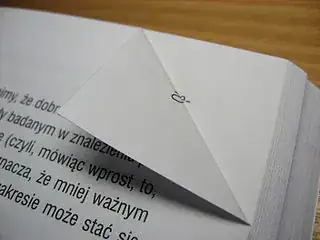
dog-eared - 1: having dog-ears (a dog–eared book)
2: shabby, timeworn (a dog–eared resort dog–eared myths)

(a dog-ear is a folded-down corner of a page, used to hold a place) Photo of a dog-eared book from Wikimedia Commons, GFDL by Derbeth
3 fray (intransitive) - 1: to wear out or into shreds
2: to show signs of strain

choster
  • 43,403
  • Tattered is good, but my intuition says it’s more likely to be used about cloth(es) than books. For books, I would think battered was more commonly used. – Janus Bahs Jacquet Dec 05 '14 at 01:15
  • @JanusBahsJacquet I semi-agree; I'd think of a "battered book" having "tattered pages." – Cat Dec 05 '14 at 04:52
3

If the pages have become detached from the book cover you could say

He was holding the detached pages...

However, the word pages alone is a sufficient and the phrase dilapidated copy explains why the pages are separate.

He was holding the pages of my dilapidated copy of Jackson's textbook

Google Books offer this example:

In our auction of June 2002 we offered a dilapidated copy of Our Wullie's first book of 1941. The spine and part of the front and back cover were worn away...

Mari-Lou A
  • 91,183
2

The word is unbound, as in an unbound book. However, this implies a book that was never bound. You might also try unbinded to refer to a book that was once bound. I haven't found much usage for the second term, but I think it would be easily understood. If you want a more commonly used word, try disassembled.

Chris Sunami
  • 19,990
2

I think we'd have to go with a cobbled-together phrase to get the meaning across that pages are missing such as:

"He was holding a ripped-out portion of my copy of Jackson's textbook."

"He was holding a disassembled section of my copy of Jackson's textbook."

"He was holding a fistful of pages from my now page-missing copy of Jackson's textbook."

"He was holding an amputated portion of my now incomplete copy of Jackson's textbook."

2

He was holding a handful of pages from / that belonged to my copy of Jackson's textbook, which had fallen apart.

Erik Kowal
  • 26,806
1

How about stack of loosened pages of, or simply loosened pages of, it's not a single word but otherwise it fits and can be used in varied registers.

Modified according to @Mari-Lou 's more refined suggestion.

pfff
  • 480
0

He was holding a sheaf of pages, torn from my copy of XXX book.

0

He was holding a ragged sheaf of pages — at least several chapters — from the unbound remnants of my copy of Jackson’s textbook.

tchrist
  • 134,759
0

The adjective loose-leaf describes books (especially textbooks) that are sold without binding. I know that's not quite what you want, but perhaps another adjective could help.