11

This question has been on my mind since I first read Hemingway's story, "A clean well-lighted place". I have never heard "well-lighted" in my life other than in this story. I have heard that a room can be "well-lit" however.

Does anyone know why Hemingway chose to put it this way?

RegDwigнt
  • 97,231
gbutters
  • 6,516

7 Answers7

12

In most dictionaries, both "lighted" and "lit" are generally listed as acceptable past tense of the verb "light," so there is no difference between them.

"Lit" appears to be more common in contemporary American English usage, though.

Greg R.
  • 1,046
  • 4
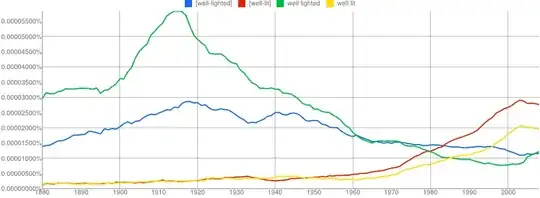
    Historically, "well-lighted" was overwhelmingly favoured, but it's been in decline for the last 100 years or so, with "well-lit" actually becoming the more common usage (40 years ago in UK, 20 in US). So in fact, Hemingway's usage was simply the norm for his time and his side of the pond. – FumbleFingers Apr 15 '11 at 12:01
  • 2
    You can see this clearly in this ngram from Google Books data: http://ngrams.googlelabs.com/graph?content=well+lit%2Cwell+lighted&year_start=1800&year_end=2000&corpus=0&smoothing=3 – JasonFruit Apr 15 '11 at 18:43
3

They are, as noted, complete synonyms.

They are both the past tense of light, one treating it as a weak verb and one as a strong. While lighted is the older, lit has been around since the 1500s, and both have lasted some time.

Hemmingway was writing in 1933, and it appears that then well-lighted was considerably more commonly used than well-lit.

Not as common as "well lighted", though he uses that too in the story; choosing to hyphenate when using it as a compound adjective modifying place, and not to when using it as a compound adjective following is; "It is well lighted."
enter image description here

That said though, even if lit were more common at the time, lighted would serve better there. Look at how often light is repeated throughout the story, often close to rhyming words bright and night; this last repeated several times too. Since lighted keeps with that repetition of /aɪt/ sounds more than lit would, it has a poetic benefit in this story that doesn't apply to most cases where one would choose between them.

Jon Hanna
  • 53,363
2

My two cents: as a lighting designer, I use "lighted" to talk about the medium of illumination--when something is well-lighted, the light itself is good (plentiful, good color, appropriately directional, etc.); I use "lit" to talk about how the light treats the thing being illuminated--when something is well-lit, the light has been used to make it visible, attractive, interesting, etc.

perry
  • 21
  • 1
    Which do you use if to talk about how the light is being sought by a parasuicide who is seeking refuge from the absurdity of being? – Jon Hanna Feb 13 '13 at 22:20
1

I don't know if I learned this somewhere or if I invented it myself, but this is how I distinguish.

I light a cigarette; the cigarette is lit. I turn on the light; the room is lighted. I ignite some kindling in the fireplace; the fire is lit. The floor near the fireplace is then lighted by the fire.

1

When I was in AP Literature, my teacher told me to use lighted for things that were illuminated via bulb and lit for things set on fire. These were more archaic uses of the terms, she insisted however. I still follow this usage when speaking; however, for my students I will accept either because language is a changing thing.

MetaEd
  • 28,488
shirl v
  • 11
0

I never really thought about this before this evening. Some (younger) colleagues and I were walking out of work, and the sun was down. One chose a different path from the one we usually take. Our usual route was more open, but dark. The more closed-in route was lighted; i.e. there was overhead artificial lighting. I commented that taking the lighted path was a good idea, and all of my companions took exception to that usage.

I hadn't realized this usage had become archaic - I've been living in countries that were not English speaking ones for over 20 years now, so maybe I'm out of touch, but I stuck by my choice. I, too, have always noted a difference between the two words. I don't remembeer learning it specifically, but when fire or burning is the purpose, I would say the thing involved had been lit. When it's artificial, or else specifically for the purpose of providing light to see by, I'd say the thing was lighted (note the difference in tense - past perfect vs. lighted as a basic adjective/passive). Again, I stand by this choice, but will also admit that I'm old. :-)

Greg
  • 1
-2

Although historically (several hundreds of years ago) "lit" was used as a verb while "lighted " was used as as an adjective. However, more recent use has developed. I agree with those who use "lighted" to describe something illuminated with artificial light, while "lit" describes something that is "burning" (e.g. candle, match, etc.)

  • Do you have any evidence for this? This Ngram seems to show that hundreds of years ago, "lighted" was the verb. – Peter Shor Sep 08 '14 at 01:44
  • Welcome to EL&U. Please remember back up your assertions with appropriate references; I would encourage you to review the help center's guidance on answering questions. – choster Sep 08 '14 at 02:51
  • Actually, the real story seems more complicated. The OED has two forms, lighted and lit, and both have been around for a long time. Shakespeare used lighted. During the 19th century, the upper-class form (which would have been the one that usually appeared in print) was lighted, and if you used lit, you betrayed your lower-class origins. – Peter Shor Sep 08 '14 at 17:32