44

Context - One might use it in the following situations:

  • "An employee has an argument with their boss and a dispute follows." (they get fired a few weeks later)

  • "A student having an argument with his teacher over his grades takes the problem to the headmaster." (the headmaster doesn't want to get into it and says the teacher is right)

  • "Workers go on strike for a week, get no raise and are considered absent from work."

You can say it to your son/daughter as a prediction: “Be careful mate, remember…(the saying)…

And you can also say it when he/she comes to you for comfort and support: “I told you, mate, they say that........(the saying).

Heartspring
  • 8,600
  • 6
  • 43
  • 73
Centaurus
  • 50,047
  • 1
    I keep thinking “Good guys always finish last”, but that's not quite the same… – Janus Bahs Jacquet Dec 08 '14 at 23:47
  • 16
    I don't see the common thread between your examples, but for your final fill-in-the-blank: *you can't fight City Hall*? (PS: no, I didn't downvote you.) – Dan Bron Dec 08 '14 at 23:48
  • @DanBron The common thread is that they are all people in a weaker position fighting someone theoretically stronger. – Centaurus Dec 08 '14 at 23:54
  • 11
    Be careful mate, you're pissing into the wind. – Jim Dec 09 '14 at 00:17
  • 10
    Don't tug on Superman's cape. Don't spit into the wind. Don't pull the mask off the ol' Lone Ranger. And don't mess around with Jim. – Hot Licks Dec 09 '14 at 00:20
  • 7
    Fighting a losing battle. – Joe Dark Dec 09 '14 at 00:33
  • Am I right to understand "the weakest part" in the question title to mean "the weaker party [in a dispute]"? – Sven Yargs Dec 09 '14 at 02:15
  • It is interesting that there are actually very few "sayings" that tilt in this direction. I suspect that the natural tendency in most societies is to focus on "words of inspiration" rather than words of caution. – Hot Licks Dec 09 '14 at 04:01
  • 8
    If you want a moral: *Pick your battles.* Find a way to make your point without engaging in a conflict you are certain to lose. Otherwise, there seem to be a number of variations of might makes right, which is what came to my mind when reading your question. – jxh Dec 09 '14 at 04:15
  • We have a similar one in my language that goes along something like this: "When the elephants fight, the lemur died in the middle", which means when the people in high positions quarrel, those in low positions get the impact. – justhalf Dec 09 '14 at 07:33
  • I'm reminded or the lyrics to John Cougar Mellancamp's "Authority Song". The phrase he sings is "I fight authority, Authority always wins" – TecBrat Dec 09 '14 at 13:31
  • 1
    @TecBrat: There is also an echo of the old Bobby Fuller Four song (revisited a couple of decades later by the Clash and alluded to in a song by Lou Reed): "I Fought the Law and the Law Won"—though in that song criminal behavior was involved. – Sven Yargs Dec 09 '14 at 16:42
  • 2
    How about "Don't start fights you can't win"? – Hot Licks Dec 10 '14 at 01:35
  • In a conflict between groups rather than individuals: "God / Providence is always on the side of the big battalions", attributed to Marshal Henri de Turenne by various sources, including Martin Manser in "The 'Facts on File' Dictionary of Proverbs". – sdenham Dec 10 '14 at 23:35
  • My parents were fond of cupping their hands around their mouths and saying "WELCOME TO REAL LIFE." – Mazura Dec 12 '14 at 17:02
  • There is a Hungarian saying I'm pretty sure exists in other languages due to its deep roots in animal husbandry: "The stronger dog fornicates" with of course "fornicates" replaced by a more descriptive F verb. – István Zachar Jan 03 '15 at 13:29
  • @IstvánZachar That's true of several species. – Centaurus Jan 03 '15 at 13:33
  • 1
    @Centaurus Of course, but the saying is specific of dogs. After all, it would have been strange to convince someone in e.g. medieval Hungary not to attack the church saying "Heed my words: the stronger aardvark f*cks the more." – István Zachar Jan 03 '15 at 13:42
  • 1
    @Josh61 You can do that later or tomorrow. Never mind. – Centaurus Feb 17 '15 at 16:07

21 Answers21

92

The house always wins

is a proverb that comes out of gambling, where the house, the people running the gambling establishment, are setting up the rules so that they themselves are favored.

Mitch
  • 71,423
  • 7
    Hey, an answer with a saying that's actually in common use! Props. – Kyle Strand Dec 10 '14 at 17:28
  • 3
    As a note: This doesn't mean the weakest always lose. This means the strongest always wins (others, strong or weak, might win or lose). It might be a more common phrase (hence the up-votes maybe) but it is less precise among some other phrases mentioned. (I don't say it is unrelated). – ermanen Dec 10 '14 at 18:46
  • 1
    This saying is in common use, but it doesn't fit the question. The house "wins" on average, in the long run, by skewing the odds, but every gambler wins a hand now and then, every night some gamblers leave the house richer than when they went in, and a few actually quit while they're ahead. We're looking for a game in which there is no such element of chance. – Beta Dec 14 '14 at 06:13
45

There's an English proverb that seems to cover this situation (ironically or otherwise), namely:

Might is right

which also exists as

Might makes right

The explanation plus example at thefreedictionary.com reads as follows:

The belief that you can do what you want because you are the most powerful person or country:

To allow this invasion to happen will give a signal to every petty dictator that might is right.

Erik Kowal
  • 26,806
42

One popular⁷ saying for this is

If a stone falls on an egg, alas for the egg.
If an egg falls on a stone, alas for the egg.

According to various sources, it is of Arab origin; of Chinese origin; of Cypriot Greek origin; et al. (1,2,3,4,5,6).

Part of the lyrics for a song about this appear on a mudcat.org webpage. The chorus:

If a rock falls on an egg,
Too bad, too bad for the egg
If an egg falls on a rock
Too bad for the egg.

⁷ I should, perhaps, add the qualifier “among those who specialize in sayings or proverbs about situations where the weakest party always loses” after the word “Popular”. Numerous comment votes below suggest it isn't well-known in general.

33

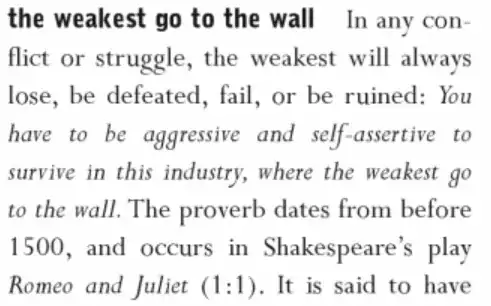
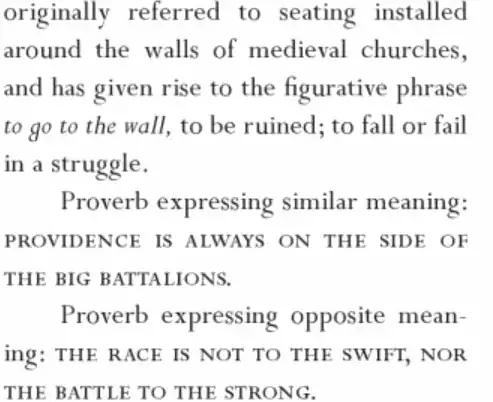
There is a proverb for this:

The weakest go to the wall


From the book "The Facts on File Dictionary of Proverbs" By Martin H. Manser (2007):

enter image description here enter image description here

ermanen
  • 62,797
26

He who has the gold makes the rules.

I can't find a reliable origin for this, but it seems common in political and economic criticism. It appears to be a perversion of the Golden Rule.

Minnow
  • 2,702
17

There's this quote, in which Don Quixote gives advice to Sancho Panza:

"Whether the pitcher hits the stone, or the stone hits the pitcher, it is bad for the pitcher."
Don Quixote, Chapter 43 (page 466)

Heartspring
  • 8,600
  • 6
  • 43
  • 73
15

Better to be the windshield than the bug.

Passuer
  • 151
  • I've never heard this before, but I love it; simple, yet universally relatable (at least in developed countries). – bcrist Dec 10 '14 at 05:10
  • 6
    In UK English it would probably have to be "better to be the windscreen than the fly"... – AAT Dec 10 '14 at 12:03
12

I'd put it this way:

Be careful, mate. You know the rule at Manor Farm: "All animals are equal, but some animals are more equal than others."

This quasi-proverb is the single, catch-all commandment at the reconstituted Manor Farm in George Orwell's Animal Farm (1945).

Sven Yargs
  • 163,267
  • 5
    I see this as saying "some people are more favored than others", with no direct connection to "people in power are favored". – Tim S. Dec 09 '14 at 13:13
  • 3
    @TimS. But in context, the rule was posted by the animals in power, as a clear indication that the other rules did not apply to them. – Eric Wilson Dec 09 '14 at 15:36
  • That is not a quote from the book. The nearest is "For once Benjamin consented to break his rule, and he read out to her what was written on the wall. There was nothing there now except a single Commandment. It ran: ALL ANIMALS ARE EQUAL BUT SOME ANIMALS ARE MORE EQUAL THAN OTHERS" – Henry Dec 12 '14 at 00:38
  • 4
    @Henry. Apart from the capitals it looks exactly the same to me? (I think only the part inside the quotation marks is meant to be a quote from the book. The other quote-formatted part is what Sven is suggesting saying.) – starsplusplus Dec 12 '14 at 15:05
5

I am reminded of the Damon Runyon quote:

"The race might not always go to the swift, nor the battle to the strong, but that's the way to bet."

Mike
  • 323
Journo
  • 51
5
  1. The term(/phrase) “(it’s a) dog-eat-dog (world)” comes to mind.

The primary stress is that of ruthless competition, but in my mind that carries a strong implication: with decorum and ethics out the window, all that’s left is to determine who is stronger.

  1. There’s also the popular corruption of Darwin: “survival of the fittest”.

Either of these can be employed positively by someone in favor of the situation, but this second phrase is especially complimentary of those who find themselves in power.

  • 1
    I came here to post that "survival of the fittest" as an answer, with the caveat that it is an oversimplification of evolutionary theory, but I like your word "corruption" even better. ;-) – ghoppe Dec 10 '14 at 16:53
  • 1
    I heard that the "dog" in this saying is not English but Hebrew, in which the word "dog" means "fish". Otherwise, it makes no sense, since dogs do not actually eat each other, but larger fish constantly eat smaller fish. – BlueWhale Dec 15 '14 at 12:45
4

"Bringing a knife to a gunfight".

That's bringing ...
Be careful not to bring ...
Nobody brings a knife ...


Or, citing Clint Eastwood:

"When a man with a rifle, meets a man with a pistol, the man with the rifle wins".

Note that this does not apply if the man with the pistol has a large sheet of armour plate under his poncho and the man with the rifle is a certified moron.

4

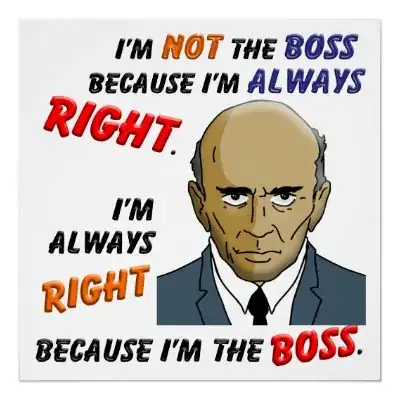
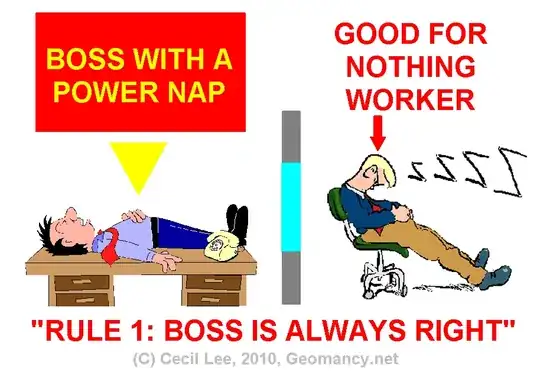
The Boss is always right.

In business, which applies well to your first and third examples, there's an old saying/joke that you might see on a mug or poster:

There are two rules:

  1. The Boss is always right.
  2. If the Boss is wrong, see rule #1.

Shortened up, you might warn a colleague before he confronts the authority figure in any situation "Careful, mate. The Boss is always right."

Rule #1 has some interesting theory:

The Boss is always right.

How Rule #1 is typically applied:

Whose the Boss?

Alternatively, "The house always wins" is very good and has already been mentioned.

Another also mentioned "Whoever has the gold makes the rules" which seems close but not exactly what you are looking for. Along the same lines is "Nice guys finish last." Another close one is "Don't rock the boat."

3

The original question and associated examples have one more common thread (aside from weak vs strong) and that is that the weaker party is the social beneficiary of the strong.

In that case, 'don't bite the hand that feeds you' comes to mind. The advice is, then, not to oppose the authority on which you're dependent.

This is a commonality that I think the other answers missed. The true caution that needs to be conveyed is that, even if the individual argument is won, the superior power will enact revenge in some way and the end result will be a net loss for the weaker, dependent party.

3

Two proverbs that directly address this:

  • You can't fight City Hall
  • God is on the side of the big battallions
DJClayworth
  • 25,795
2

All three of your examples involve disputes with the so called "powers that be."

This is why they say the best advice in such a situation would be to "choose you battles carefully," mate.

But the title of your question gives no hope of winning, so when David meets Goliath; no bookie went out of business betting on Goliath.

  • 1
    +1 for how D. Vs G. works in the real world and in the context I usually find it. – Mazura Dec 09 '14 at 17:44
  • 1
    @mazura Untrue; David can almost always win against Goliath by playing a different game. This is entirely the point of David vs Goliath; David can't win by fighting in armor like Goliath, so he wins by fighting like his people (using a slingshot). The entire point of the story is that what one considers weak may not actually be weak. You missed that point pretty hard. – Alice Dec 12 '14 at 08:07
  • 1
  • @Mazura You indicated it was how it worked "in the real world", which is a universal statement, and literally the exact opposite of the point of David vs Goliath. Citing the existence of an example does not prove the universality of that example; just because David doesn't win all the time doesn't mean he loses all the time.

    Oh, and Monsanto DID lose more than a few political and legal battles; that's why the Terminator gene was abandoned.

    – Alice Dec 13 '14 at 04:58
2

One that seems to have been missed:

The Devil take the hindmost

A proverbial phrase indicating that those who lag behind will receive no aid.

Origin: The line was first recorded in print in Beaumont and Fletcher's tragic/comic play Philaster, or Love Lies a-Bleeding, 1611

{The Phrase Finder}

1

I always liked "It's not final because it's right, it's right because it's final" Might be a little bit of a stretch from the question, but could be applied in each of the examples

-1

“Be careful mate, no good deed goes unpunished."

Sometimes actions done with the best of intentions backfire and have unexpected and usually negative repercussions.

The three examples you give, however, are not similar to each other in the motivations ascribed to the actors.

In the first example, the working girl has an argument of unknown character. Was she unprofessional? Was she airing a legitimate grievance? If the former is the case, then she was in the wrong and was fired for her insubordination. If it is the latter, the employer is in the wrong and is guilty of wrongful termination.

In the second example, the student goes over the teacher's head to confront the teacher's superior, who cannot takes sides either out of fairness to the teacher or out of sheer laziness. This example is least like the other two.

In the third example, the workers may or may not be striking for legitimate reasons.

IconDaemon
  • 2,701
  • you have missed the common factor - weak (even in the right) still loses vs the strong – JamesRyan Dec 09 '14 at 12:51
  • +1 I have heard this one before in this context and it would be understood by many. The link between "the weak" and "good deed" is that we have a bias to assume if the weak are taking on the strong, the weak are right thus the fight is a good deed. – Mike Dec 12 '14 at 06:15
-4

The Nail that Sticks Out will be Hammered--Japanese proverb

user3847
  • 2,495
  • 20
    that doesn't have to do with the weakest losing. It refers to the non-conformist getting attention. – dnagirl Dec 09 '14 at 02:52
  • That's your interpretation, dna. The Japanese, I'm sure, would differ. – user3847 Dec 09 '14 at 04:34
  • 2
    What does a Japanese proverb have to do with English? – Matt E. Эллен Dec 09 '14 at 10:37
  • 4
    @user3847 no, thats what it means in Japan too. The difference is that they use conformism as a positive. Still nothing to do with this Q – JamesRyan Dec 09 '14 at 12:53
  • +1 I take this as meaning "Keep your head down and don't make trouble". It fits as possible advice to all three examples. The strong vs weak theme is in the background, not as blatant, but still there. Why they able to hammer that nail? Because they are strong and you are weak. Remember that, mate. – Mike Dec 12 '14 at 06:23
-4

A chain is only as strong as its weakest link.

Somewhere it means that, if chain breaks it would be due to its weakest part.

Reference: http://www.phrases.org.uk/meanings/the-weakest-link.html

jaczjill
  • 125
  • 3
  • 7
    I don't think this is that relevant to the OP's question. That saying is supposed to be metaphoric for teamwork, which doesn't really apply here. – Tim Seguine Dec 09 '14 at 09:59
  • I agree that this saying is mainly focuses on teamwork. But inherently it is denoting that the reason for breakage of the chain is its weakest part. – jaczjill Dec 09 '14 at 12:04
  • No, the question is not focusing on teamwork. – Danubian Sailor Dec 10 '14 at 12:35
-6

There is a proverb in malayalam lanugage(lang in kerala, india) like

"where there is flesh, the knife moves"

I heard this as my grandma says..

benpat
  • 5
  • 8
    Welcome to EL&U. Please note that this is not a discussion forum, but a Q&A site, and all answers are expected to address the original question. As this is a site for advanced English users, we may presume the questioner is seeking an English expression. – choster Dec 09 '14 at 07:07