14

That is, the person who is querying.

The person who sends can be a sender, the person who receives can be a receiver. Similarly the person who responds (to a query) can be a responder.

But can the person who queries be a queryer?

I've thought about using initiator, but I'd prefer something more specific.

Thanks in advance.

jedwards
  • 243
  • 10
    Your problem is that you are spelling it wrong. It's querier, not queryer. – Nick2253 Dec 11 '14 at 17:33
  • 4
    Query is rather formal; inquire is more common and ask more common still → inquirer, asker. Or you could be really arcane and use quærent ! – StoneyB on hiatus Dec 11 '14 at 17:50
  • How much research have you done before asking here? – Edwin Ashworth Dec 11 '14 at 18:15
  • 3
    @EdwinAshworth I'm a researcher, but in computer science and engineering, not English, literature or linguistics. I've exhausted the tools I'm aware of for this sort of thing, but admittedly, they're not many. That being said, I'm nonetheless interested in the correct terminology. Thanks for the concern. – jedwards Dec 11 '14 at 18:34
  • 1
    "The one who's asking the question." – Hot Licks Dec 11 '14 at 19:33
  • Check the general references - now you have a whole new toolbox! :-) – Matt Gutting Dec 11 '14 at 20:30
  • A Google search for "query meaning" rapidly yields the AHDEL entry for 'query', which lists 'querier'. General reference. – Edwin Ashworth Dec 11 '14 at 23:14
  • 2
    If you are going to use the word in a technical context, and are looking for a concise way to say "the user who is entering a search query into our system", you should probably try to find a different way to describe him. In many cases, it is unambiguous to just say "the user", this is what information retrieval scientific articles say. If you want a good name for an object which initiates a query, then you don't need a word commonly recognized in everyday speech, a maintaining programmer will surely identify the purpose of an object called `SqlQuerier'. – rumtscho Dec 12 '14 at 15:24
  • You say kweer ee er. – SrJoven Dec 12 '14 at 23:58
  • Perhaps you should say "more query". ;) – Hot Licks Apr 04 '16 at 17:11

5 Answers5

29

I don't like querier/queryer/queryist/querist at all. A century or two ago, querist was actually quite common - but it's massively declined since then, and sounds seriously "Victorian" to me.

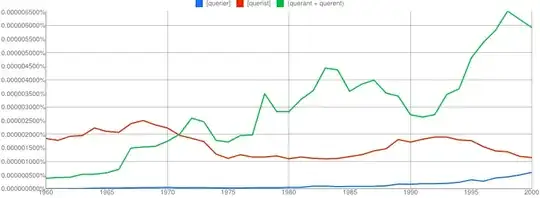
I'd go with querent (also sometimes spelled querant) as the more "modern" usage...

EDIT: Also note from that chart (click on it to see the complete page which I can't reproduce here) that the forms queryer, queryist (spellings which were never common) are now both so rare they can't even be charted for the past half-century.

FumbleFingers
  • 140,184
  • 45
  • 294
  • 517
  • The OED confirms querent. The odd thing is that it also quotes querist, with the same meaning, but makes no attempt to link the two entries. It also offers the spellingquaerent. Etymology: post-classical Latin. – WS2 Dec 11 '14 at 19:24
  • @WS2: I'm certainly glad your comment has made me look at this answer again! I originally just intended to rail against *querist, but then I edited in querier, queryer* in the wrong place and mistakenly referenced *querist* as the first word I'd written even though it was by then the last in the list. Note that under *querist, OED says compare earlier querent. Despite the implications of that "earlier", I still think querent* is the form with most legs for the future. – FumbleFingers Dec 11 '14 at 19:40
  • @FumbleFingers you said "and sounds seriously "Victorian". May I ask you whether you thi k it is a negative thing to employ such "victrian-ish" words/expressions in modern speech or not? Just curious as it's a part of my research. Thank you and I beg your pardon for the offtopic – Rossitten Dec 11 '14 at 20:43
  • @FumbleFingers The problem with the OED is that the same word can appear more than once. I was looking at querist as a derivative of query. In that particular place there is no reference to querent, as there is in the main entry on querist. – WS2 Dec 11 '14 at 22:16
  • @WS2: Yes, but assuming you're accessing OED thru the same web UI as me, once you've located any specific word there's a scrollable alphabetized list panel on the right, centred on the current entry. So for most words, the derived forms are easily accessed from there. – FumbleFingers Dec 11 '14 at 22:43
  • Querent was the word that most naturally popped into my head, but when I started looking, I found that neither ODO, AHDEL, nor (the free bits of) MW even had the word. I thought I was imagining things or going bonkers. Glad someone else agrees it's a good word for this. (There is the niggle with the Ngram that querent can also mean ‘plaintiff’, so there's bound to be some false hits for that… but still!) – Janus Bahs Jacquet Dec 12 '14 at 00:20
  • @Janus: As OED points out, *querent* can also have the specific sense a person who consults an astrologer, fortune-teller, medium, etc. It doesn't mention the legal sense specifically, but a few seconds on Google convinces me it is used in a sense that doesn't directly reflect the "base" meaning (unless you stretch a point to say the plaintiff is querying whether the legal system will hear/support his case). – FumbleFingers Dec 12 '14 at 01:31
  • 2
    Actually, the legal sense just reflects the older meaning of quaesō/quaerō in Latin, which was ‘strive, endeavour, seek for’ (whence also its development to ‘wish for’ -> ‘desire’ -> ‘want/love’ in Spanish and Portugese), and the plaintiff in a case usually does strive for something. The meaning ‘ask’ is a later development in Latin, but in English, it seems query itself was first borrowed with this sense, rather than the striving sense. So they're both quite ‘basic’, as it were, in what they reflect. – Janus Bahs Jacquet Dec 12 '14 at 01:39
  • @Janus: Right. I keep forgetting how much meanings change over time. I should make a point of checking the etymology whenever I'm looking at an OED entry. – FumbleFingers Dec 12 '14 at 01:49
  • 1
    Apparently quaestor was once much more common, but I’m betting these are all tax collectors. – tchrist Dec 12 '14 at 04:41
  • Querent is definitely the one to go for, though all of them are better than OP. – Jon Hanna Dec 13 '14 at 10:30
10

I would propose:

  • inquisitor
  • inquirer
  • questioner

Depending on the type of query you could be more specific as in auditor if the person is querying as part of an audit or auditing for example.

9

Your problem is that you are spelling it wrong. It's querier, not queryer. However, I would say that it's pretty esoteric, and may not be understood in writing as much as it would be in speech.

A more appropriate term that would be understood by the masses might be inquirer.

Nick2253
  • 4,506
  • Well, it kind of depends. If I'm reading software documentation "querier" is much clearer in intent than "inquirer." – Casey Dec 12 '14 at 23:09
5

The answer is queryist (which is now rare) or more recently querist (OED see below).

ˈqueryist n. rare = querist n.

K. Sparck Jones & J. R. Galliers Evaluating Nat. Lang. Processing Systems i. 16 (table) Role & category: queryist, habitual.

WS2
  • 64,657
0

Use the word "requester" or "questioner" instead.