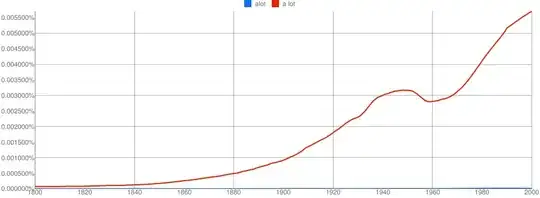
As usual, there’s a certain logic to this common mistake.
Of course if you have read and learned the spelling, it makes sense the way you’ve learned it. But imagine for a second that you weren’t really the reading type, and you didn’t know how a lot was spelled. Would you think of it as two words?
Consider We care a lot. Is lot a noun there? How many other nouns can do that? We care a bicycle? We care a friendship? I could accept We care a bunch / a bit / a little, and a few temporal expressions like We care this year / all the time, but a million other nouns don’t work. So it’s no wonder some people put a lot in the same mental bucket as sometimes, occasionally, and deeply.
Also— a lot is an idiom. It does not mean the same thing in the everyday We have a lot as it does in the more literal We have a lot in the Appalachians where we’re going to build a cabin someday. There is a pattern in English that such idioms tend to get fused into single words: all ready/already, all most/almost, a wake/awake, a way/away, and a live/alive. This also explains why alright is so common.
Of course the standard spelling has its own logic: a lot of bananas is a typical noun phrase whereas alot of bananas would be pretty odd; the lot of them and the whole lot are occasionally heard; and so on. But you can see how someone might make the mistake.