I understand "He is gone" or "Winter is gone" is the common usage. But is "She is come" or "Spring is come" as common?
Asked
Active
Viewed 3,656 times
1

-
Use, has not is. – Joe Dark Dec 28 '14 at 12:09
-
"She is come" would be incorrect -- should be "She has come". One might give "is" in "Spring is come" a little poetic license, but "Spring has come" would be closer to normal. (Though here in Minnesota we say "roadwork has begun again".) – Hot Licks Dec 28 '14 at 15:33
-
@Joe Dark Do you mean 'Use has not is'? – Edwin Ashworth Dec 28 '14 at 20:43
2 Answers
1
No, it isn't common in modern English: "is come" is archaic. "is gone" is also archaic when used as a present perfect verb form, but it is perfectly acceptable as the verb "is" (i.e. "be") with an adjective - "gone" made the leap from a participle to an adjective (meaning "not present any more", even if there was no "going" action) whereas "come" didn't really stick.
To demonstrate, consider:
He is suddenly gone...
The adverb "suddenly" makes it clear that "gone" is a verb, so in this case modern English would expect
He has suddenly gone...
Likewise modern English would expect
She has suddenly come...

user52889
- 1,011
1
As user52889 has mentioned, "is come" is not current usage and sounds clumsy. We still see it in poetry and song lyrics, religious quotes ("Christ is come"), and old texts ("The time is come"), though. "Is gone", on the other hand, remains current usage.
The ngram below finds "is come" progressively declining but still being used (in books) in the 21st century.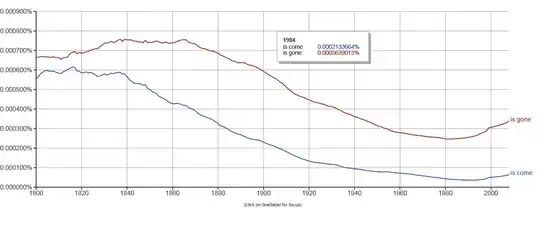


-
Could you please link to the actual Google N-gram you ran so we can see its parameters and replicate and explore it ourselves? Thanks. – tchrist Dec 28 '14 at 19:58
-
My favourite film is 'Gone with the Wind'. Nice false positive. – Edwin Ashworth Dec 28 '14 at 20:44