10

Having been bamboozled by various questions and answers on this site, I'd like to know what are the parts of speech (POS) and grammatical functions of the words and phrases in the following sentence:

  1. Bob made a book collector happy the other day.

Here I am particular interested in the status of the following items:

  • book
  • happy
  • the other day

But I also need the parts of speech and functions of all the individual words in the sentence. By functions I mean subject, complement and the like. I would also like to know the evidence for the assignments to specific functions and parts of speech.

The reason for asking this question is because the status of the three items listed above may be thought contentious by some people. For example, it might be argued by some that book is an adjective, whilst others will say it is a noun. Similarly, the other day some will argue is an adverb. Whether adverb here should be regarded as a function or part of speech in such analyses seems unclear.

  • 2
    Comments are not for extended discussion; this conversation has been moved to chat. – Andrew Leach Jan 02 '15 at 15:50
  • 2
    Since it is closed, I'll answer briefly here. "book" is a noun but functioning here as an adjective, just like "pet" in "pet cat" or "grammar" in "grammar book". In general nouns can be made to function that way. "happy" is clearly an adjective, and a complement to the verb "made". The syntax is "made X Y" where "X" is a noun and "Y" is either an adjective or a noun phrase, such as in "made him happy" or "made him one happy person". "the other day" is an adverbial phrase modifying the entire "Bob made a book collector happy". In general noun phrases denoting time can be used adverbially. – user21820 Jan 05 '15 at 10:51
  • @user21820 I heartily approve of your answer! And agree with almost all of it. Thank you! If this question gets reopened, maybe you could post it there!! Just to clarify one of the most important points, you're saying the other day is a noun phrase, right? :-) Because I definitely would agree! – Araucaria - Him Jan 05 '15 at 10:59
  • 2
    @Araucaria: Yes; it is a definite noun phrase. What else can it be? =) – user21820 Jan 05 '15 at 11:04
  • @user21820 Well exactly, but some people round here seem to think it's an adverb! Even though it's three words ... – Araucaria - Him Jan 05 '15 at 11:05
  • 2
    @Araucaria: You can also pose your questions to the Stanford parser at http://nlp.stanford.edu:8080/parser/index.jsp. I find it to be a rather accurate parser for standard (perfect) English. – user21820 Jan 05 '15 at 11:07

4 Answers4

14

Although this question almost feels like three questions in one, I will try to answer all three parts — and the general question concerning the whole sentence as well.


book

In the noun phrase book collector, the noun book is a noun adjunct, it is used attributively. A common way of expressing this is to say that book is used as an adjective, but this does not mean that the noun is an adjective. It just plays a similar role.

Looking up attributive noun, we find, for example, Merriam-Webster telling us about the label attributive used in dictionaries:

The italicized label often attributive placed after the functional label noun indicates that the noun is often used as an adjective equivalent in attributive position before another noun:
1bot·tle . . . noun, often attributive
busi·ness . . . noun, often attributive
Examples of the attributive use of these nouns are bottle opener and business ethics.

Nouns used in this way are often said to be adjectives or act as an adjective. However, they are not. Adjectives do things that these nouns do not:

A great collector => a greater collector — We can form comparatives from adjectives.
A book collector => *a booker collector — Nouns do not like it when we do that.

A great collector => the collector is great — We can use a copula followed by an adjective.
A book collector => *the collector is book — Nouns do not like it when we do that!

In the answers to this question some more arguments are listed.


happy

This is an adjective. It modifies the noun (phrase) book collector. As we can see in this explanation from perfect English grammar about using make and let, this is a very simple construction where we use subject + make + object + adjective to mean “cause the object to be the adjective”:

We can also use subject + make + object + adjective. This means 'cause the object to be the adjective' (the adjective can be good or bad):
• Her story made me really happy.
• The traffic jam made us late.


the other day

This is not an adverb, but a noun phrase that is used as an time adverbial.

The British Council teaches us about adverbials of time:

We use adverbials of time to say:

• when something happened
• for how long
• how often (frequency)

We often use a noun phrase as a time adverbial


the whole sentence

Bob made a book collector happy the other day.

Bob — a noun functioning as the subject in the sentence.
made — a verb, functioning as the main verb describing the action that the subject executes.
a book collector — a noun phrase, functioning as the object of the sentence.
happy — an adjective, modifying the object of the sentence.
the other day — a noun phrase functioning as a time adverbial modifying the verb.

The noun phrases can be further taken apart as follows:

a — indefinite article
book — noun adjunct, or attributively used noun, modifying collector
collector — noun, head of this noun phrase

the — definite article
other — adjective modifying day
day — noun, head of this noun phrase

oerkelens
  • 36,622
  • +1 Nice answer:) As you'll see, I'm about to put a bounty on this. I was wondering if you felt like giving any simple bits of evidence to show why book is a noun, for example? – Araucaria - Him Jan 07 '15 at 16:03
  • 1
    @Araucaria: evidence as to why book is a noun? I could try to conjugate it in the sentence to show it is not a verb, I could try to form a superlative to show it is not an adjective... But I am not sure what evidence you are looking for? A simple refutation of it being an adjective is easy enough, if that is what you mean :) – oerkelens Jan 07 '15 at 16:22
  • Superlative/comparative would be good! Could modify it I suppose? (i.e. does this require an adj or an adv, etc). :) – Araucaria - Him Jan 07 '15 at 16:25
  • 2
    I added two arguments and a link :) Any more ideas for additions are welcome, I'll have a look at them when I get home :) – oerkelens Jan 07 '15 at 16:30
  • @oerkelens I may add some later, but I don't want to kill off any competition just yet ;) – Araucaria - Him Jan 08 '15 at 02:16
  • 1
    @Araucaria: You are quoting selectively, I think: " The simple answer is “Yes.” A better answer is “Well sure, sorta.” But the best is answer is “What’s an adverb?” And thereon hangs a much longer tale." So I think you might read simple in simple answer as: "The obvious, simplified answer, that keeps things nice and simple without getting into details", but it is immediately followed up by "but there is a better answer"... – oerkelens Jan 08 '15 at 12:11
  • 1
    @oerkelens Agreed, however, that 'better' answer implies that next Tuesday is kind of an adverb. It doesn't say that next Tuesday can't be an adverb because it's two words. The commenter was implying that the status of noun phrase adjuncts isn't disputed when they're more than one word! This is just not the case. The commenter has talked abbout multi-word adverbs or adverby things in other posts too, as I recall. It's a valid concern of the question here. – Araucaria - Him Jan 08 '15 at 12:23
  • 1
    The concern is certainly valid - not only about supposed multi-word adverbs, but certainly also the nouns that are suddenly adjectives. I myself have been reprimanded for calling a noun an adjective, and I fully agree that I deserved the reprimand. (And I subsequently became very fond of the words attributive and attributively :) ) – oerkelens Jan 08 '15 at 12:47
  • If 'the other day' may be atomised (I'd prefer to regard it as a unitary time adverbial), 'other' is not an adjective but a determiner. It references 'day' within a (time) framework rather than describing attributes (this fine day). – Edwin Ashworth Jan 13 '15 at 00:55
  • I mostly work with lower-level ELLS for whom this stuff never comes up. For them, I'd just say "book collector" is a compound noun and leave it at that. But for my own education: the pecan of "pecan tree" would be a noun adjunct/attributive noun? – miltonaut Jan 14 '15 at 09:07
  • @miltonaut: yes, pecan is a noun adjunct or attributive noun in pecan tree. – oerkelens Jan 14 '15 at 09:58
  • @oerkelens: Thanks! I've been using adjectival noun for all these years, but apparently that's not the proper term any longer nor has been for some time. – miltonaut Jan 14 '15 at 10:04
  • @Araucaria - Not here any more: Why can't we say that the other day is an adverb phrase modifying happy? – user405662 Mar 05 '21 at 05:59
  • 1
    @user405662 Well, it's not an adverb phrase because none of the words in it's an adverb. More importantly, it's a noun phrase. But if your question is whether we could say that the other day is modifying happy, the answer is that in theory it could be, although the meaning would be slightly different. The most natural reading of the sentence is probably that whatever Bob did to make the book collector happy was done the other day. It is, of course, possible though that the imaginary speaker intends to say that the result was the collector was happy the other day. So, yes. Kinda! – Araucaria - Him Mar 05 '21 at 12:07
  • 1
    I have been taught that in the sentence They rested at noon, at noon is an adverb phrase modifying the verb rested (answering the question rested when?). Here too neither of the words in it is an adverb. Or have I been taught wrong then? @Araucaria - Not here any more. – user405662 Mar 05 '21 at 18:33
  • 1
    @user405662 Well, that's kind of very 19th Century ;). In modern grammars, the good ones anyway, there's a clear line between word and phrase categories on the one hand and grammatical relations on the other. "Adverb phrase" in that bad, old type of grammar is skewing the line between the function of the phrase and the type of phrase it is (how it is built). It's like the difference between 'Noun Phrase' and 'Subject'. When that 19th century grammar say 'adverb phrase' in that kind of sentence, it means 'modifier of a verb phrase'. It says nothing about what kind of Phrase it is! – Araucaria - Him Mar 13 '21 at 01:48
  • 1
    @user405662 The problem is described, entertainingly, here: Lexical Categorisation in English Dictionaries and Traditional Grammars Enjoy! – Araucaria - Him Mar 13 '21 at 01:58
  • 1
    @Araucaria— Thanks a lot! And Pullum I highly adore. Am sure gonna enjoy it. :) – user405662 Mar 13 '21 at 05:13
4

Parts of speech are categories, their members sharing various properties. One of these properties is the functions that the members can perform. These functions are relations, and each should be capable of coming before of. For example, in book collector, book is a dependent (more specifically an attributive modifier) of office. It generally makes no sense to say that something is a noun of or verb of.

If we look at families. Man and woman are categories (like parts of speech). You can see a man or woman outside of a family situation and generally still put them in the right category based on various properties such as facial hair, breasts, size, voice, etc. One of the properties of men is that they can function as 'husband of', 'brother of', 'parent of'. Women can be distinguished from men partly in their inability to function as 'husband of' or 'brother of', but both men and women can function as 'parent of'.

Back to words, the members of the category of English nouns share a range of properties, not just the relations into which they enter. They (typically) inflect for number, and many name concrete objects. Adjectives have other properties, like inflecting for grade (tall, taller, tallest). Number and gradability are distinguishing characteristics, but functioning as 'attributive modifier of' nouns is a shared characteristic. Only when book takes on more characteristics of adjectives such as becoming gradable (booker, bookest; like fun--traditionally a noun--being inflected funner and funnest) would we say that it actually now belongs (also) to that new category.

Here, as always, happy is an adjective (it inflects for grade: happier, happiest), but its function is not attributive modifier but rather the predicative complement of make. Here, we could say also she made the book collector president, and president would similarly be the predicative complement of make. Finally, the other day is a noun phrase (it's headed by a noun & can function as a subject of a verb). It's not an adverb (it can't be modified by very, it doesn't inflect with -ly). It is an adjunct of make.

There are many more properties of adjectives, nouns, etc, but it would be too much to discuss here. Suffice it to say you need to look at more than simply the relations something enters into.

  • 1
    +1 for a very good analogy. I disagree with your definition of what puts a word in the adverb class (which is of course the messy bastard child of word classes to begin with), and you seem to have neglected/forgotten to comment on the syntactic function of the other day, unless you consider ‘adjunct’ on its own a syntactic function (I’d disagree with that, too—it’s a category, not a function; I’d also consider the other day an adjunct of the sentence as a whole, rather than of make). Other than that, I pretty much agree with everything you’ve said here. – Janus Bahs Jacquet Jan 11 '15 at 16:15
  • It's not really a definition, just some typical characteristics, but yes, adverb is messy. – Brett Reynolds Jan 11 '15 at 16:19
  • 1
    Yes, I think it's an 'adjunct of' the verb. Adjunct is the relationship it has with the verb. You can't look at a word or phrase standing on its own and say, "that's an adjunct". And yes, there's a good argument to say it's an adjunct of the clause. – Brett Reynolds Jan 11 '15 at 16:21
  • 2
    Note that I didn’t say adjunct is a word class category—it’s a category/group of functions. The trouble with adjunct is that it’s not a single thing and not a single function, just like, say, argument isn’t. There are different types of adjuncts that function in fundamentally different ways and are adjuncts of fundamentally different things. An attributive adjective or noun is also (in some views, at least) a subtype of adjuncts, for example. The other day here I would label a(n adverbial) temporal clausal adjunct (because to me it modifies the clause, not the verb). – Janus Bahs Jacquet Jan 11 '15 at 16:34
  • @JanusBahsJacquet, Brett Doesn't that just make it a general function. For example, complement is a function, but we can be more specific and say Direct Object or locative complement or complement of a preposition etc? [Also adjunct is used slightly differently by H&P, or for example Bas Aarts, whilst passing]. – Araucaria - Him Jan 11 '15 at 16:51
  • 2
    Well, see, I would also say that complement isn’t actually a function itself, but a superset of certain functions. But maybe that’s just me being overly programmer-like and structuralist. Sure, all adjuncts have some things in common; but the five adjuncts in “Yesterday, I really made that book collector happy about his newest purchase all right” function in such different ways that I just think that especially with adjunct, the blanket term is almost as useless as the blanket ‘adverb’ category. – Janus Bahs Jacquet Jan 11 '15 at 16:53
  • I see. I misunderstood @JanusBahsJacquet. Yes, it's a higher-level function name: dependent > adjunct > etc. You could get more specific, but I think this level of generality is appropriate to the question. – Brett Reynolds Jan 11 '15 at 16:54
  • @Araucaria Really, apart from this stuff about adjunct functions, I would basically just be repeating Brett’s answer. He said almost exactly what I would have said, using (probably) about a third of the space I would have ended up with. – Janus Bahs Jacquet Jan 11 '15 at 17:02
2

Book collector is a noun+noun compound.

Happy is an adjective.

The other day​ is a noun phrase.

1

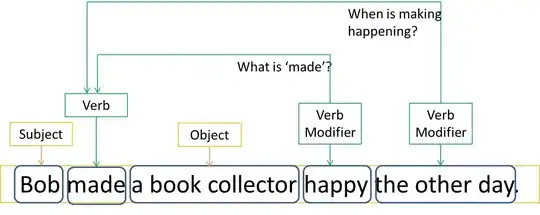
Abstract

The example expression can be redistributed in the following structure:

[Subject][Verb][Object][Modifiers]

Each phrase serving one of the above mentioned purpose is further sub-divided in to individual parts of speech.

Result Structure of the Expression

Description

Structure of an expression can be deduced by understanding the following:

  • Meaning
  • Grammar
  • Style/Idiomatic usage

Relations and Parts of Speech

I'll tackle this by identifying the right questions and proposing precise answers. Expression: Bob made a book collector happy the other day.

  1. What is going on here? --> (Someone) made (Someone) happy. Verb = made

  2. What did they make? - (That is how was verb applied) --> happy - a state A state would be an abstract Noun.


  1. Who made (Someone) happy? - We are looking for the Subject, the entity that did the activity in this case --> Bob Bob is a subject. Bob is also a (Proper) noun.

  2. Who was made happy? - We are looking for the Object, the entity for which the task was done --> a book collector 'a book Collector' is an object.

'A' is the indefinite article. An indefinite article points to nonspecific objects, things, or persons that are not distinguished from the other members of a class. Essentially, articles are Adjectives as they point to a noun.

In addition, 'book collector' is a compound of: Book + Collector. What does a 'book collector' mean? Someone who collects books. Breaking this further down, a 'book collector' is a type of collector who collects books. As 'book' provides the information on the type of the noun 'collector', 'book' is an adjective. 'Collector' is a noun.

To read more on Noun Phrases and Compound Nouns, refer to: Compound Nouns

To delve deeper in to the nuances, 'book collector' is a Noun phrase or Noun-equivalent. Source:Chicago Manual of Style - Noun-equivalents and substantives


  1. When did this happen? The other day We get the information about when the action took place. Therefore, 'The other day' acts an adverb.

Looking in to the terms individually: 'The' acts as the 'definite article to 'other day'and acts as an adjective. More on the topic: Purdue University OWL: Using Articles 'day' is the time when this occured. It is a Noun. 'other' tells us about the day. It is an Adjective.

More on compound adverbs here: Chicago Manual of Style - Phrasal and compound adverbs


PS: Thank you for the rep points. I've successfully added a detailed image and links to cite. Thanks for the workout. Please review and suggest updates. Edit: *Formatting, Structuring, Adding information

  • Thank you my upvote fairy! Now, I'll improve this answer. – chatterji Jan 14 '15 at 11:23
  • Nice diagrams! And a proper go at explaining the functions! Thanks. But I'm not sure about happy. I don't think that this is a modifier of made, I think it's a complement of the verb. The word happy is often a modifier in noun phrases, but it is usually a complement when it is a phrase in the verb structure. Here it describes the object, so we could say it is a predicative complement. But nice diagrams etc :-) (I don't think I can upvote it yet, because of the 'happy' issue! – Araucaria - Him Jan 14 '15 at 11:36
  • Also, is there any reason why book is an adjective here? You don't seem to give a reason ... You talk about its function, describing/modifying collector but not specifically about the part of speech. – Araucaria - Him Jan 14 '15 at 11:38
  • @Araucaria What an insight! Let me start by admitting that I am not certain of the answers that I'll suggest. Let me try, nevertheless. A [Verb Complement is an object to the verb] (http://grammar.ccc.commnet.edu/grammar/objects.htm). By calling it an Adverb, I am adhering to the definition- An adverb is a word that qualifies, limits, describes, or modifies a verb...(http://www.chicagomanualofstyle.org/16/ch05/ch05_sec153.html). Now, book - Considering the Compound Noun, the Part of speech that book plays must be relevant to the phrase and must not be judged standalone. Views? – chatterji Jan 14 '15 at 12:02
  • "the Part of speech that book plays must be relevant to the phrase and must not be judged standalone" - actually, that's one reason why I asked the question. Really the role that a word/phrase plays relevant to the larger phrase it is in is its function, not its part of speech. So modifier, complement and so forth are descriptions of the function. But parts of speech can be thought of as being independent of a particular role they are playing (we need to be careful though, because there are many homophones out there!). So, although book is a modifier of the word collector it ... – Araucaria - Him Jan 14 '15 at 13:19
  • ... isn't really an adjective. Both nouns and adjectives can be modifiers of other nouns. We can do tests to find out, for example, we can have a rare book collector. Here we are using an adjective to modify the word book. If book was an adjective we would normally have to use an adverb, because adjectives can't usually modify other adjectives. But we can see that a rarely book collector doesn't work here ... Does that help? (You could look at Brett's answer - it's not as thorough as yours, but it has some good explanations) :-) – Araucaria - Him Jan 14 '15 at 13:23
  • This just keeps getting better! On the record, Parts of Speech are not my forte. But, here is to another take. rare book collector. rare modifies books. rarely_ is not idiomatic. IMO rare is an adjective. To solve this, consider that rare books is a compound modifier in itself. A simile can be drawn with [rare] [http://www.merriam-webster.com/dictionary/rare] in "rare roast beef". Of course, all these inferences are drawn on the assumption that Form (PoS) follows Function. :) – chatterji Jan 14 '15 at 17:55
  • Personally, rare book collector presents an ambiguity - Is the book rare or is the book collector rare? In the previous comment, we have chosen what was convenient to us. It may not be accurate. Therefore, I discourage such a use. (That's what studying for GMAT does to you :'( ) Keep me posted. :) – chatterji Jan 14 '15 at 18:10