If A is one time bigger than B, it is equal to 2B. So if A is three times bigger than B, it is equal to 4B. Yet I am seeing "two times bigger" to mean "twice as large" in more and more places.
Any insights?
If A is one time bigger than B, it is equal to 2B. So if A is three times bigger than B, it is equal to 4B. Yet I am seeing "two times bigger" to mean "twice as large" in more and more places.
Any insights?

To Google Ngrams!
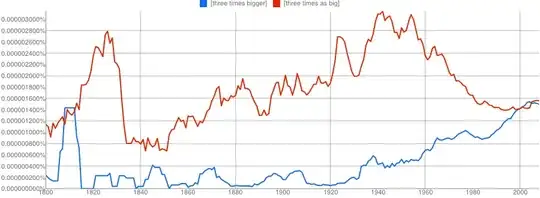
While we can't make a claim as to the specific intended meaning, we see that usage of "three times as big" has rapidly declined since the 1940s, while usage of "three times bigger" has simultaneously increased.
It is safe to say that "three times bigger" is acceptable (whatever its meaning), but it has not (yet) replaced "three times as big".

To me the thing in saying "B is three times larger than A" (i.e., B= A+3A), when you MEAN "B is three times as large as A" (i.e., B=3×A") is WRONG, and this cannot be argued. Therefore, it should be discouraged in daily use and prohibited in printed material.
The argument that it's so common that it should be accepted, instead argues to me that we need a better education system, including more on logical thinking.
I believe the biggest culprit in this heresy is publishers, both in the media and in books, magazines, etc, who think "three times larger than" SOUNDS better than "three times as large as", and have few to no people with solid math/science backgrounds. A number of years ago I read somewhere that the editorial staff of most major newspapers has no one with a solid math/science background. Unverified, but it makes me wonder.

I should start by saying I'm not a mathematician!
When I read
"A is three times bigger than B"
I understand
A = B x 3.
So it seems very odd to me when the OP suggests that "if A is three times bigger than B then A is equal to B x 4".
On reflection I realise the OP is extrapolating - confusing unnecessarily - from a rare (arcane?) usage. It is much more usual ngrams to say
>"A is twice as big as B"
than it is to say
>A is "one time bigger" than B.
