2

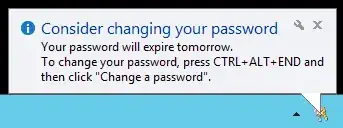
Every 30 days Windows prompts me to change my password here at work. And every 30 days I wonder why the folks at Microsoft chose the phrase

Your password will expire tomorrow.

enter image description here

instead of

Your password expires tomorrow.

Is one more correct than the other?

  • 6
    They mean exactly the same thing to me in this particular context. The only difference I can think of is that with the future tense, an implicit ‘unless’ clause can be understood. “Your password will expire tomorrow if you don’t change it before then” is a perfectly cromulent sentence, but “Your password expires tomorrow if you don’t change it before then” is jarring. I sincerely doubt that much thought went into it, though: since the ‘unless’ clause is not stated, both are perfectly fine, and whoever wrote it probably just wrote it the way it popped into his mind at the time. – Janus Bahs Jacquet Apr 01 '15 at 13:01
  • 1
    Well, why do you think the folks at Microsoft should choose "Your password expires tomorrow" instead of "Your password will expire tomorrow"? Please explain why exactly you think the current wording is wrong or how exactly it changes the meaning. Thanks. – RegDwigнt Apr 01 '15 at 13:44
  • If anything I find Change a password a bit odd. Change your password would seem more 'sensible', unless there are multiple passwords that can be changed I suppose. – Frank Apr 01 '15 at 15:18
  • @JanusBahsJacquet "cromulent"? I had never heard that. Has it got into current usage? – Centaurus Apr 01 '15 at 15:27
  • It's a Simpsonism. – Brian Hitchcock Apr 03 '15 at 09:42
  • @BrianHitchcock Simpson is smart. – Kris Apr 04 '15 at 13:54
  • Yeah, he's added a lot to the vernacular. I especially like craptastic ! – Brian Hitchcock Apr 04 '15 at 22:55
  • What's with the "passive voice" tag? – Kris Apr 06 '15 at 08:22

2 Answers2

2

Both correct.

"Your password expires tomorrow" -- statement of fact in a flat reality wrt time; using the narrative present for future time events is common

"Your password will expire tomorrow" -- statement of prediction in a time-layered reality

Marius Hancu
  • 7,714
1

It's not without good reason that the authors chose to say

"Your password will expire tomorrow".

The situation is conditional: the password is in a state that is set to change "tomorrow" (unless you do something today.) See the next sentence to understand the significance of the modal verb indicating the "default" behavior as it stands.

will (ODO)

5 Expressing habitual behaviour: They will do this at a certain time of day …

However, the situation can be changed.

The next sentence begins

To change your password …

OTOH,

"Your password expires tomorrow."

is a plain and simple statement of reality without an indication of possible alternative. (You can't do anything about it – no matter what you do, it expires – For your information only … )

The user needs to be alerted and prompted for action: ... will expire ... ("is going to expire") has the tone of an impending situation that can be averted.


Unconditional statement:

A typical dog lives for 13 years, so it adds up to quite a lot of cash. (src: the Web)

Conditional:

A typical dog will live for over twelve years … Just be sure that (i.e., if --ed.) you can give the right amount of love and care (src: the Web)
Kris
  • 37,386