9

Jootha is a Hindi word which means that the food, which actually belongs to me has been tasted by someone else, without my permission. In India this is considered as a taboo and states that the food is not in its original intended state.

My friends suggested a few words like preconsume and foreeat which after some searching and user comments indicated were not correct English words. The closest word that I found that conveyed a similar meaning was ort. It means a scrap or morsel of food left at a meal. But still this doesn't convey the same meaning as clearly as the Hindi word.

Please suggest a word or a phase with which I can convey similar meaning as the Hindi word "jootha".

  • When would you *want* a word with that meaning? – Peter Shor May 17 '15 at 20:10
  • No. Short of someone spitting in (or something similar) I don't think this is a concept of taboo in English-speaking places I'm aware of. In fact, the concept of a "taster" to be sure a royal person's food/drink is not poisoned is positive. – Catija May 17 '15 at 20:12
  • 1
    Actually we were trying to come up with an English word that conveys the same meaning as "jhootha", a hindi word, which means that the food, which actually belongs to me has been tasted by someone else, without my permission. – Mono Jamoon May 17 '15 at 20:14
  • Not my downvote, but consider also asking if there is an expression or phrase in English which is more acceptable and conveys the appropriate meaning. – Mari-Lou A May 17 '15 at 20:15
  • 2
    You should include that comment of yours in your question, it clears up a few queries I had about the post! :) – Mari-Lou A May 17 '15 at 20:17
  • There's always that old saw: ABC gum (Already Been Chewed!). Or, I suppose, regurgitated. But this situation is not common enough in Western cultures that we've developed a dedicated word for it. – Dan Bron May 17 '15 at 20:19
  • @DanBron but the question doesn't seem to refer to food that's been chewed and spat out. – Catija May 17 '15 at 20:25
  • wow, two down-votes, can somebody please explain what is wrong with the question? Is it a grammatical mistake or the question seems to be unclear? – Mono Jamoon May 17 '15 at 20:25
  • This reminds me of one of my favorite commercials from when I was younger: http://youtu.be/QdrClZ8h_PU – Catija May 17 '15 at 20:29
  • 5
    @RickeshJohn I didn't downvote you because your question is clear and demonstrates research. But my guess is you're getting downvoted because the answer to your titular question is a blatant and unequivocal no, which renders the broader question trivial (in other words, native speakers are reacting to be embedded premise that these words do or should exist). You should reframe it along the lines Mari-Lou suggested. – Dan Bron May 17 '15 at 20:32
  • I have altered the whole question. I am sorry but I am not very clear with the etiquette for marking modified content. I have included a post script to indicate that the question has been altered. Should I delete this and ask a fresh question? – Mono Jamoon May 17 '15 at 20:53
  • 1
    No, it's a good question. Wait and see, people will start replying. I was in the middle of editing your post, but your edits are really good. – Mari-Lou A May 17 '15 at 20:55
  • 3
    @RickeshJohn - Referring to a local taboo and the fact that the food *was not in its original intended state.' it sounds like that the food was contaminated*. –  May 17 '15 at 20:57
  • 2
    There's no issue with editing while there are no answers. Once you do get answers, it's generally a good idea not to change a question in such a way that existing answers are invalidated, if that's possible. You don't actually need your PS here because there are no answers which are relevant to a previous version, and the system already flags that a question has been edited (and by whom). – Andrew Leach May 17 '15 at 20:58
  • @Mari-LouA Thanks, the question appears to be very clear now :) – Mono Jamoon May 17 '15 at 21:11
  • Would the owner of this food refuse to eat it, because someone tasted it in advance, or just rebuke the offender? – ScotM May 18 '15 at 00:32
  • I don't think 'jootha' as a concept exists outside India. One can't equate the words ort or leftover to jootha, because they refer to food, while jootha may refer to food, cutlery, plates, glasses and even hands. *In a way, jootha may mean contamination* (as in, others can't use the cutlery already used by you to feed yourself, or you cannot touch anyone's plate or cutlery with your hand with which you are feeding yourself, or no one should consume the food from the same plate which you are using).. to be continued.... –  May 18 '15 at 06:45
  • ... *continued from above* You may check out "contamination with saliva" in the following link: Etiquette of Indian dining PS- The correct spelling is jootha and not jhoota. http://www.quora.com/What-is-the-English-word-for-the-Hindi-word-jhoota-as-in-Khana-Jootha-hai –  May 18 '15 at 06:47
  • The genuine equivalent in English, for equivalent outrage and horror, would probably be closer to "someone pissed in my food." At least it would be "someone slobbered all over my food." That said, I would stick with "jootha" and just explain it. It really has no one-for-one counterpart in English. – Robusto May 18 '15 at 11:58
  • The English word for jootha is jootha. It's even in the Encyclopaedia Britannica. More to the point, the moment you use a word in English, it is an English word. That's called borrowing. Every language does that, and a vast majority of English is borrowed already, so what's the problem. – RegDwigнt May 19 '15 at 17:55
  • More to the point still, jootha is only an English word. It was specifically created for the English audience using English characters to convey English pronunciation. The Hindi word is झूठा. There is no such thing as jootha in Hindi. – RegDwigнt May 19 '15 at 17:58

5 Answers5

4

I don't think the concept exists in English, so it's not surprising that there's no word for it. The closest I can come is double-dipping in which a veggie / crudite / chip is dipped in a common sauce, partially eaten, then dipped again. Some people consider this unsanitary and therefore taboo.

From the Urban Dictionary "Double dipping is a generally frowned upon act where a person at a party with snacks dips a chip he/she has already taken a bite out of into the dip a second time."

Jim Mack
  • 11,882
  • 4
    The amusing thing about double dipping is that it's not significantly more unsanitary than regular "single dipping". – Catija May 17 '15 at 22:20
4

I'm Indian. I've looked high and low for this word. I hate to break it to you my friend, IT DOES NOT EXIST.

Tushar Raj
  • 21,025
  • 1
    This answer reflects a parochial view of English, and belies our inclusive flexibility. If there is no word that fits exactly, then we can put jootha on the plate with its definition, or expand the usage of the word that comes closest. Tainted seems to be quite a close metaphor for jootha: noun, food tainted by a taboo of unauthorized tasting; adjective, tainted by a taboo of unauthorized tasting. – ScotM May 18 '15 at 00:52
  • 2
    @ScotM: I do remember reading an article about Hindi words English should adopt. Jootha was pretty high on the list. – Tushar Raj May 18 '15 at 00:57
  • @Area51DetectiveFiction - I guess you are just right, and any tentative answer would just make this an opinion-based issue. –  May 18 '15 at 10:01
  • @Josh61: True that. Till the good folks at Oxford University Press read ScotM's comment above and act on it, I think we're out of options here. – Tushar Raj May 18 '15 at 10:04
  • 1
    @Area51DetectiveFiction - the fact that the term is based on a local taboo makes it unique and the translation for it is just jootha. What's the English for pizza? –  May 18 '15 at 10:09
  • @Mysti: Finally. Someone who'd appreciate that 'tainted' could never come close to 'jootha' in all its glory! – Tushar Raj May 18 '15 at 15:54
  • @Josh61: Good point. I'm so gonna steal that! – Tushar Raj May 18 '15 at 15:55
  • 1
    LOL! The English word for pizza is pizza ;-) – Good A.M. May 18 '15 at 19:17
  • @Area51 oh but the word has been adopted into English. It got adopted the very second someone first used it. It might be less popular than pizza, but that has nothing to do with the word proper, and everything to do with the fact that the concept itself is less popular than the concept of pizza. How often do you use the word amaranthine, say? Certainly less frequently than jootha, I'd guess. And yet you somehow think the former is English but the latter is not? Nah, that can't be right. – RegDwigнt May 19 '15 at 18:06
  • ... and the fact that the good folks at publishing house X are too slow to catch up doesn't mean anything. Publishing houses are always too slow to catch up, by design. Millions of native speakers on the Internet are using words right now that are not mentioned in any publication by Podunk University Press. So what, who gives a flying anything about that. They don't have a say in anything. No publishing house has. English is not being designed by a committee. – RegDwigнt May 19 '15 at 18:15
  • @RegDwigнt: I get what you're trying to say, but forgive me if I don't fully agree. The fact that publishers are slow to catch up doesn't give credence to every word ever used. English isn't designed by a committee, but no one knows exactly how it is designed. Some would say it is designed by all of us as a community, and there must be a (poorly defined and impossible to gauge) threshold that a usage must cross to be considered acceptable. Many Indian words have crossed that threshold, (yoga, chai) but jootha hasn't. – Tushar Raj May 19 '15 at 18:26
  • @RegDwight: ...Anyway, I think the OP wasn't interested in whether or not Jootha has been accepted as a loanword. He was looking for an English equivalent, and I don't think there is one. Whether he should go ahead with jootha itself is a different question. – Tushar Raj May 19 '15 at 18:26
  • Yes, that much is true. But again, that's what borrowing is there for. English "doesn't have" a word for saudade or zeitgeist or perestroika, either. And yet lo and behold, it actually does. Oh and one more thing: just because a word is included by Podunk University Press, doesn't help it reach the threshold, either. They might have entries on pizza, amaranthine, and jootha, but that still wouldn't affect whether or not and how often people actually use these. Joga and chai are popular because joga and chai are popular, not because they're sitting in a dictionary somewhere. – RegDwigнt May 19 '15 at 18:33
  • @RegDwigнt: That I agree with. I hope more people see things your way and don't raise eyebrows when an Indian uses jootha for want of an equivalent term. – Tushar Raj May 19 '15 at 18:36
3

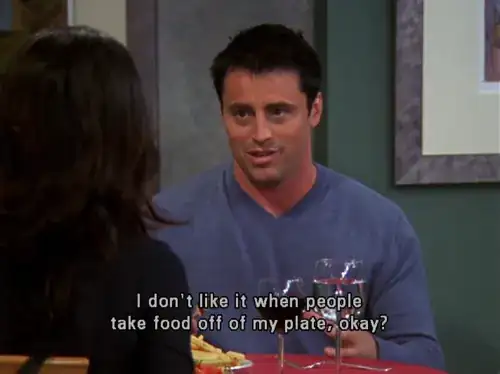
enter image description here

Some people like their food too much to share it with anyone :) but the idea that the food on one's plate must not be violated or as one user described— tainted—by someone else's mouth is not totally outlandish to English native speakers.

Normally, a person drinking straight from a bottle of water will not offer to share it with a friend or a coworker. And some people will visibly recoil if you suggested they taste an ice-cream which you'd already licked. The most likely reaction would be eww; gross; yuck and a few will add: “It's got your germs all over it!”

However, among close friends it is acceptable to take a taste of that person's beverage especially if it is alcoholic. And men will bond by sharing the same bottle of beer together. Sharing food or allowing friends and family members to taste something from your plate using a fork is very common, the vast majority of European and North American speakers find this behaviour totally normal, and would be surprised to discover sharing food in this manner is taboo in different cultures.

Therefore if the OP wants to convey the meaning of Jootha in English he will have to use that word and give its definition, and more importantly, explain that it is part of their culture. This may be fine in a relaxed situation over dinner but with a complete stranger I can see how this solution might be viewed as being intrusive and time consuming.

In a situation where a short phrase will have to do, I might say any of the following with an almost apologetic tone of voice and shrugged shoulders, just to convey that you understand the listener might find this odd but you are powerless to do anything about it.

  • I'm sorry that food has been touched by someone else
  • I'm sorry, but I cannot share the food on my plate
  • Please, don't touch my food.
  • My culture forbids me to drink from the same bottle, glass, etc.

I would strongly advise against using the term ort, a word which is becoming increasingly rare as confirmed by this Ngram. Results from Google Books show many false positives, such as last names of authors, acronyms, and the name of a children's book character. The most common and easily understood expression is without doubt leftovers.

Mari-Lou A
  • 91,183
  • Anyone hailing from outside India need to become familiar with the Indian habits associated with the act of eating.

    At home, generally, Indians don't eat with knives and forks. It's a common practice to eat with one's own fingers straight off one's plate. Fingers are licked in the process, obviously. Contamination, if you can call it that, occurs. This is the reason that food cannot be consumed by another, who calls it "jootha" food.

    – Sankarane May 18 '15 at 18:48
  • Contd...

    The picture above doesn't adequately represent this phenomenon, I'm afraid.

    Further, within a family, this may not be viewed that way. For e.g., a mother may finish off the leftovers from the plate of her child.

    – Sankarane May 18 '15 at 19:01
  • 1
    @Sankarane This is an attempt on how people from the West might share similar viewpoints on hygiene. Foods such as hamburgers, french fries, pizzas, chips/crisps, and baked cakes tend to be eaten with fingers, but humid foods are usually eaten with cutlery, and are therefore seen to be less of a hygiene risk—rightly or wrongly. The OP may or may not be aware of this fact, and hence should be prepared if non-Indians express surprise if he points out that his food is "tainted" when touched by somebody else. It was my impression, that this did not exclude the use of cutlery. – Mari-Lou A May 18 '15 at 20:32
2

In India, on auspicious days, special food items are prepared for offering to one's deities at home. The cook begins cooking only after a shower, and with clean hands. Food is prepared with utmost care, with the best ingredients, using super-clean pans and dishes and finally, without testing it by tasting.

If anyone tastes it before it's offered, the food is considered unfit for offering. I would then say, it becomes metaphorically tainted:

verb

1.1 Affect with a bad or undesirable quality:

ODO

As a rough equivalent of jootha: The food is tainted by the taboo associated with unauthorized tasting.

N.B: jootha refers only to the tainted food, not the action itself - just to dot the i's and cross the t's.

Sankarane
  • 2,405
  • 1
  • 12
  • 19
  • But it would have to be very rough because "taint" is more usually used to describe something that is actually unsafe to consume... you'd not be able to say "I can't eat this because it's tainted" without explaining how it was tainted. – Catija May 18 '15 at 00:17
  • I believe 'taint' can also mean the following:

    to violate the chastity of, to desecrate, to defile, etc.

    I've picked the more common 'taint', as being close to that Hindi word.

    – Sankarane May 18 '15 at 00:30
  • Thanks for the embellishment, ScotM, oh... the scary guy! – Sankarane May 18 '15 at 00:55
0

If you are looking for a serious word commonly used by adults in a formal setting, I'm stumped.

If you'll accept an informal word with juvenile overtones, then I'll mention cooties.

NOAD labels this word as informal, and defines it as:

a children's term for an imaginary germ or repellent quality transmitted by obnoxious or slovenly people.

That definition seems to embody much of what you're after: a certain "unclean" state after a breach of manners or etiquette.

So, one could say:

Ew, gross! You gave my food cooties!

As I said, though, you'd be much more likely to hear this in a middle school cafeteria than in the lunchroom at a corporate office. Still, sometimes an informal word is better than no word at all.

J.R.
  • 58,828
  • 5
  • 95
  • 196