5

Anyone who's watched CW's Arrow would recognize this line immediately:

They've got guns. You've got a bow and arrow.

They never say a bow and arrows. They never say a bow and an arrow. They say a bow and arrow, which still sounds idiomatic. I'm trying to make sense of it. These are the explanations I came up with.

  1. arrow here is an uncountable noun.

    • However, OD doesn't list any specific uncountable senses of the word. And phrases like a quantity of arrow sound wrong. The Oxford Dictionaries entry lists the bow and arrow phrase as an example, though.
  2. a bow and arrow is an idiom meaning a bow and a set of arrows (and maybe a quiver).

    • Again, I can't find this idiom under arrow or bow. So I'm not sure if this is right.
  3. They're talking about just one arrow (which is on the bow at the time).

    • If that's the case, why drop the article?

Also, I can't think of any analogical phrases. Is a gun and bullet a thing? I think one would say "I've got a gun and bullets".

Please help me explain the singular arrow here.

EDIT: Just so it's clear, I'm specifically interested in the usage of a before the set phrase bow and arrow. And the reason for the singular form of arrow in the phrase.

Similar set phrases have been pointed out to me in the comments:

  • ‘a knife and fork’: one fork (presumably)
  • ‘a fish and chips’: many chips (presumably)

But: ‘a bow and arrow’: many arrows (presumably)

I'm still curious.

Mari-Lou A
  • 91,183
Tushar Raj
  • 21,025
  • "A gun an bullet" might not be used like "bow and arrow", but if I said to you "Maybe you deserve a bullet to the brain", would you assume I'm carrying only one bullet? – Flater May 29 '15 at 09:27
  • @Flater: That's neither here nor there. The real question is: would you say "Maybe you deserve bullet in your brain"? – Tushar Raj May 29 '15 at 09:33
  • Sling and stone. – TimR May 29 '15 at 12:19
  • Cannon and ball. – TimR May 29 '15 at 12:23
  • @TimRomano: I don't think so. You're forgetting the article. – Tushar Raj May 29 '15 at 12:28
  • 2
    The leading article can be dropped with bow and arrow too. The main question is the singular in the second element. – TimR May 29 '15 at 12:29
  • @TimRomano: "You've got bow and arrow" is not quite as baffling as "You've got a bow and arrow". Perhaps I didn't make it very clear, but it's the article that confuses me the most. – Tushar Raj May 29 '15 at 12:31
  • It's idiomatic -- that's all you need to know. – Hot Licks May 29 '15 at 12:37
  • 2
    The handheld weapon is conceived as "launcher-cum-projectile", and that's why we have the option to use the article. David fought with sling and stone. David killed Goliath with a sling and stone. (https://books.google.com/books?id=x1sEAAAAQAAJ&pg=PA136&dq=%22a+sling+and+stone%22&hl=en&sa=X&ei=d2BoVfKRCoeGyATZ9oLgBw&ved=0CDwQ6AEwAg#v=onepage&q=%22a%20sling%20and%20stone%22&f=false) – TimR May 29 '15 at 12:56
  • Do you eat with your fingers, or with a knife and fork? – TimR May 29 '15 at 12:58
  • @TimRomano: ChopstickS , but if I said "a knife and fork", how many forks am I implying. Are you picturing one, or the 'Titanic'-style shebang? (no sarcasm intended. I'm actually curious.) – Tushar Raj May 29 '15 at 13:01
  • Well, we use only one fork at a time, even if we have several (or many). The knife and fork are used in tandem. They're a duo. Hence "a knife and fork". You can't get much done with only a knife, or with only a fork, when you're presented with food that needs to be cut into smaller pieces, a chicken breast, say, or an entire game hen, or a beef steak. – TimR May 29 '15 at 13:06
  • 1
    @TimRomano KJV of the Bible actually specifically writes "...with a sling and a stone...". So I disagree that adding an article is optional; it should be either necessary (if you hyphenate the words) or incorrect (if you don't). "A bow and arrow" should be incorrect, it's either "A bow-and-arrow" or "Bow and arrow". – Yang May 29 '15 at 13:19
  • 1
    @Yang: But what does it really mean (linguistically, not typographically) "to hyphenate the words"? What aspect of natural language does the hyphenation represent? I'm not saying that there isn't such an aspect, just questioning your emphasis on orthography/typography here, which are mere conventions. – TimR May 29 '15 at 13:21
  • 1
    That it's a noun, not a set phrase. This is distinct from the "fought with sling and stone" usage, where "sling and stone" qualifies the style of combat. My point is that these are two distinct usages; and more generally, you can't just add an article to a phrase. – Yang May 29 '15 at 13:25
  • @Yang - a fish and chips. https://books.google.com/ngrams/graph?content=a+fish+and+chips&year_start=1800&year_end=2008&corpus=15&smoothing=3&share=&direct_url=t1%3B%2Ca%20fish%20and%20chips%3B%2Cc0 –  May 29 '15 at 13:26
  • @TimRomano: So, if I'm correct in assuming that a single fork is used most of the time, the singular fork doesn't bother me. – Tushar Raj May 29 '15 at 13:28
  • @Josh61 - But not a fish and chip. More than one chip, so chips; single fork, so fork; more than one arrow, yet arrow ; you see my problem? – Tushar Raj May 29 '15 at 13:29
  • 1
    @Yang: you can't just add an article to a phrase. Speakers do use or do drop articles in phrases such as "bow and arrow", "sling and stone", depending upon how "single-nounish" such combos are understood to be. We can say "I eat with a knife and a fork" or "I eat with knife and fork" or "I eat with a knife and fork". – TimR May 29 '15 at 13:31
  • @TusharRaj - we are dealing with an idiomatic expression, a very old one apparently. Bow and arrow is a fixed expression, I don't think it make sense to discuss why arrow and not arrows. –  May 29 '15 at 13:32
  • @Tushar Rah: It's not that a single fork is used "most of the time". It's that knife and fork are used in tandem; regardless of how many forks are in the place setting, only one is used at a time. One cannot hold two forks in the same hand (not typically). – TimR May 29 '15 at 13:32
  • Bow and arrow is used unhyphenated also as an adjective. http://www.ebay.com/bhp/bow-and-arrow-set –  May 29 '15 at 13:40
  • @Yang: Now, why is it that we cannot write "They fought with bow-and-arrow"? – TimR May 29 '15 at 13:40
  • @TimRomano - good point!!! –  May 29 '15 at 13:40
  • 1
    I think you're getting confused by my mentioning of hyphenation. Let's ignore the typographical point altogether, my point is: "with bow and arrow" is perfectly correct in one context, "you've got a bow and arrow" (which I prefer to hyphenate) is perfectly correct in another context, this does not mean they are correct for the same reasons. The two usages are distinct. The asker's example is of the latter case; you two are talking about the first case. – Yang May 29 '15 at 13:48
  • Take another example, "...he intended to visit the Crimea with fire and sword." This is correct because "fire and sword" is a set phrase. But here there is no such thing as "a fire and sword". These are two distinct grammatical forms, and they don't always overlap. It just happens that with "bow and arrow" both usages are fine, but the asker's example is definitely the latter usage. Hence, why I wanted to use hyphenation to distinguish between the two. – Yang May 29 '15 at 13:48
  • @TusharRaj - I wonder what is your question at this point; the use of expression as a noun or as an adjective? Hyphen or no hyphen? Article or not article? and which article? –  May 29 '15 at 13:52
  • @Josh61: I didn't mention the hyphens or the noun/adjective thing. To find out what I want to know, read my previous comment to you. I'll edit this into my post shortly. – Tushar Raj May 29 '15 at 14:01
  • Another example of a set phrase: "His bread and butter." Would you hyphenate this? No. Why? Because it's not an indefinite noun. These are distinct. Let's move on. – Yang May 29 '15 at 14:08
  • @Yang - if "bow and arrow" is not a set phrase in "a bow and arrow" than the phrase is at least unusual, it should be "a bow with arrows" for instance. –  May 29 '15 at 14:11
  • https://www.google.com/search?q=%22a%20skull%20and%20crossbones%22&tbs=bks:1&lr=lang_en&gws_rd=ssl – TimR May 30 '15 at 10:21

2 Answers2

6

Bow and arrow is a set phrase with its roots in history:

  • The bow and arrow is a projectile weapon system (a bow with arrows) that predates recorded history and is common to most cultures. Archery is the art, practice, or skill of applying it. (Wikipedia)

Ngram: bow and arrow vs a bow and arrow vs a bow and an arrow.

Referring to hunting back in history, I think that the expression has an idiomatic nuance that gun and bullet has not, yet!

  • As per your edit referring to the indefinite article a:

the set phrase, as highlighted above, is bow and arrow, a definite or indefinite article in front it is used according to the specific context and according to the rules that govern the usage of articles.

  • 1
    Thanks for answering. I had the opportunity only now to go through your linked page. The page doesn't even mention the phrase 'a bow and arrow', let alone explain it. I've edited my question to include that I'm specifically interested in knowing why a is used before the set phrase. – Tushar Raj May 29 '15 at 12:44
  • @TusharRaj - the set phrase, as highlighted in the answer, is *bow and arrow*, a definite or indefinite article in front it is used according to the specific context. You can see Ngam examples as a reference. –  May 29 '15 at 12:57
  • bow and arrow vs bow and arrows Ngram How do explain that the plural form in this case? – Mari-Lou A May 30 '15 at 06:37
  • The point is that 'Bow and arrow' is a set phrase ( An unvarying phrase having a specific meaning, ODO) and as such the 'bow and arrow' or a' bow and arrow' are expressions which use the mentioned set phrase. Of course both bow and arrow are also two distinct independent terms that can be used in a number of different ways such as: my bow and my arrow/s, one bow and two arrows, one nice bow and some broken arrows etc. The examples you show bow and arrows, checking inside Ngram, they are all used in the non idiomatic sense of 'bow and arrow' but as independent terms. – –  May 30 '15 at 16:48
  • @TusharRaj - in what way does it not answer your question? –  May 30 '15 at 22:05
  • @Josh61: It answers that it is a set phrase, which is correct. However, I still don't know why the singular arrow refers to plural arrows. Other binomials normally have terms in the proper number, as I pointed out in the comments to Mari's answer. – Tushar Raj May 30 '15 at 22:10
  • @TusharRaj - so actually your question is: why the set phrase bow and arrow is not bow and arrows ? –  May 30 '15 at 22:17
  • @Josh61: In light of the discussion, I suppose that would be it. – Tushar Raj May 30 '15 at 22:23
  • @Josh61: I thought about editing the question, but decided against it as that would invalidate your answer. If you want, you can edit my question. – Tushar Raj May 30 '15 at 22:25
  • Well, once it is clear why the expression 'a bow and arrow' is a valid one, your first question, you may just add as an additional question in the same post why arrow and not arrows in the set phrase . ( to which I really don't think you can find an indisputable answer) –  May 30 '15 at 22:30
  • My impression is that is has to do with a really old expression, but mainly with the fact that *bow and arrow* refers to *a weapon consinting of a bow and an arrow!* ***http://www.britannica.com/EBchecked/topic/76056/bow-and-arrow –  May 30 '15 at 22:52
6

The expression “bow and arrow” is an example of siamese twins, also known as irreversible binomials, binomials, binomial pairs, freezes and nonreversible pairs in linguistics. There are several posts on EL&U that talk about this language feature which is not exclusive to English.

Binomials have two main characteristics. The first, as noted by the Original Poster, is that the order is usually perceived as fixed. The second is that the two terms are normally the same part of speech, though not always Nouns.
Araucauria

Frozen reduplicative phrases like these, especially ones made of nonsense or phonosemantic roots like riffraff or hocus-pocus, are simply called Freezes in the literature, following Cooper and Ross 1975, the first study to investigate them thoroughly.
John Lawler

Thus ‘word-pairs’ such as bed and breakfast; birds and bees; cat and mouse; Adam and Eve; fish and chips, and trinomials such as: blood, sweat and tears, and lock, stock and barrel are clichés whose word order is normally fixed.

Using the OP's example, people rarely say or write: “arrow and bow”; “arrows and bows”; “bows and arrows”; or “a bow and an arrow”.

...the more general tendency to represent powerful groups first (Hegarty et al., 2010). This explanation is in line with Cooper and Ross's (1975) and Mollin's (2010) observations derived from language corpora that more powerful elements are mentioned before less powerful ones (as in bow and arrow; sun and moon; parent and child; cow and calf) and with McGuire and McGuire's (1992) argument that groups of higher sociocultural status are mentioned first.
The Oxford Handbook of Language and Social Psychology

See also the recent EL&U question Why do we say ‘kith & kin’ and not ‘kin & kith’?

However, bow and arrow is quite unique, it ought to be bow and arrows, inasmuch as the first noun is singular (because we use ‘a bow’,) and its corresponding partner, arrow(s), should be plural because an archer uses more than one arrow to shoot. Instead, both terms are singular, they seem to follow the unspoken rule that pair nouns in binomials remain either singular or plural, such as: mother and child; chalk and cheese; friend and foe; hammer and nail. Or plural as in: brothers and sisters; birds and bees; ladies and gentlemen; and odds and ends.

Occasionally, the first noun is singular or uncountable whilst the second is plural;
e.g. fish and chips; bacon and eggs; and fun and games.

But even rarer are the instances where the first noun is plural followed by a singular or uncountable noun: strawberries and cream; pickles and ice cream, were the only examples I could come up with.

According to Cooper and Ross (1975:65-66) cited by Susan Mollin (The (Ir)reversibility of English Binomials...)

There are twenty semantic principles [the authors] distil from their collection of freezes: […] adults before children, male before female, positive before negative, singular before plural, […] nominal before other parts of speech, count before mass, and the food hierarchy (which they give as fish > meat > drink > fruit > vegetables > baked goods > dairy products > spices).

Where does the singular countable noun arrow fit here? Apparently it defies the twenty principles listed, bow being singular, should be followed by the plural noun arrows. However, the order of the two nouns do comply with Cooper and Ross's semantic and phonological constraints: bow is the source of power hence it earns first position; it is monosyllabic and therefore must precede arrow which is bisyllabic.

Moreover, the/a bow and arrow, along with its timeless image, have both become symbolic and iconic. We associate the phrase and image with the sport, archery; military warfare; hunting; mythology and love.

cupid
2. A representation of Cupid as a naked cherubic boy usually having wings and holding a bow and arrow, used as a symbol of love.

2008, Basic Illustrated Archery [emphasis mine]

Primitive man first made use of the bow and arrow as a weapon... as archery continued to evolve and develop, more and more civilizations began using the bow and arrow to defend themselves...

Imagine for a moment someone with a bow and arrow. ... Robin Hood, the notorious outlaw and accomplished archer, is one of the most popular choices.

Pre-25,000 B.C.: early man may have invented the bow and arrow in Africa,... where the first stone arrow-heads were discovered.


British English corpus

And finally, looking at Google Ngram, we see that the expressions: “a bow and arrows” (blue line) and “his bow and arrows” (red line) were more common in the 18th and 19th century than its modern day counterpart, “a bow and arrow” (green line)
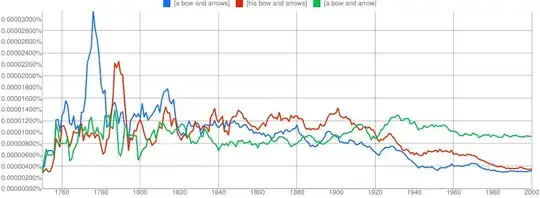
Chart listing variations of "a (his) bow and arrow(s)"

If we compare the bare binomials bow and arrow (blue line) with bow and arrows (red line) we see that the latter form is still used, but its marked descent began in the 1920s. Ngram
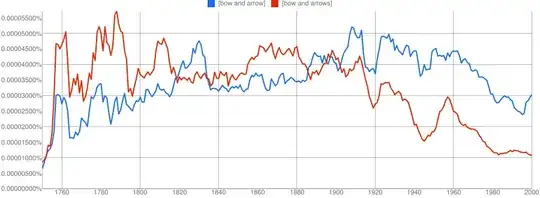
enter image description here

Citations of “bow and arrows”

1799, The New Robinson Crusoe… By Joachim Heinrich Campe

ƒo that, a little before night, about ƒix o'clock, he exerciƒed himƒelf in the ufe of his bow and arrows, in order that he might be in a condition to defend himƒelf, ƒhould he be attacked by any human ƒavage, or fierce animal. In a little time he acquired ƒuch a dexterous uƒe of his bow and arrows, that he could hit a mark, not bigger than a crown-piece at a great diƒtance

1835, Gentleman's Magazine, and Historical Chronicle

East Smithfield.
Thomas de Meose held a messuage, and one water mill, and eight acres of meadow, with the appurtenances, in East Smithfield, London, by the service of finding for the king a footman, with a bow and arrows, for forty days at his own charge, in the Tower of London, in the time of war.

1853, English Forests and Forest Trees,…

By the 6th of Henry VIII. all male servants were to provide themselves with one bow and four arrows, which their master was to pay for, stopping the purchase-money out of their wages. Another statute passed in the same reign enjoined the use of archery more extensively. It ordained that every man under sixty, except spiritual men, justices, &c., should use shooting with the long-bow, and have a bow and arrows continually in his house; that he should provide bows and arrows for his servants and children.

1855, The New Church Repository and Monthly Review

As war in the Word signifies spiritual war, therefore warlike arms, such as the sword, spear, shield, target, bow and arrows, signify such things as are proper thereto.— A. R. 299

1928, My People, the Sioux; Page 9

About the first gift I received from my father was a bow and arrows. He made them himself, painting the bow red, which signified that he had been wounded in battle.

1941, An Apache Life-Way

Conspicuous, too, are weapons of war and chase—the bow and arrows, quiver, bow cover, shield […]
As soon as the boy is provided with a bow and arrows he spends a great deal of time gaining accuracy in handling them. […]
When the boy is sufficiently strong to handle a bow and arrows, some member of the extended family — the father, the mother's brother, or the grandfather — provides him with them and gives him the necessary advice.

1954, Boys' Life, page 51

Archery can give you some of this summer's best fun, if you just know how to get the most out of your bow and arrows. You'll need bow, arrows, arm and finger guards, and — preferably — a quiver.

Mari-Lou A
  • 91,183
  • Thanks. And upvote. But the basic question remains. Even if it's an irreversible binomial, why is the second term singular when it shoud be plural? I do realize that the terms in freezes can take both forms, but they usually take the form of what they represent. (Strawberries and cream, because there's more than one strawberry, fish and chips, as there's more than one chip. And yet, bow and arrow). And, as you discovered, bow and arrow was popular indeed. Whatever happened to that? Frankly, this raises more questions than it answers. – Tushar Raj May 30 '15 at 18:04
  • PS - I'm not entirely convinced that fish is singular in 'fish and chips', but that's another story. – Tushar Raj May 30 '15 at 18:05
  • We would say "an archer shoots with a bow and arrow". – Mari-Lou A May 30 '15 at 18:11
  • So, my 3rd guess is right. We're talking only about the one arrow in action. The article is dropped because it's a freeze. And the set phrase began to appear (incorrectly?) in sentences like "You've got a bow and arrow". Am I correct? – Tushar Raj May 30 '15 at 18:14
  • Could be... the singular "arrow" represents the missile, the weapon. It seems that arrow is singular because it obeys the standard pattern of binomials: singular + singular, or; plural + plural. See the Siamese twins link for an extensive list of pair-words. – Mari-Lou A May 30 '15 at 18:21
  • I haven't verified every single entry, but I don't see a singlular term representing plural things. Also woth noting is that some forms which look singular are actually mass nouns (bacon and eggs, fun and games), and others have the same plural form (fish and chips). The more I think, the less I understand. – Tushar Raj May 30 '15 at 18:27
  • Anyway, I request that you try to discover why we ditched 'bow and arrows' in favor of 'bow and arrow'. That might be the key. Also, if there's any resource that corroborates our guesswork about projectile weapons, that'd be great. I can't offer much, but there's an accept and 15 small points in it for you. – Tushar Raj May 30 '15 at 18:30
  • 1
    You're right about the mass nouns, I edited my answer accordingly. As for a singular noun with a plural meaning, I couldn't find any. I did say bow and arrow is quite unique. – Mari-Lou A May 30 '15 at 18:31
  • I'm hoping J Law would stumble onto this and have a good explanation! – Tushar Raj May 30 '15 at 18:33
  • @TusharRaj No one has ditched "bow and arrows" it's just losing out to "bow and arrow", the reason for this I suspect is that binomial nouns are sometimes alliterative e.g. spic and span, emphasize the order of perceived importance e.g. Adam and Eve; or simply prefer the singular N + singular N; or, plural N + plural N pattern. – Mari-Lou A May 31 '15 at 09:48
  • This answer has the blessings of John Lawler. Accepting it. – Tushar Raj Jun 04 '15 at 17:46
  • What is the plural of bow and arrow? – GJC Jan 17 '20 at 17:16