83

I'm wondering if there's a word, phrase, or idiom to describe the action of deliberately confusing people by using complex sentences. For example, some politicians will throw out some big words and fancy sentences to confuse people what he or she really mean.

In Chinese, we say that the politician is "玩文字遊戲". Direct translation would be "playing a word game". And some English-Chinese dictionaries' suggest "play on word", "play with words", "word play", and "paronomasia". However, upon further researching by Googling, I don't think any of these is correct.

Nicole
  • 11,828
RexYuan
  • 1,632
  • 11
    To be crude: The polititian is 'bullshitting' or 'talking out of his ass'. It may not connote the 'complex sentences' part, but it does capture how you feel about it. – Tushar Raj Jun 24 '15 at 17:40
  • probably - conworder similar to conlanger (psst - I made this word : conworder) – alpa Jun 24 '15 at 18:09
  • One of the uses of rhetoric. It is an art to deliver a speech with a lot of words and to say nothing. Scientists have another problem. They have been using their academic terminology for so long that they are unable to translate what they want to convey into normal language. – rogermue Jun 24 '15 at 18:13
  • In political terms, we have 'filibuster' for when politicians just say whatever they can in order to pass time: https://en.wikipedia.org/wiki/Filibuster It doesn't necessarily fit your question, but is interesting if you are unfamiliar with it. – ps2goat Jun 24 '15 at 19:41
  • 2
    You are correct that "play on/with words" means something completely different in English: it corresponds roughly to "punning" or similar, nothing generally to do with obfuscation. – neminem Jun 24 '15 at 21:26
  • See also http://english.stackexchange.com/questions/4659/is-there-an-english-word-meaning-the-use-of-uncommon-words – Mitch Jun 25 '15 at 01:52
  • 6
    https://xkcd.com/1322/ – Double AA Jun 25 '15 at 04:59
  • 4
    Fans of the Yes Minister TV show will immediately understand if you refer to it as "pulling a Sir Humphrey". Some examples: http://aadithyakv.com/blog/sir-humphreys-longest-sentences/ – Gaurav Jun 25 '15 at 07:27
  • @Gaurav Sir Humphrey was pretty well matched by his boss. Blackadder, though less intelligent than Sir Humphrey, was way ahead of his boss the Prince Regent. Wanting to change is mind: "But that [what the prince had said the day before] was a joke. And a brilliant one!" – Level River St Jun 25 '15 at 08:59
  • 6
  • 2
    An example of this phenomenon is the monologues from the fictional civil servant Sir Humphrey Appleby, created by Anthony Jay and Jonathan Lynn, in the series Yes, Minister and Yes, Prime Minister for the British Broadcasting Corporation. Perhaps readers would like to peruse the following Appleby quotations, noted for their verbosity. https://en.wikiquote.org/wiki/Yes,_Minister –  Jun 25 '15 at 13:03
  • @TusharRaj I disagree in that bullshitting or talking out of his arse is really about substance rather than style. It is saying they are making no sense/without justification etc etc. I think the question is the opposite which is about the style that is used to distract from (yes, I completely agree, probably bullshit) substance. – Cor_Blimey Jun 26 '15 at 19:15
  • 1
    @Rexyuan the direct translation of playing a word game is also used in English. It describes the issue accurately: the using words to avoid the issue. Alternatively, as the answer says, Obfuscating is a great single word to describe it, but playing a word game is a phrase that would convey the same meaning and yet be more widely understood. – Cor_Blimey Jun 26 '15 at 19:19
  • 1
    From The Master -- Sir Humphry, in Yes Minister: https://www.youtube.com/watch?v=8keZbZL2ero https://www.youtube.com/watch?v=MYz_A_1xRqc – Baard Kopperud Jun 29 '15 at 08:37
  • @Mari-Lou - In relation to the page-links you provided here - it's also ironic to consider the voting differentials between those two and this OP. Amazing. –  Jun 29 '15 at 20:49

25 Answers25

162

I would call this obfuscating.

Merriam-Webster gives us the following definition for the word:

Obfuscate: to make (something) more difficult to understand

So in the case of the politician you might say, "The speech seemed deliberately obfuscated" or "Her obfuscating delivery masked the negative consequences of her actions" or "They missed the hard truths in the speech thanks to his profuse obfuscation"

Dog Lover
  • 6,445
79

What about Convoluting:

con·vo·lute

gerund or present participle: convoluting

make (an argument, story, etc.) complex and difficult to follow.

Ex: "this 'professor' is worse than a lawyer in convoluting his words to suit his peculiar point of view."

  • +1 I feel this is an equally good answer! I would accpet this, if I can accpet multiple answers – RexYuan Jun 26 '15 at 01:27
  • 1
    Obfuscate is popular because of all the Stack Overflow-ers on this site. Therefore, since convolute is also popular, there must be comparatively few Electrical Engineering or Physics or Math members on this site. (convolution, or convolving, is also jargon in those fields for reshaping one waveform with another). – Alex Shroyer Jun 29 '15 at 15:02
  • @hoosierEE: Ah, but obfuscation of code is exactly analogous to what the OP is trying to describe, whereas convolution of waveforms is not generally for the purpose of... y'know... obscurantism. – Beta Jun 30 '15 at 00:08
70

How about circumlocution?

circumlocution:
1: the use of an unnecessarily large number of words to express an idea
2: evasion in speech

Merriam-Webster

Gaurav
  • 1,724
53

That would be sesquipedalian

using a lot of long words that most people do not understand

Synonyms and related words

Words used to describe writing or speech style:articulate, chatty, circuitous...

reference:

http://www.macmillandictionary.com/dictionary/british/sesquipedalian

Bookeater
  • 7,213
  • 2
  • 21
  • 35
  • 18
    That's especially good because if you were to say it would sound like you were (the irony). +1 – Avon Jun 24 '15 at 17:41
  • @Avon Fun link: http://www.scrabblewordsolver.com/blog/words-to-impress-and-confuse-your-friends-intelligent-words-to-use/ – Bookeater Jun 24 '15 at 17:44
  • 6
    This word is hopelessly sesquipedalian. – Tushar Raj Jun 24 '15 at 17:53
  • 1
    @TusharRaj Not quite so hopelessly as the one for those who are mortally afraid of long words, the star-crossed hippopotomonstrosesquippedaliophobes (yes, the typos and generally bad compounding is part of the word). – Janus Bahs Jacquet Jun 24 '15 at 18:15
  • @JanusBahsJacquet: So that's what I am. I never knew :) – Tushar Raj Jun 24 '15 at 18:18
  • 5
    But sesquipedalian implies nothing about trying to confuse people- it means merely, given to the use of long words. – Jim Jun 24 '15 at 18:28
  • 5
    @jim But accusing a political opponent of "deliberately discombobulating the electorate with their sesquipedalian rhetoric" would be fun – Avon Jun 24 '15 at 18:36
  • But @Janus, I don't believe this is a legitimate word or psychological disorder. My laptop started smoking when I tried to copy/paste it here, and the DSM 5, though sesquipedalian in its own right, says absolutely nothing about "hippopotomonstrosesquippedaliophobia." –  Jun 24 '15 at 19:09
  • @LittleEva At a guess, I'd say a good 75% of the phobias you'll find on the Internet are less than legitimate psychological disorders. On the other hand, I believe we've established quite firmly that your laptop at least does suffer from hippopotomonstrosesquippedaliophobia. ;-) – Janus Bahs Jacquet Jun 24 '15 at 19:13
  • @Janus - hmm, I hadn't considered that. –  Jun 24 '15 at 19:15
  • 3
    Sesquipedalian most properly refers to the individual word, not the overall statement -- it's a "foot-and-a-half" long. – Hot Licks Jun 24 '15 at 19:15
  • TVTropes rather brilliantly refers to this as "Sesquipedalian Loquaciousness" – Gaurav Jun 25 '15 at 07:27
  • Also sesquipedalian is an adjective, and OP is asking for a verb. – stephan.com Jun 30 '15 at 05:53
24

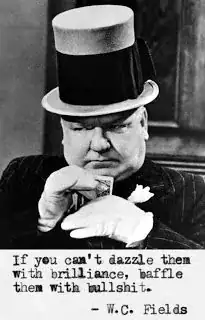
One apt idiomatic expression for what the OP describes is, If you can’t dazzle them with brilliance, "Baffle 'em with Bullshit", a phrase attributed to the American comedian, W.C. Fields.


enter image description here


“”Bullshit is a greater enemy of the truth than lies are.—Harry Frankfurt

Bullshit (also known as bollocks in the UK, Ireland and Australia) often shortened to BS, is nonsensical claptrap, or words without any particular connection to reality. Bullshit may be used as a means of obfuscation, or it may simply be a way to pass time or fill space on a page. There's a lot of it, and it is often an indicator that someone is trying to mislead and/or they don't know what they are talking about.

Rational Wiki


baffle verb: 1. totally bewilder or perplex. "an unexplained occurrence that baffled everyone"

synonyms: perplex, puzzle, bewilder, mystify, bemuse, confuse, confound, disconcert;

Google

  • Though quite vulgar, i would agree with this, and the person doing this would be a 'Bullshitter'. – Terry Jun 24 '15 at 17:48
  • It's like I'm clapping, but slowly, for dramatic effect. If others are present, the slow clap often turns into a full-blown applause. Which I'm hoping happens here. – Tushar Raj Jun 24 '15 at 17:48
  • 1
    @LittleEva: No, thank you. I read this quote in a stray Readers' Digest ages ago but I had forgotten about it. Thanks for reminding me. Now that I've started working, I'm sure I'll get opportunities where I have to follow Mr. Fields' priceless advice! – Tushar Raj Jun 24 '15 at 18:01
  • @Terry - I agree with your assessment of the idiom's vulgarity, however that's often the nature of vernacular expression. :-) –  Jun 24 '15 at 18:04
  • @littleava I would disagree with the rational wiki. Bollocks and bullshit have two different meanings, at least where I'm from. Bollocks is when someone is talking nonsense rather than making some thing overly complicated. – Terry Jun 24 '15 at 18:09
  • @Terry - there may be points where the two overlap. –  Jun 24 '15 at 18:11
  • 1
    @LittleEva I realize that now I think about it. – Terry Jun 24 '15 at 18:11
15

Bamboozle came to mind for me. merriam-webster and some other sources give connotations of con-artist type of action, rather than just complex sentences.

Google's 2nd definition:

confound or perplex.
- "bamboozled by the number of savings plans being offered"

Seems to fit the bill.

  • 3
    "Bamboozle" and "befuddle" are the best so far, they're the only ones that fit and are also in common usage. I'd use "Bamboozle" when implying that it is a deliberate attempt to manipulate someone into something (e.g. a salesman trying to 'blind someone with science' or a politician creating vague fears), and "Befuddle" when it could be an accident (e.g. a poor communicator) or where creating confusion is the end goal (e.g. a politician dodging a question by confusing everyone, then changing the subject). – user56reinstatemonica8 Jun 25 '15 at 11:38
  • Yup, those are the connotations I'd associate with "bamboozle" and "befuddle". – Peter Cordes Jun 25 '15 at 11:41
15

You could say that the person is using sophistry (sometimes called sophism). Merriam-Webster defines sophistry as

  1. the use of reasoning or arguments that sound correct but are actually false

  2. a reason or argument that sounds correct but is actually false

The term originally came from a Greek word meaning "wisdom". It referred to the teachings of sophists, teachers who taught philosophy and rhetoric to the sons of nobility. The Wikipedia article on sophism describes how the word took on its modern, negative meaning:

The practice of charging money for education and providing wisdom only to those who could pay led to the condemnations made by Socrates, through Plato in his dialogues, as well as Xenophon's Memorabilia. Through works such as these, Sophists were portrayed as "specious" or "deceptive", hence the modern meaning of the term.

In other words, sophistry can be used to deceive people by wrapping an incorrect or illogical argument in persuasive rhetoric. Sophists don't need to know what they're talking about; they just need to sound like they do.

A good example of this usage in regard to politicians is a CBS News article called "Our Politics and the New Sophists."

Nicole
  • 11,828
13

Befuddling:

verb

[WITH OBJECT] (usually as adjective befuddled) Cause to become unable to think clearly:
ODO

From the Testimony of Senator George T. Oliver in Campaign Contributions:

I have the facts and the names and am not going to let a cheap bunch of politicians befuddle anybody...
Emphasis added

ScotM
  • 30,572
11

You could say that they are engaged in double-talk:

1 : language that appears to be earnest and meaningful but in fact is a mixture of sense and nonsense
2 : inflated, involved, and often deliberately ambiguous language
definition from m-w.com

Hellion
  • 59,365
8

The word you are looking for is "dissembling". I would define it as obfuscation for the purpose of misdirection.

My-my-my-my-my, you-you-you-you-you, oh my goodness gracious me, just you leave that to me. You can't go mixing your chickens with the pineapples and wandering up the wrong side of the garden path, goodness gracious, don't you worry about that, oh my word, goodness gracious.

Sir Joh Bjelke-Petersen, Premier of Queensland, Australia, circa 1984

Sir Joh was famously direct and to the point when he did want to answer the question.

Here's a dictionary definition:

to hide your real intentions and feelings or the facts
He accused the government of dissembling

CDO

Dissembling does not require complex sentences, but this is the typical form. Dissembling that doesn't use complex sentences is likely to be very effective because it is atypical and less likely to be seen for what it is.

Dissembling focusses on the misdirection aspect. If you want a word that emphasises the pompous wind-bag aspect you want the already mentioned sesquipedalian.

  • Hi Peter. This is a great answer, but you should include the definition in the answer rather than just providing a link. – Dog Lover Jun 25 '15 at 02:35
  • The OP provided the definition. Dissembling means exactly what he said: language that intentionally conceals meaning. – Peter Wone Jun 25 '15 at 02:41
  • 2
    Dissembling is a good term for deceptive or misleading language, but it doesn't convey the specific notion of excessively complex or confusing language. One can dissemble merely by making false statements without disguising them in elaborate rhetoric. – barbecue Jun 26 '15 at 02:52
  • What barbecue said. Also, in my experience "dissembling" is usually used in a defensive context: when one's accused of something, one may dissemble to provide a smokescreen for a retreat; when one is forced to apologize, one may dissemble to avoid actually admitting guilt. I gather that the OP's interest is more in "trying to sound important, intelligent, or convincing, despite not having any solid argument," which is a little different. –  Jun 26 '15 at 16:59
  • @JonofAllTrades - and there lies a window into my culture. We do not respect our elected. How do you tell whether a politician is lying? His mouth is open. Don't you worry about that, my goodness me. – Peter Wone Jun 29 '15 at 08:59
8

A rather wonderful word that isn't used enough: bloviating, or bloviation. As per Wikipedia:

Bloviation is a style of empty, pompous political speech particularly associated with Ohio due to the term's popularization by United States President Warren G. Harding, who described it as "the art of speaking for as long as the occasion warrants, and saying nothing". The verb "to bloviate" is the act of creating bloviation.

In terms of its etymology, according to one source, the word is a "compound of blow, in its sense of 'to boast' (also in another typical Americanism, blowhard), with a mock-Latin ending to give it the self-important stature that is implicit in its meaning.".

5

Newspeak is often used to refer to the kind of language you are describing:

  • speech or writing that uses words in a way that changes their meaning especially to persuade people to think a certain way. (M-W)

  • propagandistic language marked by euphemism, circumlocution, and the inversion of customary meanings. (M-W)

  • deliberately ambiguous and contradictory language used to mislead and manipulate the public.(AHD)

Newspeak

  • n (1949) the name of the artificial language used for official communications in George Orwell's novel 1984, often applied to any corrupt form of English, especially the propagandist and ambiguous language of some politicians, ...(Movers and Shakers: A Chronology of Words that Shaped Our Age)
  • 2
    Also from your M-W link: propagandistic language marked by euphemism, circumlocution, and the inversion of customary meanings. +1. – Tushar Raj Jun 24 '15 at 17:34
4

If you were talking about a Terms of Use agreement, or warrantee information, I'd suggest legalese, but I don't think that works very well with politicians. You might try disingenuous.

J.R.
  • 58,828
  • 5
  • 95
  • 196
4

blind with science
blind somebody with science (British & Australian)
if you blind someone with science, you confuse them by using technical language that they are not likely to understand

(thefreedictionary.com)

And that is science in the broader sense:

a systematically organized body of knowledge on a particular subject.

(Google)

Avon
  • 5,258
  • 1
    @itsme it certainly can be, and I think often is, deliberate – Avon Jun 24 '15 at 17:39
  • @LittleEva I'm not sure the song helps explain it very much but thank you again nonetheless – Avon Jun 24 '15 at 18:46
  • no, it's pure entertainment or amusement. Of course. I only included it because there are amusing elements to much if the phrases that relate to the OP's concept. –  Jun 24 '15 at 18:48
4

Kafkaesque: (after Franz Kafka) Marked by a senseless, disorienting, often menacing complexity.

Kafkaesque beauraucracy

[Wiktionary]

Jimmy
  • 2,392
  • 1
    First off, that's an adjective...the question asks for "an action." Besides, kafkaesque is much more literary and has a surreal connotation to it. I don't think it'd ever be appropriate to use it to simply mean "obfuscated" or "convoluted." – Mdev Jun 25 '15 at 03:10
  • 1
    @Matthew - I think Kafkaeque is pretty reasonable answer. It might not fit his context, but it could. eg. Crikey, this is a Kafkaesque requirements document if I ever saw one. – dwjohnston Jun 25 '15 at 06:18
4

I think that obscurantism could fit your intended meaning quite well.

Ivan Karajas
  • 141
  • 3
3

Specifically for politics the word spin is often used to describe the case where words are chosen carefully to mislead the audience.

For example, you might say "Mistakes were made" instead of "I made a mistake".

Adam
  • 416
3

Technobabble:

Technobabble (a portmanteau of technology and babble), also called technospeak, is a form of jargon that uses buzzwords, esoteric language, specialized technical terms, or technical slang that is incomprehensible to the listener.

Usually, technobabble combines words that really do exist into inexistant portmanteau words or in sentences that have no semantic value.

If the sentence is meant to have a sense but is just very highly technical and hard to grasp for the layman, then it's jargon.

gaborous
  • 187
1

When a politician uses many words, but doesn't actually address a difficult topic, you would say they are "talking around the issue" or "blowing smoke". A less known phrase would be "hiding behind words".

Neil
  • 111
1

Jargon:

  1. The specialized language of a trade, profession, or similar group, especially when viewed as difficult to understand by outsiders: a crime novel that uses a lot of police jargon.
  2. Nonsensical or incoherent language: "Your description will be considered as mere jargon by every man of sense" (Alexander Hamilton).

[...]

  1. language that is characterized by uncommon or pretentious vocabulary and convoluted syntax and is often vague in meaning.

http://www.thefreedictionary.com/jargon

user45623
  • 111
1

In regards to the politician example you mentioned, "word play" tends to mean something else. In English, "word play" tends to refer to jokes or riddles that make use of quirks in the English language, similar to the Chinese use of "grass mud horse".

There are many other great answers to this question such as "obfuscate" and "convolute".

Obfuscate tends to mean more specifically that it is made difficult to understand; convolute tends to simply mean that something is made more complicated than it should be.

Another good word to use here would be "wordsmith". This is especially appropriate to use to describe a speaker who is carefully using language to not only confuse, but to manipulate his audience into thinking or doing something they normally wouldn't do, and often doing that in a sly way.

For example, a recording company executive that hates people making copies of music might say publicly, "Thieves are hurting our business when they make copies of our music." At first glance, this looks like a straight-forward statement that unauthorized copying of music hurts record companies, but upon closer analysis, you can see that he is equating copying to stealing, a notion that record companies definitely want the public to believe in.

A rational person would normally not think of copying as stealing as stealing, by definition, deprives the victim of the thing being stolen, but the above statement tends to be much more accepted.

Vivian River
  • 1,901
1

Confusticate is a portmanteau introduced by Tolkien that combines confuse and complicate to achieve the desired meaning.

Usage limited only to those familiar with Tolkien's work, though, I guess.

The original quotation from "The Hobbit" is

"Confusticate and bebother these dwarves!"

In this instance, it's really being used as a general curse (on them), and in fact is actually expressing annoyance at them, rather than wishing confustication and bebotherment on them.

GreenAsJade
  • 1,742
0

Reductionism is the explanation of things that can be explained in a simpler way, is that what you are looking for?

0

Though the term has more than one meaning, Riddling seems to be an appropriate answer to your question. I was quite surprised to not see this term among the first few responses.

The many answers that followed to answer the question were great. My word list has become an even greater arsenal.

The word "Riddling" in my response here takes on the meaning to speak in riddles or to deliberately confuse people by using complex sentences.

Complex sentences are technically defined as an independent clause joined with a dependent clause however, in this case they usually are not difficult to understand. Ex. After the rain storm was over, the city was flooded.

Dunnup
  • 210
-2

It is not completely accurate, but a close description could be "bombastic":

http://dictionary.reference.com/browse/bombastic