2

Background

I was writing some comments in my code. There's a class that holds ID numbers for items that were replaced, and ID numbers for the items that replaced them.

Above the variable holding the old ID numbers, I wrote:

The keys and ID numbers for the components that were replaced

I then began to write the corresponding comment for the other variable, holding the new ID numbers:

The keys and ID numbers for the components that...

Question

When something has been replaced by something else, we can say those items were "replaced". Is there a corresponding past tense word to describe the items that they were replaced with?

Substituted maybe?

Basically, finish that second sentence as concisely as possible, in a manner as similar to the first as possible.

DCShannon
  • 2,143
  • "that were the replacements" or "that replaced the old ones", perhaps? – Damkerng T. Jul 21 '15 at 01:14
  • @DamkerngT. Yeah, you can clearly use a phrase that references the ones that were replaced. However, you don't need to reference the new ones to say that the old ones were replaced. I was just struck by yet another example of an apparent lack of symmetry in English. – DCShannon Jul 21 '15 at 01:17
  • 2
    What is wrong with substituted? – Val Kornea Jul 21 '15 at 01:29
  • 1
    B replaced A. No "was"; it's active, not passive. – John Lawler Jul 21 '15 at 01:55
  • There's related stuff in “Replace with” versus “replace by” about how active/passive voice affects the with/by preposition choice. Basically, Active voice favours with, Passive voice favours by**. – FumbleFingers Jul 21 '15 at 02:33
  • @vladkornea I don't know that anything is wrong with 'substituted', it just didn't seem quite right. Also, I didn't think of it until I was about done writing the question. – DCShannon Jul 21 '15 at 20:11
  • @JohnLawler I don't understand what you're trying to say. If B replaced A, then A was replaced. "A was replaced" is a complete sentence by itself. – DCShannon Jul 21 '15 at 20:12
  • B replaced A. A was replaced by B. A was replaced. – John Lawler Jul 21 '15 at 20:14
  • @JohnLawler Yes... and? – DCShannon Jul 21 '15 at 20:16
  • Your question is flawed. There is no "B was .......". B is the agent, A is the patient, was is the auxiliary for the passive, which makes the patient the subject. Agent subjects don't occur with passives. That's all. – John Lawler Jul 21 '15 at 21:03
  • @JohnLawler Sounds like you have something strange and interesting to say about this subject. I wouldn't mind seeing an answer challenging the frame of the question if you wouldn't mind writing one. That being said, neither B nor A is really the 'agent' here. I'm the agent. I replaced A with B. I did something to A, and I did something to B. 'Replaced' describes what happened to A. I'm just looking for a word to describe what happened to B. – DCShannon Jul 21 '15 at 21:14
  • Which depends on what it was. It may have been inserted, or it may have been rethreaded, or it may have fallen in. If you leave off the agent *I* from a passive, it becomes indistinguishable from the passive of a simple transitive B replaced A. Deletions always cause ambiguities. – John Lawler Jul 21 '15 at 23:30

5 Answers5

2

The word emplace is suitable:

: to put into position <missiles emplaced around the city>
Merriam-Webster

Its use has been adopted by C++ to mean creating an element in a container without copying.

jxh
  • 10,463
  • There we go, that's it. Nice find: The keys and ID numbers for the components that were emplaced. – DCShannon Jul 21 '15 at 20:19
  • I don't like this answer, because it does not convey that a replacement happened. – Fax Jun 05 '19 at 10:55
  • @Fax: This was an answer I provided for the OPs ask. I would probably use different wording instead of replacement, such as current and previous (ie, The current keys and ID numbers and The previous keys and ID numbers). – jxh Jun 05 '19 at 13:18
1

The keys and ID numbers for the components that were replaced

The keys and ID numbers for the components that are the replacements

Probably. Or possibly:

The keys and ID numbers for the new components

Depending on what you really mean by replacements.

Are they one for one replacements, i.e. there was a list [1, 2, 3] and you have replaced 1->5, 2->6 and 3->7 yielding [5, 6, 7]?

If so, your data structure would possibly be better served as a list of tuples anyway, and then you could say:

The key and ID number replacement pairs

Or is there just a new list and you're listing the changes, i.e. [1, 2, 3], [2, 5, 6, 7] where the "replaced" list is [1,3] and the replacements are [5, 6, 7]?

If so, it might be clearer to say specifically:

The keys and ID numbers for the components that were removed

The keys and ID numbers for the components that were added

  • 1
    I upvoted, because it's essentially the answer I would have given, but I think the most apt phrasing is: The keys and ID numbers for the replacement components which doesn't actually appear on your list of options. – Chris Sunami Jul 21 '15 at 16:09
0

Supersede

take the place of (a person or thing previously in authority or use); supplant.

0

The first thing that came to mind was:

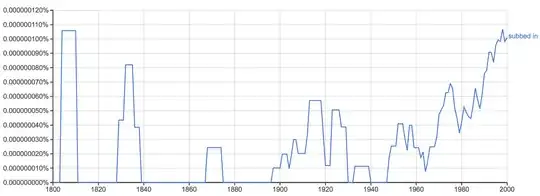
"subbed in"

...the past participle of 'sub in'

It sounds quite casual to my ears, but code comments are code comments :). It has been around for a while:

enter image description here

0

The problem is that replace is active, replaced is passive, so they lend themselves best to different constructions. If you really want to maintain parallelism, however, then it's actually your first phrase which is best rewritten. May I suggest

The keys and ID numbers for the replaced components

and

The keys and ID numbers for the replacement components

Chris Sunami
  • 19,990