What’s the difference between these two alternatives:
- Are you going to England this summer?
- Will you go to England this summer?
What’s the difference between these two alternatives:
"Are you going?" is the more natural British English usage when you are simply asking about plans or intent. "Will you go" works too, but sounds a bit clunky. "Will you...?" is also the way you might ask someone to do something, rather than just asking about their plans - as in "please go...."

As a native AusEng speaker these two sentences are very similar in meaning, but I think there is a slight pragmatic difference. This answer represents my intuition as to what that difference is, and I welcome feedback on it.
I should first note that I am considering only a neutral intonation. If for example the word you was stressed (to contrast with someone else) then the difference I suggest below would no longer apply.
Are you going to England this summer?
I think this is the unmarked option. This question would be appropriate to ask in many situations:
Will you go to England this summer?
This is a marked sentence, as is common for sentences with will (at least in conversation or less formal registers, where going to is the dominant future marker.) I think that this sentence would be used if both of these factors were true:
But if you were asking in this way it may be more natural to add a still to the question.

English, unlike many languages, doesn't have a true future tense. We can use the present tense to indicate the future if the context makes it clear. Alternatively we can use the auxiliary verb, 'will'. Originally 'to will' meant to wish or to intend something to happen. Nowadays it can still have that sense but more often it simply indicates future events.
Are you going to England this summer? ---> Is it a fixed plan that you are going?
Will you go to England this summer? ---> Do you intend to go?

Although it was the huge bounty that drew my attention to this question (as intended by the member who placed the bounty) I am not at all sure that we can assume there is a difference in meaning between 'are you going' and 'will you go' here, simply because OP asks, "what is the difference?"
What if somebody were to ask,
What is the difference between 'twelve' and 'a dozen?'
[You could possibly split hairs and find out some profound difference between 12 and a dozen, but the only difference I can think of is almost nonsensical: a person who does not know what 12 means could still ask for and buy a dozen eggs where 'a dozen' is a standard number for packing/selling certain products.]
Same here. It seems to me that in this specific pair of examples given by OP,
Are you going to England this summer?
Will you go to England this summer?
'are you going' and 'will you go' mean the same thing. 'Will you be going', and 'do you intend to go' would also have the same meaning. Native users might well prefer one expression over another, and I am not a native speaker. But I cannot imagine that the meaning of the question changes appreciably whether you say 'are you going' or 'will you go' -- and the possible answers are all the same: yes / no / not sure / not decided / God willing. Conclusion: semantically there is no difference.
Note: I appreciate the logic of the subtle distinction made by some other answers here that "are you going to" refers to a pre-planned activity and really means "are you going through with the pre-planned action" whereas "will you (go)" is a more open-ended question simply asking "are you likely to do something in the future" -- but this is possibly not a clear-cut distinction because not all speakers might mean the same thing; so such a statement needs to be interpreted in context.
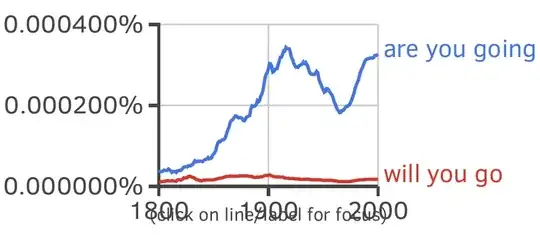
However the Google Ngrams comparison I did, as advised by a senior member, suggests another difference in usage, which is that
'are you going' is used much more often than 'will you go' presumably by native speakers of English, and this is true for both American and British English.

We use "going to" for planned activities, and "will" for promises and predictions.
"Are you going to England this summer?" Is asking if the person plans to do that.
"Will you go to England this summer?" Is asking for a statement of certainty or a promise.
In many cases, "will" and "going to" can be used interchangeably without much change in meaning or understanding by the listener. I feel that this is one such case. There are others where this is not true.

;@kld_rm
Are you going to England this summer? are you going expresses plans that you made in the past for the future considerations, here it means that in the past you thought in the matter and as a result you planned to visit England in the future "this summer "summer is still to come" for instance, I planned in 2016 to buy a car in 2018 so I could say: I am going to buy a car in 2018. it is grammatically quite correct.
Will you go to England this summer? will you in this context means you have not decided yet whether or not to visit England this summer it is simple future. hope it helps!

''but the only difference I can think of is almost nonsensical''
I beg to differ, greatly.
Think of multiple, infinite even, situations where context, urgency and power relations come into play when using ''will you...'' vs ''are you going to...''.
Take a work/office relationship — one employee to a superior asks ''Are you going to authorize extra hours for Christmas overtime this year?'' versus ''Will you (or won't you) authorize extra hours for Christmas overtime this year?''
I included (or won't you) because it's necessary to take into account that when you use ''Will you..'' you are automatically implying that you're also asking ''or won't you'' in the same sentence. ''Will you'' clearly feels more direct and not so passive or polite as ''are you going to'', and depending on the tone of voice can even be confrontational and/or be perceived as putting someone on the spot.
Ergo ''Conclusion: semantically there is no difference.'' — again, I beg to differ, vehemently, because context is king.
Because the verb "will" is used with a second verb, "going," it is an auxiliary verb. The most related definitions of the auxiliary verb "will" from Merriam-Webster are:
1—used to express desire, choice, willingness, consent, or in negative constructions refusal • no one would take the job • if we will all do our best • will you please stop that racket
3—used to express futurity • tomorrow morning I will wake up in this first-class hotel suite — Tennessee Williams
6— (a) used to express determination, insistence, persistence, or willfulness • I have made up my mind to go and go I will; (b) used to express inevitability • accidents will happen
Definitions #3 and #6 are inappropriate in this case because the statement is expressed as a question. The form of definition #3 is that of an expressed anticipation, but nevertheless a conclusion, as in "You will go to England this summer." The form of definition #6 is used to answer a question, as in "You will go to England this summer!"
The differences between my previous two example sentences and your second example sentence are punctuation and the word order of the subject in relation to the auxiliary verb.
Will you go to England this summer? (Definition #1)
You will go to England this summer. (Definition #3)
You will go to England this summer! (Definition #6)
Once again relying on Merriam-Webster, the defnition of "are" is:
Present tense second-person singular and present tense plural of be
Your first example sentence is an example of the present tense, second-person singular. (Rewording your example as present tense, plural results in, "We are going to England this summer.") As with your use of the verb "will," the verb "be" (expressed in its present tense, second-person form "are") is also combined with a second verb, "going," and is therefore an auxiliary verb. The only relevant definition of "be" from Merriam-Webster is:
2—used as the auxiliary of the present participle in progressive tenses expressing continuous action • he is reading • I have been sleeping
In this form and as a question, the verb "are" expresses the idea that the decision to go to England should be well established and the questioner is asking for verification that the decision is still valid. Because this form of the verb "be" expresses continuous action, it implies that knowledge of the decision to go to England was known in the past.
In conclusion, and to answer your question.
Are you going to England this summer? means both questioner and the person questioned knew in the past about the decision to travel to England and that the decision to travel had been made. The question is asked to verify the decision is still valid.
Will you go to England this summer? means either the decision to travel to England was not previously known or, if it was, the decision had not been made. The question is an invitation to make the decision.
Finally, please note that despite my inability to find a specific reference to establish it, and to complicate this discussion even more than it already is, the question "Will you go to England this summer?" can be used colloquially as a very formal and polite version of "Are you going to England this summer?" Used in this context, the two sentences are identical, and this is likely the cause for the many answers that express the idea of equality. However, without surrounding dialog or character development in a story, this equality should not be assumed.
"be going to" shows decision or plan but "will" just shows an event happening in future. So both can be used with two different connotations.


