65

I had assumed that "hi" was a somehow abbreviated form of "hello," but though both of these words appear to have originated from a noise to attract attention, hi actually predates hello. These words both appeared in the mid- to late 1800s, and seem to be primarily American usage. Does anyone know what Americans used for greetings prior to this time period?

Update on 9/10/11:

Although I have come to feel that "how do ye" and its variant "howdy" are most likely the common greetings in the early days of America, part of the difficulty in assessing this is the lack of recorded everyday speech. I was also unaware that "howdy" was used anywhere other than the US South prior to the 1800s, but the OED begs to differ (if someone has the citation for this, please feel free to link it).

There was considerable discussion in chat about the problem of researching common conversational speech, and during the course of that discussion, I realized that probably the best place to look would be plays, since they involve dialogue that might represent a "natural" conversation.

After a lot of searching through early American plays, I came across "holla" used as a greeting in the early American drama The Contrast by Royall Tyler. It was written and performed c. 1759, and its setting is contemporaneous New York City, therefore this greeting is probably an example of natural speech.

Interestingly, I did not find any instances of any other greetings. However, finding plays that were actually set in America in the 1700s and were also written around that period proved difficult.

Daniel
  • 57,547
Kit Z. Fox
  • 27,819

4 Answers4

47

How do ye / How do you do / Howdy?

From the etymology.com page on howdy:

howdy 1840, first recorded in Southern U.S. dialect, contraction of how do you do (1630s), phrase inquiring after someone's health; earlier how do ye (1560s).

Note that a search for "how do you do" in the Corpus of Historical American English (COHA) (1810s - 2000s) in particular brings results that are from the early 1810s (see number of occurrences per decade below). This supports that the usage of "how do you do" precedes the year in which Americans started greeting with "hi" according to etymonline.com (1862).

COHA search results for HOW DO YOU DO

Similar searches in the COHA for "how do ye do" and "howdy" support that also their usage was prior to when "hi" started being used as a greeting.


Hal / Hail

Disclaimer: no evidence that these words were used in America. What follows is more like an interesting note on the history of greetings in English:

The book Speech acts in the history of English dedicates an entire chapter to greetings in English language history. Among the greetings that it covers, I would say that the closest one to hi! in spelling and usage is hail! The author describes hail as the Middle English daughter form of the Old English interjection hal. Hal! would literally mean health!.

You can browse the book here in Google Books.

b.roth
  • 21,782
  • 1
    I appreciate the contribution, but "howdy" (as recorded by Etymonline) barely predates "hi" and there isn't anything to suggest that "hail" was commonly used in America (I know you disclaimed this, and I did find the note interesting, just not applicable). – Kit Z. Fox Jun 03 '11 at 02:25
  • 2
    @Kit - I just updated my answer to show that according to the COHA, how do you do is used since the 1810s at least. Note that 1810s is the furthest in the past that the corpus goes. – b.roth Jun 03 '11 at 08:29
  • 1
    That's a pretty good demonstration, but are you sure it's "how do you do" as a greeting, and not "how do you do that thing you do," etc? – Kit Z. Fox Jun 03 '11 at 11:50
  • 2
    Yes, "how do you do?" as a greeting. This is something that we can verify in the search results of the COHA. When you click on the number of occurrences (as on my screenshot above), the site shows you the text fragments where they were found. I just checked the 8 occurrences in the 1810s and confirmed that they were all used as greetings. – b.roth Jun 03 '11 at 12:08
  • Good, good. Now we're on to something. Did you check "Howdy" and "How do ye" and "hail" as well? – Kit Z. Fox Jun 03 '11 at 12:11
  • I was not able to check "hail" because its usage as a greeting similar to hi was before the 1810s, which is when the COHA coverage starts. But I was able to check "howdy" and "how do ye do" to confirm that they were really used as greetings. – b.roth Jun 03 '11 at 12:20
  • 2
    Regarding hail: “Wesðu Théoden hal,” quoth Éowyn, speaking Old English. Hail and whole, she bids him salubriously. And in good heath, too. :) – tchrist Feb 03 '12 at 22:48
  • Although interesting, this answer would appear to have no connection to the question? – Fattie Feb 17 '16 at 14:44
  • @b.roth, What's your race? – Pacerier Oct 04 '17 at 12:52
19

The word hello was originated in 1865/1870s. These other words are considered much older and may have been used:

  • Howdy, stereotypicaly Southern American greeting, Contraction of How do you do? (1820–30)
  • How do you do?, seems like the most likely phrased used (1625–35)
  • Good Day/Morning/Afternoon (1175–1225)
  • Greetings (Before 900)

Source

Fattie
  • 10,520
Ambo100
  • 1,894
12

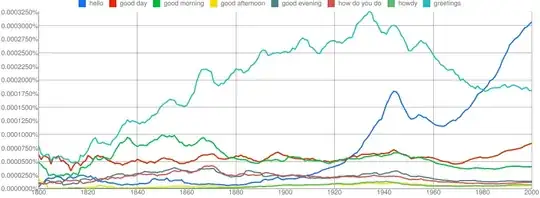
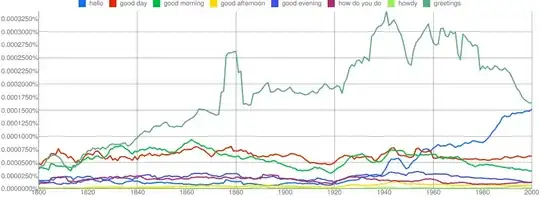
Since this seems to call for some trend analysis data, I did the needful and used Google Ngrams.

American

American Google Ngram comparison of 'hello'

British

British Google Ngram comparison of 'hello'

...from which comparison I take it that

  • 'hello' isn't that terribly unknown in British English.
  • 'hello' even seems to follow (roughly) the same trends in both BrE and AmE
  • 'hello' started to rise in popularity around the turn of the last century in both AmE and BrE.
  • 'good X' combined seem to outweigh the others until 'greetings' took over in the 1870's

Of course there are all sorts of possible problems:

  • I didn't use 'hi' because that got a zillion false positives from OR of 'III' in chapter headings and Old English 'hi' for ModE 'he'.
  • these are from books, which tend towards the more formal. I find 'greetings' to be stilted and archaic even though it seems to be currently still quite popular.

I'm still left with the nagging feeling that, as pompous as it sounds to my 21st century AmE ears, 'greetings' was actually -used- at least in print. I woulda guessed 'howdy' but not in books.

Mitch
  • 71,423
  • 4
    The problem with "greetings" is that you will have many instances of variations on "They exchanged greetings." The greeting itself might have been "Hey!" You'd have a similar problem with the other phrases, except for "howdy" and "hello" (unless there's some context I can't think of where these would not be used as interjections). – Kit Z. Fox Jun 03 '11 at 11:47
  • Thanks for demonstrating the British trend for "hello," and sharing your OED etymology too. It's not immediately relevant, but it does indicate that Etymology Online is probably way off-base in with its origin. Which means, of course, that this whole question is probably moot; if "hi" and "hello" predated the American colonies, then there was no time "before Americans said 'hi'." – Kit Z. Fox Jun 03 '11 at 11:48
  • +1 for use of Ngrams. It's also interesting to extend the search date back to 1700, and see earlier occurrences of "hello", e.g. 1735 http://books.google.com/books?id=wDYxAAAAMAAJ&q=%22hello%22&dq=%22hello%22&hl=en&ei=2wTxTbfTNM2x0AHb8_28BA&sa=X&oi=book_result&ct=result&resnum=5&ved=0CEIQ6AEwBA I haven't found any before 1735 except false positives. – LarsH Jun 09 '11 at 17:38
  • P.S. I noticed the link I just posted doesn't allow us to see the "hello" quote. This one does: http://www.google.com/search?q=%22hello%22&tbs=bks:1,cdr:1,cd_min:1730,cd_max:1740&lr=lang_en It says They said 'Hello' pleasantly and I replied 'Hello'.... – LarsH Jun 09 '11 at 19:17
  • On a related note... here is an example of both "Hi!" and "Hello!" used not as greetings but as exclamations. http://books.google.com/books?id=d5IPAAAAQAAJ&pg=PA255&dq=%22say+hello%22&hl=en&ei=ZR3xTaPgEIfb0QGNlpXWBA&sa=X&oi=book_result&ct=result&resnum=4&ved=0CEQQ6AEwAw#v=onepage&q&f=false – LarsH Jun 09 '11 at 19:25
  • OK one last comment... the "1735" book I mentioned is erroneously or misleadingly dated in the NGrams data store. The story in it that includes "hello" seems to be actually from 1907 (http://www.archive.org/stream/ashleysamericaq00incgoog/ashleysamericaq00incgoog_djvu.txt). – LarsH Jun 09 '11 at 19:56
  • @LarsH: Google is excellent for having all that stuff available and searchable and graphable like that...but it ain't perfect. I've heard of lots of date errors in google books. How did you find that error? When I clicked through to the Ashley's of America Quarterly, it wouldn't show the original text. – Mitch Jun 09 '11 at 20:00
  • @Kit, re: You'd have a similar problem with the other phrases, except for "howdy" and "hello" (unless there's some context I can't think of where these would not be used as interjections). They may always be an interjections, yet not always greetings. As pointed out above, hello and hi can be an exclamation of surprise. "Hello" also shows up a lot as an OCR error for "bello", "(Ot) hello", etc. – LarsH Jun 09 '11 at 20:01
  • @Mitch - see the link I just added in the comment you were replying to. – LarsH Jun 09 '11 at 20:02
  • Should "cheers" be in the British ngram? I seem to see that one from Brits online a lot (although I could be misinterpreting it...) – T.E.D. Sep 14 '11 at 13:17
  • @T: I tried to keep the same ones in both AmE and BrE graphs. One could do a more thorough listing of terms ('howdy','hey', 'whazzup', etc), and I had to stop somewhere. – Mitch Sep 14 '11 at 15:56
  • Very late to the party, but the search box from the link states that the search is case-sensitive. Change the terms to "Hello,Good day,Good morning,Good afternoon,Good evening,How do you do,Howdy,Greetings" and you wind up with significantly different results. Especially since these salutations often begin sentences, it implies more accurate results. – MetalFrog Mar 13 '12 at 19:47
  • @Mitch, I'm sure "greetings" has way too many false positives in your charts – Pacerier Oct 04 '17 at 12:55
  • @Pacerier me too. But can you give some examples? – Mitch Oct 04 '17 at 13:56
0

I think "How are ya" changed to "Hai" and then to "Hi"?

BZ1
  • 133