I'm wondering where the term "ballpark estimate" comes from? Sometimes "ballpark" is said stand-alone to mean a rough estimate, as in "these numbers are a ballpark". I understand it must come from baseball or some other sport. Does it refer to the idea that a batter might point in the direction he'll hit the ball? Or is it something that relates to a rough guess at the attendance that day? What part of the ballpark or sports does one use a rough estimate?
Asked
Active
Viewed 6.7k times


3 Answers
31
Etymonline has this interesting bit:
ballpark "baseball stadium," 1899, from (base) ball + park (n.). Figurative sense of "acceptable range of approximation" first recorded 1960, originally referring to area within which a spacecraft was expected to return to earth; the reference is to broad but reasonably predictable dimensions.
But I'll bet there's more to the story. . .
Edit #1:
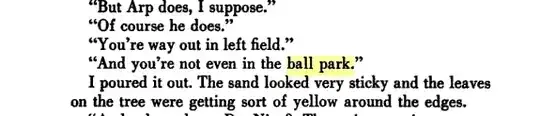
Looks like the first figurative use of the phrase is from Kenneth Patchen's 1945 Memiors of a Shy Pornographer. In a discussion of the merits of various great artists, two characters have this dialogue:
The earliest use of the phrase I can find in the context of facts and figures is from 1950 (check) in Volume 5 of Petroleum Processing:

Edit #2:
There's several phrases involving ballpark that have similar usage trajectories. Ballpark figure and ballpark estimate mean approximate or rough. It seems these are derived from the earlier phrase in the ballpark to mean within a particular range or area. Additionally, in the same ballpark has come to mean within the same scope or range.
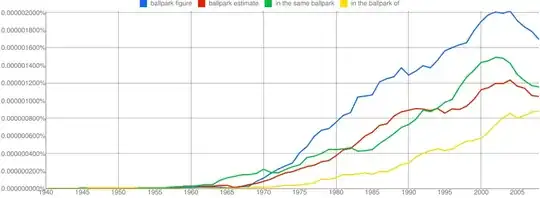
Edit #3:
To get back to the Etymonline entry, I found an interesting article from a 1976 issue of American Speech by Willis Russell and Mary Gray Porter that claims the theory of the figurative use of ballpark originating in 1960 has to do with an actual satellite recovery area in the Pacific Ocean near Hawaii called the "ballpark." The article includes several early 60s references to this location. The authors conclude, however, given new evidence of earlier figurative uses of the phrase, that the U.S. space program was not the origin of ballpark as approximate.

Callithumpian
- 24,764
-
maybe its because baseball stadiums all vary in size and therefore a "ballpark estimate" would mean the size of a ballpark -- something already very roughly defined – Doug T. Jun 02 '11 at 21:57
-
13I've always assumed (without any real support) that it's the difference between "within the ballpark" (this ball is in play) and "out of the ballpark" (it's a goner). To be "in the ballpark" means it's within a range that you can deal with. I think. :-) – Monica Cellio Jun 02 '11 at 22:00
-
@Monica: +1 While I was lost in Googleland, I think you actually answered the question. – Callithumpian Jun 02 '11 at 23:19
-
@Monica Cellio - you should probably enter that as an answer :) – manojlds Jun 02 '11 at 23:45
-
@manojlds, I think it's overcome by @Callithumpian's excellent Google research, but I'll go ahead and add it just because I've never had a comment with more than 2 up-votes, let alone 8. :-) – Monica Cellio Jun 03 '11 at 02:49
-
+1 very good answer. I couldn't have said it better myself. – nohat Jun 03 '11 at 04:47
-
Your Kenneth Patchen example refers to a response to the "way out in left field" comment, which is also a figurative expression. One theory about that expression is that this arose at Chicago's second West Side Park, home of the Chicago Cubs from 1893 to 1915. After the Cubs moved to what is now Wrigley Field, the West Side Park property eventually became the home of the University of Illinois College of Medicine. The U of I built its Neuropsychiatric Institute building in what had been left field. "out in left field" = Crazy. http://en.wikipedia.org/wiki/Left_fielder#Out_of_left_field – Zoot Jun 03 '11 at 14:22
-
1@nohat: Thanks. If you had answered, I'm sure it would have been in the same ballpark. – Callithumpian Jun 03 '11 at 23:45
14
(Submitting this as an answer based on a suggestion in comments to Callithumpian's answer.)
I've always assumed (without any real support) that it's the difference between "within the ballpark" (this ball is in play) and "out of the ballpark" (it's a goner). To be "in the ballpark" means it's within a range that you can deal with. I think. :-)

Monica Cellio
- 18,063
2
I think it comes from the crowd in the ballpark, which is always a rough estimate for the commentators etc.
One school of thought over the saying's origin is that it lies in baseball and refers to the way in which stadium announcers would give an estimated attendance figure for the game.

manojlds
- 161