14

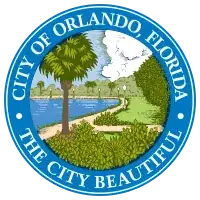
I have always wondered why the motto of the City of Orlando, FL (USA) is worded as The City Beautiful instead of The Beautiful City:

Orlando's city seal

Is The City Beautiful grammatically correct? If so, do you have examples of mottos or common phrases that use the adjective after the noun?

herisson
  • 81,803
Jaime Soto
  • 1,895

5 Answers5

16

This is anastrophe, or more broadly, hyperbaton: a change to conventional word order for the sake of emphasis, in this case poetic effect. The first article mentions the City Beautiful movement specifically. Here, interesting you might find this question.

Jon Purdy
  • 32,386
4

Yes, the phrase is grammatically correct. It is an example of anastrophe, as @Jon Purdy stated.

Here is an example which would negate the conjecture that using the adjective after the noun is archaic usage: The magazine whose title is House Beautiful. This was a popular print magazine and continues to exist in the present as a popular online publication.

Also consider the series of contemporary books by James Herriot (first published in 1972):

  • All Things Bright and Beautiful
  • All Things Wise and Wonderful
  • All Creatures Great and Small

Each of these are examples of adjective following the noun. All are contemporary titles.
  • 1
    "Contemporary titles"? They're lines from a hymn which was written in 1848. – Peter Taylor Jun 04 '11 at 09:44
  • 1
    Yes, I realize that. However they are ALSO the titles of very mainstream books published in the 1970's, which are still popular reading material. – Ellie Kesselman Jun 04 '11 at 09:56
  • 4
    Shakespeare's still popular reading material. That doesn't mean that the language he wrote in isn't archaic. The word order may be perfectly acceptable in contemporary English, but to demonstrate it you need examples which are both contemporary and not intentionally old-fashioned. – Peter Taylor Jun 04 '11 at 10:22
0

"The House Beautiful" was the name of a Victorian movement (a reaction against utilitarian design). Not only is it still understood, the phrase is the title of a magazine and a current radio series.

Tim Lymington
  • 35,168
-1

I think it is archaic;
For example, in Pilgrims Progress(circa 1678), the main character(Christian) stopped at a house called "The Palace Beautiful"

Thursagen
  • 41,919
  • To me it sounds as if Beatiful is meant to be a noun here, not adjective. So The Beautiful City (obviously adjective) and The City Beautiful (probably noun) are different things, although not entirely different in meaning. – Philoto Jun 04 '11 at 05:53
  • Not unless you think along the lines that "The City Beautiful" is a short form of "The City that is Beautiful". – Thursagen Jun 04 '11 at 05:57
  • Yep, something like this. – Philoto Jun 04 '11 at 05:58
  • In The Pilgrim's Progress, I think Beautiful is serving as proper noun. The palace (named) "Beautiful". The country (named) "Germany". Thus it could similarly be "Orlando", the city (nicknamed) "Beautiful". – Ben Voigt Jun 05 '11 at 03:27
-1

Mission Impossible is from "Mission: Impossible" (that is, the word impossible is further clarifying the word mission). Admittedly, you could express "The city: beautiful" in the same way, but I suspect it's as Philoto says instead: beautiful is a noun. Or, more specifically, city beautiful is a noun phrase.

Loquacity
  • 1,988