1

Both "tunable" and "tuneable" seem to be in common usage.

Is there a source which can be used to justify a preference for one or the other for general usage, possibly as a function of whether one is considering a particular nationality or dialect of English?

3 Answers3

2

According to this Google Ngram, "tuneable" was more common in the beginning of the 19th century and then both "tunable" and "tuneable" became less used. After the 1920s, "tunable" has become more prevalent than "tuneable". But I believe both of them are equally correct and which one to use is a matter of taste. "Tuneable" is made from "tune" and "able", if you remove the "e" or not, it has no significant impact on either the meaning or pronunciation of the word.
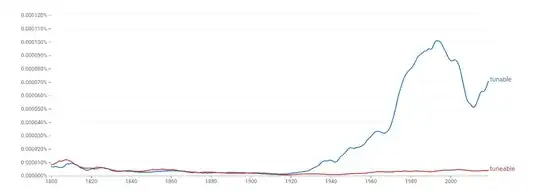
enter image description here

Lexico has both versions. Merriam Webster says "tuneable" is a variant of "tunable".

0

I think you will find the last part of this page helpful. 1

tuneable: It is still not too old-fashioned to cling to tuneable, though sentiment is moving towards the Americanised variant. But by choosing tunable you need to be consistent, which ultimately means adopting aging instead of ageing. Scaleable does not become as clearly readable as scalable -- which is why the British prefers to keep the -e- in its rightful place. Americans only have the choice of tunable, luckily British English retains the -e-. The US variant looks much too "fishy" if you ask me.

  • 1
    This implication here is that "tunable" is more common in American English. – Patrick Sanan Nov 19 '15 at 18:08
  • @Patrick: It's probably true that *loveable* is slightly more likely in current BrE, but as this NGram shows, even Brits have decisively favoured *lovable* for well over a century. I'm sure it'll be the same for all words of that general pattern. – FumbleFingers Nov 19 '15 at 18:34
  • 2
    "Scaleable does not become as clearly readable as scalable -- which is why the British prefers to keep the -e- in its rightful place." Something wrong there: the first clause argues against the -e- but the second argues to keep it. On the score of readability, "scaleable" seems easier to understand because the element "scale" is clear, whereas in "scalable" it isn't even obvious that the first "a" has the vowel of "scale" rather than that of "gala" or that of "balance". Perhaps the author accidentally swapped the two spellings? – Rosie F Feb 08 '20 at 07:19
  • 1
    "But by choosing tunable you need to be consistent, which ultimately means adopting aging instead of ageing. " - I don't think that's true at all. You should be consistent in how you spell any given word, and I would agree that you should probably be consistent about any other words ending in "une", but I don't think every word ending in "e" has to be treated the same way. – nnnnnn Nov 04 '20 at 07:19
0

Lengusa corrects it as ‘tunable’. It has lots of contemporary and credible sources. I would suggest you use ‘tunable’.

https://lengusa.com/sentence-examples/Tuneable