14

A tall tale is a folkloric story that is generally wildly exaggerated and told for the amusement of the listeners. Tall tale tellers usually claim some sort of personal involvement in the story. I was curious about the origin of the phrase itself, and in the course of poking around, I found that tall in this phrase means exaggerated, so "tall tale" means an "exaggerated story."

What I can't seem to find is where this term originated. It seems to be sometime in the middle to late 1800s in the US, but who coined this term? Was it a famous author? Did someone publish a book of tall tales around that time?

(More specifically, the argument revolves around whether or not Mark Twain was responsible, although if it's not him, then who?)

EDIT: According to Etymology Online, tall "meaning 'exaggerated' (as in tall tale) is Amer.Eng. colloquial attested by 1846." (Now I will look to find where it is attested in 1846.)

Another Edit: An additional bit of interest is that a tall tale is considered folklore, and this word (folk-lore) was very famously coined by William Thoms in 1846.

Malady
  • 805
Kit Z. Fox
  • 27,819
  • I always thought that the phrase was a reference to Paul Bunyan, THE "tall tale", but I don't have any references to back that up. – KeithS Jun 27 '11 at 14:55
  • Were tall tales originally oratorical tales, which then spread much like rumors do, resulting in their exaggerated nature? If so, it might be very difficult to pin down when the first usage of "tall tale" was used. Could the term have been commonly spoken prior to its being written? – Eri Jun 27 '11 at 15:54
  • Using tall with tale/story is trivial metaphorical usage that doesn't really justify searching for "first recorded use". Both forms were probably repeatedly re-coined anyway, in speech and writing. – FumbleFingers Jun 27 '11 at 16:10
  • @Fumble My interest justifies it for me. – Kit Z. Fox Jun 27 '11 at 16:33
  • @Eri Tall tales are like a storytelling genre, but the exaggeration is intentional (unlike a rumor) and part of the style of telling. I don't know if it was used in spoken English a long time before it was written, but I suppose it's possible. – Kit Z. Fox Jun 27 '11 at 16:42
  • @Kit: I'm not saying the usage isn't interesting, just that I can't see how you could meaningfully identify a "first use". Here's one from 1855 that has slightly archaic meaning and/or grammar... http://books.google.com/books?id=prY5AQAAIAAJ&q=%22tall+tale%22&dq=%22tall+tale%22&hl=en&ei=6MUIToqtB8_wsgaVgrG5DA&sa=X&oi=book_result&ct=result&resnum=4&ved=0CD0Q6AEwAzgU – FumbleFingers Jun 27 '11 at 18:07
  • @FumbleFingers: That 1855 reference is from the introduction (page xi) of a reprint of an omnibus of two books, one from 1855 and one from 1890. It's impossible to tell when the introduction was written. – Peter Shor Jun 27 '11 at 19:21
  • @Peter Shor: I don't disagree. My substantive point is simply that the expression was around long before the 1920s when it really took off. I'm not trying to get a badge for finding "first use"; I've repeatedly said I think that's a bit of a lost cause. – FumbleFingers Jun 27 '11 at 21:20
  • @FumbleFingers the link you posted in 2011 shows to be dated 1968, Google has since improved their OCR readings, thankfully! http://books.google.it/books?id=prY5AQAAIAAJ&q=%22tall+tale%22&dq=%22tall+tale%22&hl=en&ei=6MUIToqtB8_wsgaVgrG5DA&sa=X&oi=book_result&ct=result&redir_esc=y – Mari-Lou A Dec 10 '14 at 12:37
  • @Mari-LouA - why did you delete your answer? –  May 06 '16 at 12:27
  • One is tempted to suspect that Paul Bunyan had something to do with popularizing the term, though apparently his name was not well known prior to about 1910. – Hot Licks Feb 24 '19 at 23:04

6 Answers6

6

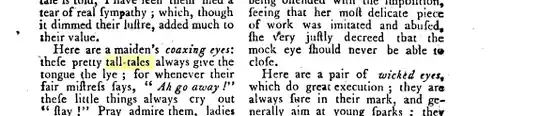
Here's a possible early example from The American Museum for February, 1788:

Here are a maiden's coaxing eyes: these pretty tall-tales always give the tongue the lye ; for whenever their fair mistress fays, " Ah go away !" these little things always cry out " stay !"

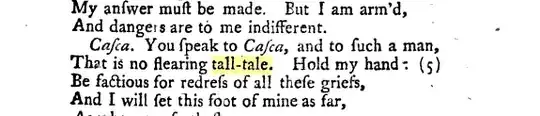
A 1752 printing of William Shakespeare's Julius Caesar includes tall-tale:

You speak to Cæsca, and to such a man, That is no fleering tall-tale.

Modern copies render this as:

You speak to Casca, and to such a man
That is no fleering tell-tale.

So the 1752 was probably a typo, but could the mistake have been influenced by the existence of tall-tale?

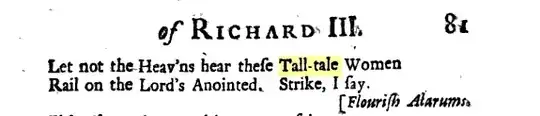
The same applies to this 1714 printing of The Life and Death of Richard III:

Let not the Heav'ns hear these Tall- tale Women Rail on the Lord's Anointed.

Hugo
  • 67,535
3

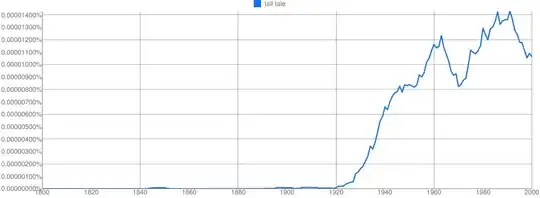
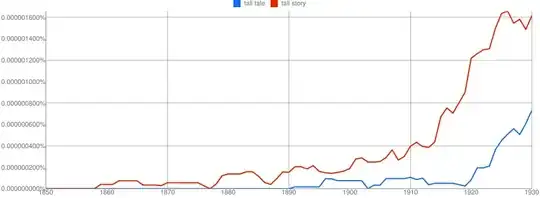
Ngrams show usage since around the right time

enter image description here

and the term definitively has its place in American short story, which was one of Mark Twain's playgrounds. However searching through Mark Twain's writings, gave no results so I wonder if it could have been him.

Wikipedia references points to several interesting sites; tall-tale postcards starting at 1908.

Unreason
  • 12,446
  • 1
    The first two instances I could find of "tall tale" in Google books, 1879 and 1881, were both Canadian. – Peter Shor Jun 27 '11 at 14:31
  • Here's one from London, 1839 http://books.google.com/books?id=soAEAAAAQAAJ&pg=RA2-PA201&dq=%22tall+tale%22&hl=en&ei=RpUITqrIHsmdOvL--d4M&sa=X&oi=book_result&ct=result&resnum=4&ved=0CD8Q6AEwAw#v=onepage&q=%22tall%20tale%22&f=false – Unreason Jun 27 '11 at 14:38
  • @Unreason: that's a typo for tell-tale (although the printed words are clearly tall-tale.) – Peter Shor Jun 27 '11 at 14:39
  • @Peter, yes, agree, just was thinking about it myself – Unreason Jun 27 '11 at 14:41
  • Thanks for the link for searching Mark Twain's body of work — that's a great resource! I guess you are right that he probably didn't come up with this phrase. That's a bummer; I had lunch riding on it. – Kit Z. Fox Jun 27 '11 at 16:37
  • @Kit, but if he did, there is at least an equal chance that he would use it in his writtings for some newspaper, which the above link does not search (?) – Unreason Jun 27 '11 at 18:38
  • @Unreason Well, then. There's still hope for it! Thanks. – Kit Z. Fox Jun 27 '11 at 18:50
1

The more common expression originally was tall story. Here's an NGram showing how the two variants stacked up before the US started getting seriously attached to tall tale in the 1930s... . ...and here's a snippet from the Athenaeum magazine showing that even back in 1870, we Brits recognised the metaphorical tall as American. But as other NGrams show, the US tall tale usage didn't really dominate until the 1940s.

I don't think there's anything remarkable about using "tall" to mean "exaggerated". As to why US usage massively favoured coupling it with tale rather than sticking with the established story, I think Americans just like the partial alliteration better, so it caught on.

LATER as mentioned elsewhere, I don't think it's meaningful to look for a "first use" of the tall tale variant. However, I do suspect that an important factor in its sudden rapid rise starting in the late 1920s may be the Paul Bunyan stories which became incredibly popular around then, and were invariably refered to as tall tales (the fictional character Bunyan was always depicted as a big, tall man).

Mari-Lou A
  • 91,183
FumbleFingers
  • 140,184
  • 45
  • 294
  • 517
  • Thank you for the "tall story" information, but to be clear, I am specifically interested in the first use of "tall tale." – Kit Z. Fox Jun 27 '11 at 16:35
  • @Kit: Per my comment on your question, and the last paragraph of my answer, I really don't think it's meaningful to look for a "first use" of either variant. You'll find "Tall-tale women" in Shakespeare's Richard III, for example. Such transparent metaphorical usage would probably be repeatedly "re-invented" by people who didn't know it as a "stock phrase". – FumbleFingers Jun 27 '11 at 17:29
  • 2
    @Fumble I have only found "tell-tale women" in Richard III. I haven't yet found any reference to "tall tale" prior to the late 1800s (except for typos and OCR errors), and while it might not be meaningful to you to find the first use of the word, it is meaningful to me. – Kit Z. Fox Jun 27 '11 at 17:46
  • @Kit: I stand corrected re "tell-tale", but I still don't think I can help with your search for a specific early usage. The term was clearly around for generations before it suddently took off in the US within a decade or two in the 1920s. – FumbleFingers Jun 27 '11 at 17:51
  • For future posts including NGrams, do you mind adding a link to the search you used? I was wanting to take a peek at what happened post-1930 and it would have been helpful to see the parameters of your search. No biggie; but it would be nice. :) – MrHen Jun 27 '11 at 18:08
  • 1
    @MrHen: Done. I don't know why I never thought to do that before, but in future I'll try to make a point of including the link as well as the chart itself. I only chose that particular date range because I wanted to show what was happening prior to the big rise. – FumbleFingers Jun 27 '11 at 18:14
  • @Mari-Lou: OED has *tall = grandiloquent, magniloquent; high-flown; esp. in tall talk* first recorded 1670. The more specific exaggerated, highly coloured. U.S. colloquial sense is first recorded 1846 as "our Arkansaw friend's stories smelt rather tall". But I still think "first use" is a fairly meaningless concept for this particular usage. – FumbleFingers Dec 10 '14 at 15:39
  • Ahh, I found that entry too in the 1919 OED edition. I think I'm onto something more interesting now, but Kitfox really wanted to know who first created this term , and that I'm afraid, is impossible to find out. – Mari-Lou A Dec 10 '14 at 15:58
  • @Mari-Lou: To repeat - I really do think it's not a matter of saying it would be difficult/impossible to identify who first used *tall* with the exact sense under consideration. It's actually meaningless - like trying to identify the first "human being" (whose parents were obviously not "human", if you want to go down that pointless route). It's easy to imagine a smooth transition from 1374: Quick, prompt, ready, active thru 1450: Comely, goodly, fair, handsome; elegant, fine and 1529: doughty, brave, bold, valiant, followed by later nuances as specified above. It's a continuum – FumbleFingers Dec 10 '14 at 17:01
  • Yes, I appreciate that. And you are right that the meanings of words evolve, and continue a long progression. I did say that your answer had the soundest explanation, but I believe mine will prove to be at least interesting (if albeit meaningless), I've done a fair bit of reading/skimming/scanning online, my answer's nearly done. I'll throw myself to the arena tomorrow. – Mari-Lou A Dec 10 '14 at 17:07
  • 1
    @Mari-Lou: I eagerly await the chance to be the lion to your Christian tomorrow! :~) – FumbleFingers Dec 10 '14 at 17:09
  • You can begin mauling... – Mari-Lou A Dec 11 '14 at 08:45
1

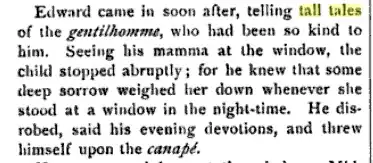
Found this 1873 reference via Michael Quinion's discussion of the phrase. It's from a story called Gentle Hortense; or, the Maiden’s Leap by Emma E. H. Specht:

http://books.google.com/books?id=CUjQAAAAMAAJ&pg=PA475&dq=Emma+E.+H.+Specht&hl=en&ei=bNkMTtG5CNPegQempJThDQ&sa=X&oi=book_result&ct=result&resnum=6&ved=0CEIQ6AEwBQ#v=snippet&q=tall%20tales&f=false

Callithumpian
  • 24,764
  • This is the link to the snippet http://quod.lib.umich.edu/m/moajrnl/acg2248.2-12.005/375:15?rgn=full+text;view=image;q1=tall+tales – Mari-Lou A Dec 14 '14 at 09:44
1

I fell into this looking for the origin of “tall tale”. I was pleasantly amused by the smooth flow of answers & gentle comradery. Everyone so short & precise.

I have difficulty making long stories short, or would it be making tall stories short or small?

I believe the German ‘toll’ has a clear relationship with the Bearlá na Sassenach (Saxon’s Anglish)word ‘tall’. Tall & toll are homonyms.

Central & upstate NYers say Merry Merry got merried. NYCers say Merry Mary got married (Merree mare-ee got Mah(r)reed.)

You all know that English is an Eater of Tongues, right? I believe you are all right, & together have flushed out the pheasant in the blush. Or bloomin’ Bush. It’s tail fathered out like a fan.

Tall, tell, tale are so close it is easy to see them morph back & forth into each other though because at an esoteric level they are related.

English being an obviously young, prominent & the dominant language in the world at this time.

English gobbles up words like a chicken, grain. I foresee a spreading of a form of Chinglish dialect being absorbed into our relatively young English, like all the others it has souped into its stew. However the Chinese might feel. On many levels the proliferation of English & its baby brother, American, a sign the world is indeed shrinking.

I believe you are all correct, IMHO, however I disagree about the word Telltale. A telltale is an informant, a tattletale rat. It implies someone who is a gossip or loose lipped. In the UK & Nothern Ireland they are called
Supergrass. It is supposed to be derived from ‘snake in the grass’ or traitor.

The Irish or Gaelic word for ‘tall’ is ‘ard’, meaning ‘high’ as in Ard Righ(ree) or High King. Probably the root of our word Art as the Latin is a derivative of the Celtic, an older civilization the Romans grew to conquer & absorb.

So tall & high are synonyms. There is also a term (sorry, I’m an hereditary keeper of the lore)High Tales, which indicates it is not going to be a ‘low’ tale, & possibly will be of important & intrinsic value.

High Tales are wondrous & magical. Tall tales are amusing & hopefully enjoyable. What tale are we all serving?

Pin the tail on the... Do tell. Love & Light. Gra agus Solas.

0

Perhaps "tall" comes from German toll meaning amazing, incredible or extraordinary.

ADJ.

1 [UGS.] (großartig) great [INFML]; fantastic [INFML]; (erstaunlich) amazing; (heftig, groß) enormous [RESPECT]; terrific

  • 1
    If that were the case then there would be instance of "toll tales" or "toll stories", I think. Have you found any such things? – Matt E. Эллен Dec 08 '14 at 09:31
  • @MattЭллен but what about its pronunciation? The word tall can be pronounced like toll i.e. /tɔːl/. Is the term tall derived from German? – Mari-Lou A Dec 08 '14 at 11:30
  • @Mari-LouA That's true. I suppose toll could have been converted to tall before ever being written, but such speculation is not particularly helpfull without evidence. – Matt E. Эллен Dec 08 '14 at 11:35
  • Google translates http://de.wiktionary.org/wiki/toll as great. It kinda fits, but yes, a little more evidence would have been nice, but it's not so poor as to merit a downvote IMO – Mari-Lou A Dec 08 '14 at 11:37
  • Lots of German immigrants in the US during the 19th century: German emigration to the United States occurred in three major waves. The first, which came mainly from southwestern Germany in the years 1845-1855, consisted of 939,149 men, women, and children – Mari-Lou A Dec 08 '14 at 11:48
  • @Mari-LouA but the phrase has been around since long before then. Hugo places it as far back as 1714. – Matt E. Эллен Dec 08 '14 at 11:51
  • @MattЭллен he also says tall-tale could've been typographical errors for tell- tale What does OED say for "tall tales"? Presumably Etymonline carries the same dates, which is 1846. Isn't it wonderful how one small comment can actually lead to a possible answer? – Mari-Lou A Dec 08 '14 at 11:55
  • Interestingly, German toll appears to be cognate with English dull, an adjective one certainly hopes not to encounter describing a story. – phoog May 01 '19 at 15:34
  • @Mari-LouA there were many German speakers in the US before the beginning of the 19th century. – phoog May 01 '19 at 15:36
  • @MattE.Эллен Germantown was founded outside Philadelphia in 1683. Also the 1714 instance seems probably to be a misspelling or variant spelling of "tell-tale." – phoog May 01 '19 at 15:49
  • @phoog I posted a very long and detailed answer based on the German/Scandinavian immigration supposition, it was later self-deleted because of the lack of support it generated. After three years, I might consider resurrecting it. I might... – Mari-Lou A May 01 '19 at 15:57