0

I’ve seen this picture of a leaflet being tweeted today. It’s supposedly issued by the UK government and distributed widely:
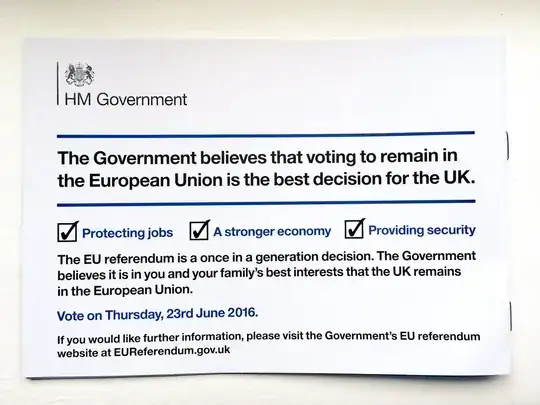
The referendum is a once in a generation decision. The Government believes it is in you and your family’s best interests that the UK remains in the European Union.

Am I overlooking something or does it really contain the grammar error discussed in "You and your" vs. "Your and your"?

I could see the possessive ’s applying to the whole phrase

it is in (you and your family)’s best interests,

because the plural interests wouldn’t properly match singular your, i.e. it’s a short form of either of

  • it is in your best interest and in your family’s best interest
  • it is in your best interest and in your family’s best interests

instead of

  • it is in your best interests and in your family’s best interests
tchrist
  • 134,759
Crissov
  • 949
  • 1
    It's a typo probably. Also, it should read: once-in-a-generation decision. The EU is well known for this kind of scrappy writing. – Lambie Apr 18 '16 at 21:09
  • @Lambie Yes, I would have put hyphens there, too, but then I’m German. I would also have expected either “June 23rd, 2016” or “23 June 2016”, but I’m not well versed in British conventions. Please spare the rants for elsewhere. – Crissov Apr 18 '16 at 21:16
  • 23 June 2106 is usual BrE. What rants? What allows you to say that to me? It is a fact, but I guess that might be not known by a callow youth. There's always time to learn: http://ec.europa.eu/translation/english/guidelines/documents/misused_english_terminology_eu_publications_en.pdf Also, this: please spare us your rants. You can't spare rants for elsewhere. – Lambie Apr 18 '16 at 21:44
  • To me, it's the sort of pedantry that most native English speakers can't be bothered with. Does anybody not understand what it means? – Simon B Apr 18 '16 at 22:14
  • "You and your family" is a common expression, e.g. in "we invite you and your family to join us". It may then be considered as a nominal group, to which the genetive case can be applied, like in "a husband and wife's story". – Graffito Apr 18 '16 at 22:15
  • 2
    @SimonB. When a non-native speaker asks a serious question about correct English usage you should not dismiss this as "pedantry". Some people do actually care about good English. – fdb Apr 18 '16 at 23:33
  • @Crissov The most common UK format for dates is 'day month year' - both 23rd June 2016 and 23 June 2016 are perfectly acceptable & common. The format 'month day year' is more common in the USA. – TrevorD Apr 18 '16 at 23:36
  • 1
    @Lambie You say "The EU is well known for this kind of scrappy writing.", but it's a leaflet from the British Government - not from the EU! – TrevorD Apr 18 '16 at 23:38
  • 1
    @Crissov You state "the plural interests wouldn’t properly match singular your". "Interests" is very commonly used in the plural because each person has multiple interests. – TrevorD Apr 18 '16 at 23:43
  • And while we're pulling the government's leaflet apart, shouldn't the last clause strictly be in the conditional tense: "... that the UK remain in the European Union" (not remains**)? – TrevorD Apr 18 '16 at 23:49

1 Answers1

1

"I could see the possessive ’s applying to the whole phrase"

You are right. This is normal idiomatic English. Like "the girl I used to go with's father".

fdb
  • 5,541