76

President Obama in a press conference, in London today, has said that if Britain votes to leave the European Union and makes separate application to the United States for a trade deal, she will be at the "back of the queue", behind the EU.

Some people assert that Obama has been prompted in his remarks by David Cameron, Prime Minister of the UK, and that the President is really only saying this to do Cameron a favour. (It will be a major political blow to Cameron if he loses the Referendum on 23 June.)

On the BBC programme Any Questions this evening, Nigel Farage, leader of the UK Independence Party, and vehement supporter of Britain voting to leave the EU, said he thought it inconceivable that an American such as Barack Obama would use the word "queue". Americans, he asserted, say "line". So according to Farage, it was not Obama speaking, but, in effect the UK government had written his script for him.

Do Americans use the word "queue", and more specifically does President Obama say "queue"?

Added: A somewhat more complete context for the quote:

He said there could be a US-UK trade agreement “down the line” but warned: “It’s not going to happen any time soon, because our focus is on negotiating with a big bloc, the EU. The UK is going to be in the back of the queue.”

(I can't vouch for the accuracy of the quote, of course. HL)

Hot Licks
  • 27,508
WS2
  • 64,657
  • 62
    Is it so inconceivable that President Obama, knowing he was in London speaking to a UK audience, would deliberately adopt a Britishism in his speech, something that is increasingly common? – Zach Lipton Apr 24 '16 at 18:06
  • Mod notice: Comments are for requesting clarification. They are not for discussion of the question, answers, or politics. If necessary, this question will be locked. – Andrew Leach Apr 24 '16 at 20:16
  • @ZachLipton Speaking personally, no I don't think it is inconceivable, Zach. – WS2 Apr 24 '16 at 21:18
  • 6
    If I spoke in England, I would say "queue" rather than "line" in cases that I believed were appropriate. I simply understand that it's more common there. – user2338816 Apr 25 '16 at 10:06
  • 1
    He could have used the word queue to resonate easier with the intended audience. We British know about queues and like our queuing etiquette; what we don't like is people jumping in front of us for any reason. That's part of the reason Obama has been criticised for the threat of moving us to the back – gabe3886 Apr 25 '16 at 14:50
  • 1
    @ZachLipton He could have said "I .. am .. a .. Londoner!" and see what happened, I suppose. Worked for that other president who pandered to locals in Europe. – corsiKa Apr 25 '16 at 15:33
  • @HotLicks Video is available on Youtube if you want the full context. – richardb Apr 25 '16 at 18:43
  • @ZachLipton That article says 'over “a coffee.”' - erm, what is the American equivalent of "a coffee"? – Jez Apr 26 '16 at 08:15
  • @Jez Possibly without the article? I think Americans would say over coffee. – WS2 Apr 26 '16 at 08:45
  • 5
    This is a commonly known word in the US. Line is more common, but queue is also used. In particular, line is more commonly associated with a physical line (such as people waiting to buy groceries at a cash register), whereas queue is more commonly associated with an abstract or conceptual one. The denotation is the same, and the connotation is loosely the same, but the usage somewhat differs. (Sometimes line will be used in situations where queue would work just as easily; it is a more commonly used word.) – Panzercrisis Apr 26 '16 at 12:57
  • I am quite certain that he would use line rather than queue had he scripted the remark himself. Someone on his speech-writing team probably translated for him. Americans do not use the word queue in reference to "standing in line". I do not hear it in casual conversation, formal speeches, or on television. – gariepy Apr 26 '16 at 14:36
  • putting the word-choice issue aside, the political assertion that barack was catering to Cameron seems far-fetched. The argument barack was making is contrary to Cameron's interests right? – max pleaner Apr 26 '16 at 16:34
  • @macsplean No. It was very much in Cameron's interests. That's the whole point. Cameron is committed to staying in the EU, and if the vote in the Referendum goes the other way, many pundits believe he will be so weakened that he will be forced to resign. In saying that Britain would be at the back of the queue for a trade deal with the US, if she came out of the EU, Obama is effectively warning people against voting to leave. – WS2 Apr 26 '16 at 18:44
  • @ws2 thanks for explaining that. I guess Cameron is neoliberal, not just conservative – max pleaner Apr 26 '16 at 19:44
  • It might be interesting to know that later memoirs admitted this was a muff that happened because Obama was fed the line by his British partners, just as critics alleged. – Casey Oct 06 '21 at 05:06

14 Answers14

80

So, line is much more common in American English, especially when talking about a line that is actually physically embodied. However, queue is not unknown, especially among those with exposure to British English. Whether he was fed the line or doing it as a favor, I can't say, but it would certainly be more than reasonable for Obama to use the British-preferred word when discussing British matters, especially if he was 'aiming' it at a British audience.

I don't see any Obama quotes using it prior, but here's Biden using it in a similar manner in 2014 regarding the Obamacare queue/line

"Get in the queue, now," Biden urged viewers. "Get in the queue. There is still time today."

Per Mr. Farage, this would presumably have been "Get in line" unless he was fed the line then...

herisson
  • 81,803
Dusty
  • 18,931
  • 12
    This is pretty much it. Obama is a politician. Good politicians know to tailor their message to their local audience. Even in the US, we have local dialects which politicians will try to pander to when visiting. For example, how "Missouri" is pronounced depends on what part of the state you are in. It regularly makes headlines when a POTUS candidate uses the "wrong" local pronunciation during a visit. – T.E.D. Apr 25 '16 at 14:41
  • 7
    It's not even about being a politician. Just about anybody who travels on a regular basis will use the local words for things, if they know them, when talking to people in that area. – Kevin Apr 25 '16 at 16:11
  • 8
    @Kevin - Quite. I will never forget the dead silence that ensued when I was with a group of guys in New Orleans in the 80's and a visiting Aussie asked the group if he could borrow a fag. – T.E.D. Apr 25 '16 at 17:16
  • 6
    @T.E.D. Had a similar incident where a visiting British student got irritated with some boys who had teasingly taken her notebook and demanded that they give her back her "bloody pad" – Kevin Apr 25 '16 at 17:44
  • 5
    Particularly if he used the phrase "down the line" just prior, because reusing line to mean something different wouldn't be good style. – Sobrique Apr 25 '16 at 18:35
  • I don't think the last sentiment adds value to the answer, especially given the examples provided in another answer. – Nate Diamond Apr 26 '16 at 00:25
  • @NateDiamond: Your comment does not seem to make sense. The last line of the answer is saying that, by Mr. Farage's logic, a British person must have coached Mr. Biden on his utterance in a completely unrelated context, which is absurd. Hence we conclude that Mr. Farage is being silly. – Nick Matteo Apr 26 '16 at 14:22
  • @T.E.D. - The problem I see with that statement is the word "borrow". I don't smoke, but my understanding is that cigarettes are pretty much single-use commodities. I don't think anyone is going to want it back when you're done with it... – Darrel Hoffman Apr 26 '16 at 14:53
  • It's not at all uncommon for Americans to use the word "queue," especially when describing a CONCEPTUAL "line" rather than a literal line. Americans would almost never use "queue" to describe a literal line of people who are waiting for something. However, it's quite common to use "queue" (I'd argue MORE common than "line") to describe an abstractified system whereby people are batched. All of which is to say, President Obama's comment was not even slightly out of character for an American. Whether or not he was prompted, remains unanswered ;-) – mHurley Apr 26 '16 at 15:20
  • @Kundor Ah, that's not how I read the comment. I read the comment as agreeing with Mr. Farage's logic given the concessions listed in the earlier part of the answer, specifically "I don't see any Obama quotes using it prior". I can see that it can be read without bias toward Mr. Farage and simply be acknowledging his position. As such, I rescind the comment but believe it could be better worded to remove confusion, given that it is the accepted answer. – Nate Diamond Apr 26 '16 at 15:57
  • @DarrelHoffman - Two things here. 1) Sharp eyes there. That isn't the word he used. I don't remember the exact word (it was 30 years ago), and I didn't want to invent my own Aussie lingo. 2) In the USA at least "borrow" is the typical word used ("bum" is also used). I'm not a smoker either, and it always struck me as odd too. I'm guessing the implication is that one day when the requestor has a pack on them, they will reciprocate. – T.E.D. Apr 26 '16 at 16:21
  • @T.E.D. Also heard: "borrow a rubber" (misused in the US), "fancy a shag?" (misused in the UK). When I was in Australia, I was asked if this "thong" was mine (a flipflop), while I once heard someone in the UK talk about "having a fag behind the bikeshed at school." – Joel Apr 26 '16 at 19:36
  • @T.E.D.: Good politicians have people who write their speeches - and those know ho to tailor the speeches to the right public. So when in England, speak British English. :-) – Martin Schröder Apr 29 '16 at 08:56
67

I agree with those who have said it is more likely he used 'queue' in preference to 'line' after speaking to advisors. But it's also interesting to note that Obama seems to like the word. He's used it a few times before, and in a non-British context:

February 25, 2010 Remarks in a Discussion on Insurance Reform at a Bipartisan Meeting on Health Care Reform: "Okay, all right. There were several people who were still in the queue who didn't have a chance to speak prior to us breaking."

November 13, 2011 The President's News Conference in Kapolei: "Could I just say that Chuck's the only guy who asked two questions so far. So just--when I cut off here, whoever was next in the queue--[laughter]--I'm messing with you, Chuck."

November 19, 2013 Remarks to the Wall Street Journal CEO Council and a Question-and-Answer Session: "We've got to make sure that we have a legal immigration system that doesn't cause people to sit in the queue for 5 years, 10 years, 15 years, in some cases, 20 years. "

So, to answer your question, there's nothing unusual or sinister in Obama's use - it seems part of his idiolect.

T.J. Crowder
  • 2,125
tardy pigeon
  • 755
  • 4
  • 8
41

"Queue" was used, in the reported statement, in the sense of a "priority" ordering of the elements, and that sense is perfectly idiomatic US English. It's saying, in effect, that the UK would have the lowest priority.

This is different from saying "I had to stand in line for hours to order the new iPhone."

And "queue" is well-known and understood in the US, at least in government. From the Congressional Record, Jan 21, 2015:

Mr. McCONNELL. We were able to process several amendments to the Keystone bill today, and there are now seven more in the queue and pending. Senators should expect votes related to amendments to this bill throughout the day tomorrow.

March 2, 2007:

With regard to moving forward on this legislation, I encourage Members on our side of the aisle who have amendments to come down, get them in the queue. We will have a number of amendments, as the majority leader has indicated, next week. The best way to proceed, if a Senator is on this side of the aisle and has an amendment, is to come on down and offer it and get it in the queue.

Jan 26, 2015:

Ms. MURKOWSKI. Mr. President, we continue to talk to Members on both sides of the aisle to set up a path toward passage on this bill that will include some amendment votes on pending amendments and others that are waiting in the queue. We will look to set some of those votes tomorrow after lunch.

Sept 5, 2006:

Mr. FRIST. Mr. President, today we continued debate on the Department of Defense Appropriations bill that we started before the August recess. We have three amendments pending, and we expect to have more amendments offered tomorrow. Votes can be expected before the weekly policy luncheons and throughout the day. We will work to finish this important spending bill no later than tomorrow or Thursday. Members who have amendments still to offer to this bill should consult with the bill managers to get their amendments in the queue. Again, I welcome my colleagues back from the recess. We have a lot of work to do, as I outlined earlier this morning, over the course of the next several weeks, and we can expect some very full days.

(And about 430 others. I think this decisively destroys any argument that "queue" is unknown in the US or is only known to "techies".)

Hot Licks
  • 27,508
  • 2
    Please provide support. Yes, I know you are older than my T-shirts, and yes, you are 100% born and bred in the US but... "back of the queue meaning" last in priority is a meaning with which I am unfamiliar. – Mari-Lou A Apr 22 '16 at 20:25
  • 5
    @Mari-LouA - Then you're not very "up" on US English, are you? – Hot Licks Apr 24 '16 at 21:45
  • 2
    @Mari-LouA - I have to agree with Hot Licks. I would say that "back of the queue" meaning last in priority or wait your turn is fairly common in BrE. – TrevorD Apr 24 '16 at 22:19
  • @TrevorD - I don't think Mari-LouA is claiming anything about what :back of the queue" means in BrE. Just whether it's common in US. And certainly where I grew up you would get a strange look (and then mocked) if you said queue. – Joel Apr 26 '16 at 19:39
21

"Line" is used rather than "queue" for these purposes in American English, but in a technical, rather than colloquial, context, the term "queue" gets used all the time. As an American computer programmer, I work with queues and queued data on a regular basis, and I would never use the word "line" in that context. But if a person is being sent to the back of something, it's a line, not a queue. Using the term "queue" in that context will definitely sound like a British-ism to American ears.

Mason Wheeler
  • 1,546
  • 5
  • 17
  • 25
  • 2
    +1, but we're talking about a country (an "object" in programming parlance), not a "person". I'm pretty sure I would have used the word queue had I been saying the same message. – phyrfox Apr 22 '16 at 21:09
  • @phyrfox Yes, but you don't "send an object to the back of" a queue; you insert it into the queue and it gets placed at the back. The notion of pulling someone/something out of line and sending them to the back is nonsensical in the context of a computer science queue. – Mason Wheeler Apr 22 '16 at 21:36
  • 2
    @MasonWheeler How fortunate, then, that Obama did not talk about a queue in the context of computer science. – pipe Apr 23 '16 at 07:59
  • 3
    For the record, what he said was, "[T]he UK is going to be in the back of the queue." I don't know where the "sent to the back" phrase came from, but it doesn't appear to come from that speech. In fact, the UK (as a separate entity) is not in "the queue" at all at this time; Mr. Obama was referring to a hypothetical future time after the UK left the EU, at which time they might want a trade agreement of their own. – David K Apr 23 '16 at 15:32
  • 5
    I do suspect, however, that the use of the word "queue" was influenced by the fact that Mr. Obama was speaking to a British audience and he wanted to be understood. – David K Apr 23 '16 at 15:47
  • 1
    I find it astounding that the number of users who argue that "queue" is commonly heard and used in the US is in fact talking about computer science terms. I know next to nothing about the working of a computer, and even less about mathematics (see WS2's comment beneath Hot Lick's post) and I bet my bottom "dollar" that the majority of Americans do not either. Please, let's remind ourselves that not every user or visitor to EL&U comes from Stack Overflow. This small piece of information is also relevant to the British general public. – Mari-Lou A Apr 24 '16 at 12:30
  • 1
    Consider what the commentators would have made of it if Obama had said something like "the UK will be at the end of the line" (or could be distorted that way), since "end of the line" is US idiom for "all washed up". I'm guessing that Mr. Obama is careful to avoid getting close to that idiom. – Hot Licks Apr 24 '16 at 21:44
  • @HotLicks - To be at the end of the line is not the same as to reach the end of the line. They are completely separate idioms with completely different meanings. – aparente001 May 30 '17 at 16:27
12

As a software engineer in the US, I use the word "queue" all the time. Back when most people who subscribed to Netflix used the DVD delivery service, we called it a "queue." I think it's conceivable that the President, being a literate person, would believe that "queue" is the best word to use in this case just because it indicates a priority ordering. It is also conceivable that he knew who the audience was, and tailored his speech for them. It is also conceivable that he had a speechwriter or some other handler suggest that he use it, or that he was directly quoting something David Cameron asked him to say.

It's all conjecture, but I think he very likely could have used the word "queue" for plenty of reasons besides "someone else told him to."

thomij
  • 221
9

Does President Obama say "queue"?

I'm not sure. But I'd like to address the other part of the question, which is:

Do Americans use the word "queue"?

Do you know of any idiomatic alternatives for a phrase like "message queued for sending"?
I can't think of any. That sentence already seems 100% idiomatic American English to me.
So yes, most Americans would know what "queue" means.

user541686
  • 2,229
  • This is rather different from the use in the quote, though. I would only use queue in technical contexts like these. – Casey Apr 24 '16 at 17:37
  • 1
    I'm a programmer, so I understand "message queued for sending" — as computerese.  I don't recognize it as idiomatic American English (I have lived in the US all my life), and I don't know whether the average US butcher, baker, or candlestick-maker would understand it. – Scott - Слава Україні Apr 26 '16 at 19:06
6

For a general british audience 'queue' and 'line' are certainly not synonymous. Most british people would understand it in context but it has much less impact as a headline.

This is also different from things like faucet vs tap or fall vs autumn where the difference in transatlantic usage would be obvious.

So this seems very much like a key phrase being disambiguated for the target audience. It is entirely possible that President Obama asked for advice on how best to phrase this, and it may even be a phrase that he had heard said to him.

This certainly doesn't in any way suggest that it was a script written by somebody English. Indeed it would be strange if the president of the US didn't have advisors who would be able to fine tune prepared speeches in this way. In the same way that he would probably hold back on references to bacon and bourbon in a speech delivered in Saudi Arabia.

Similarly even if he has some prompting on the wording it seems unlikely that the President of the US is going to be 'forced' to say something on this matter that he doesn't agree with on principal. Even if he asked an aide or a UK minister how best to say it he did, at the end of the day get up and say it himself.

Chris Johns
  • 1,141
  • 2
    +1, though I don't really even think an advisor would be needed in this case. As far as I know, it's rather common knowledge among Americans that British English uses 'queue' instead of 'line' (whereas American English uses both terms interchangeably.) – reirab Apr 22 '16 at 22:26
  • 3
    Yes I certainly get the impression that President Obama is certainly well educated and informed enough to work this out for himself. – Chris Johns Apr 22 '16 at 22:33
  • You miss the point that the usage was completely idiomatic US English. – Hot Licks Apr 22 '16 at 23:31
  • 4
    I suppose you meant to write "fall vs autumn." – Dubu Apr 23 '16 at 08:39
  • @HotLicks According to whom? It sounds strange to me. – Casey Apr 24 '16 at 17:38
  • @ Dubu haha yes, well spotted, I have now corrected that error. As an aside there are a few areas of Britain (specifically Cornwall) where fall is still sometimes used for autumn. – Chris Johns Apr 24 '16 at 19:54
  • 1
    @HotLicks Re your edit to the question, of course had he said it in the British idiom he would not have said *the UK will be IN the back of the queue", but "AT the back of the queue". – WS2 Apr 24 '16 at 21:27
5

I'm sure Obama knows the distinctions between British and American English on 'queue' and 'line'. He is noted for his oratory skills, so I am confident that he chooses his words in light of his audience. It is unlikely that he would use the word 'queue' speaking to an American audience, but I would be surprised to hear him use the word 'line' when addressing British media, especially in prepared comments.

When a foreign head of state is speaking to US media, I expect them to speak some variety of English. What is so unusual about Obama speaking British English to the British?

Joel
  • 222
5

Does President Obama say "queue"?

Here's some evidence.

There are 358 speeches and press conferences by Barack Obama on this website. I'm not sure how they decide which ones to transcribe. Collecting all the speeches there, out of 1,162,735 words it seems he's publicly said "line" at least 130 times and never "queue."

Anyway I think it's pretty common for politicians to make nods to local language. For example, there's a bit of Spanish in there too, like when he went to Cuba he referred to "un future de esperanza" [a future of hope].

Edit: As pointed out by @slebetman, @tardy pidgeon's answer has some examples of Obama saying 'queue'. The press conferences in that answer don't appear in this database. As above, I don't know how the site selected the set of events that it did.

4

It's quite possible that politicians use different varieties of English in different countries.

For example, Tony Abbott, who is generally perceived as less intellectual and less internationally-minded than Obama, and therefore less likely to use different varieties of English in different countries, nonetheless gave the following anecdote differently in a speech given in Australia compared to one given in Japan, which tends to use American English. In Australia, he used the Australian English "car parks", whereas in Japan he used the American English "parking lots"

PRIME MINISTER - ADDRESS AT CEDA'S 2014 STATE OF THE NATION CONFERENCE, PARLIAMENT HOUSE, CANBERRA

Prime Minister Menzies for instance opened up trade with Japan at a time when Japanese cars were still banned from RSL club car parks.

TRANSCRIPT OF THE HON. TONY ABBOTT MP, ADDRESS TO THE JAPAN INSTITUTE OF INTERNATIONAL AFFAIRS, TORANOMON MITSUI BUILDING, TOKYO

Back in the 1960s, there were veterans’ associations in Australia that tried to ban Japanese cars from their parking lots because of understandable feelings about the war – but our countries’ leaders, I’m pleased to say, were bigger than that.

(He also gave a description of the RSL in the speech given in Tokyo, rather than mentioning it by name)

If Tony Abbott can use a different variety of English, it's very plausible Obama could as well.

Golden Cuy
  • 18,154
3

He DID say "queue". If I (British) visited New York, would I ask "Where's the elevator" or "Where's the lift?". Would you try to extract any deep meaning from my choice? Would I be accused of "cultural appropriation"? Is there any point whatsoever in this topic, other than a chance for us to display our political agendas?

Laurence
  • 659
  • 3
    The purpose is to test the assertions from some quarters that Obama's use of queue illustrates that he was primed by the UK government. – WS2 Apr 24 '16 at 13:02
2

I don't know who wrote those lines, but queue is used in in AmE:

  • a ​line of ​people or things ​waiting for something:

    • There was a ​long queue for ​tickets at the ​theater.

(Cambridge Dictionary)

Ngram: queue in AmE vs BrE.

  • I so find these NGrams odd at times. Are we really to accept that prior to 1920 Britain hardly used the word queue? I have no evidence to show it is wrong, but it seems unlikely to me. – WS2 Apr 22 '16 at 20:13
  • 1
    The word "queue" is used in American English, but is is less commonly used than "line" in expressions like "stand in ___" or "back of the ___." – herisson Apr 22 '16 at 20:15
  • 2
    See this Ngram: https://books.google.com/ngrams/graph?content=back+of+the+line%3Aeng_us_2012%2Cback+of+the+queue%3Aeng_us_2012%2Cback+of+the+line%3Aeng_gb_2012%2Cback+of+the+queue%3Aeng_gb_2012&year_start=1800&year_end=2008&corpus=15&smoothing=3&share=&direct_url=t1%3B%2Cback%20of%20the%20line%3Aeng_us_2012%3B%2Cc0%3B.t1%3B%2Cback%20of%20the%20queue%3Aeng_us_2012%3B%2Cc0%3B.t1%3B%2Cback%20of%20the%20line%3Aeng_gb_2012%3B%2Cc0%3B.t1%3B%2Cback%20of%20the%20queue%3Aeng_gb_2012%3B%2Cc0 – herisson Apr 22 '16 at 20:15
  • @WS2 a it was common also before 1920, https://books.google.com/ngrams/graph?content=queue%3Aeng_us_2012%2Cqueue%3Aeng_gb_2012&year_start=1800&year_end=1920&corpus=15&smoothing=3&share=&direct_url=t1%3B%2Cqueue%3Aeng_us_2012%3B%2Cc0%3B.t1%3B%2Cqueue%3Aeng_gb_2012%3B%2Cc0 –  Apr 22 '16 at 20:16
  • @sumelic - the point is not which is more common (line off course) but if queue is used in AmE. –  Apr 22 '16 at 20:18
  • @Josh61 So what the NGrams appear to be saying is that the use of queue took off in Britain during the first world war. It could be logical I suppose, since it is a French word. Though strictly in French it means tail (of an animal), and is not as extensively used to mean a waiting-line as it is in English; file d'attente is also quite common. – WS2 Apr 22 '16 at 20:25
  • 1
    @WS2 - Queue: late 15c., "band attached to a letter with seals dangling on the free end," from French queue "a tail," from Old French cue, coe "tail". *The Middle English metaphoric extension to "line of dancers" (c. 1500) led to extended sense of "line of people, etc." (1837).* http://www.etymonline.com/index.php?term=queue –  Apr 22 '16 at 20:28
  • 1
    @WS2 This sense of queue is a late development in English; it was originally used for a 'tail' and later for a 'pigtail'. If you consult OED 1 you will find that the earliest citation is from 1837, and all the citations have a French context; one, from 1862, actually puts the word in italics as a foreign word. The fascicles in the Q volume were published in 1902-1910. – StoneyB on hiatus Apr 22 '16 at 20:32
  • @StoneyB Not sure why I didn't go for the OED, as that's usually my first port of call. But you are perfectly right. Interestingly these two examples confirm the comment below in response to Hot Licks. 1958 Listener 20 Nov. 839/3 After the war the railways had to take their place in the queue after housing and housing repairs. 1977 Spare Rib May 19/4 Women in poor areas are always at the end of the queue for anything. – WS2 Apr 22 '16 at 20:51
  • 3
    Maybe it's the example...at least in the US Midwest, we'd say "There was a ​long line for ​tickets at the ​theater". – Kristina Lopez Apr 22 '16 at 22:40
  • 1
    Just because a word is in the dictionary doesn't mean it's widely used. As for that ngram, that shows a large spike in usage right around the advent of computing, so I'm guessing most of those hits have nothing to do with "back of the line" usages. – J.R. Apr 24 '16 at 09:10
  • 1
    @J.R. - all AmE dictionaries recognise their meaning and usage. I didn't say it is widely used but that is is used. –  Apr 24 '16 at 09:14
  • @sumelic I guess this is an aside, but what is with the explosion of "back of the line" in American sources around 1920? – Casey Apr 24 '16 at 17:45
  • It's funny you would quote Cambridge to justify American English usage. Why not use Collins or an actual American dictionary? – Octopus Apr 25 '16 at 16:49
2

On this question, a swarm of Stack Overflow users and computer experts have talked about queries and queues, as if everyone knew what they meant. Specialized language is not the language of common folk, and this is true for university level mathematics and computer science jargon. Maybe very soon everyone will be familiar with these terms and how they are used, but what about today? It is a given that Americans will largely prefer: line, or line up over queue.

So, who can say for certain that the US President Obama's expression choice in the back of the queue did not refer to the UK being physically, or metaphorically, "at the end of a line/queue"?

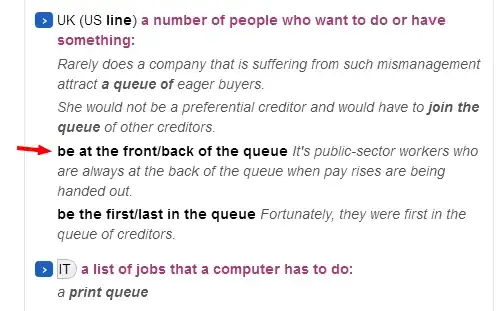
Cambridge Dictionaries cites on the Business button
enter image description here

queue
• UK (US line) a ​number of ​people who want to do or have something: be at the front/back of the queue It's public-sector ​workers who are always at the back of the queue when ​pay ​rises are being handed out.

No one is denying that Americans "know" the term queue, but there is overwhelming evidence that suggest Americans will say ‘line’ over ‘queue’

American English
Google results for line at the movie = 672,000
Results for waiting in line at the movie = 65,400
Results for waiting in line at the cinema = 32
Results for queue at the movie = 39
Results for queue at the movies = 33

British English
Results for queue at the cinema = 14,500
Results for cinema queue = 6,060

Elsewhere on EL&U we have:

  • In US English, the thing is: a line

To be on it is

to wait in line

To add to it is:

to get in line

@Mitch

Furthermore,

  • As badroit notes, queue is more common in British English whereas line is more common in American English in non-technical settings. @choster

Ergo Americans will prefer queue in technical situations. Likewise, computer scientists in anglophone countries will be familiar with its meaning of priority.

Wikipedia has a page dedicated to Queue (abstract data type). Emphasis in bold mine

In computer science, a queue (/ˈkjuː/ kew) is a particular kind of abstract data type or collection in which the entities in the collection are kept in order and the principal (or only) operations on the collection are the addition of entities to the rear terminal position, known as enqueue, and removal of entities from the front terminal position, known as dequeue. [...]
Queues provide services in computer science, transport, and operations research where various entities such as data, objects, persons, or events are stored and held to be processed later. In these contexts, the queue performs the function of a buffer.

Four days later ...

On the issue of whether President Obama was fed the expression (by his advisors or even by the British government) The Washington Post reports

Obama was simply repeating a warning made before by U.S. officials: that the U.S. is not interested in bilateral trade deals with individual countries, and that they would focus instead on deals with larger organizations like the E.U. However, the president's choice of words when making this point left many gobsmacked. The president of the United States had used the word "queue," typically used by Brits, rather than "line," considered the proper term in American English.

Twitter response

The first three twitter comments printed by the Post:

  1. First time I've ever heard an American say queue.
    Harry Cole

  2. Re Obama, no American I know, including those in UK uses word "queue", it's "line". Giveaway "back of the queue" is scripted line
    Vincent Moss

  3. "Back of the queue"? Wouldn't that be "back of the line" for an American? Maybe No.10 dipped their quill into this speech...

Further on, the newspaper adds

Okay, it's certainly true that queue is used relatively rarely in American English: As the Oxford English Dictionary says in its listing for the word, it is a "chiefly British" word. But this isn't exactly a smoking gun. As James Ball of Buzzfeed UK was quick to point out on Twitter, Obama has actually used the word "queue" a number of times before.

It then lists three instances

  • (2010) "There were several people who were still in the queue who didn’t have a chance to speak prior to us breaking."
  • (2011) Could I just say that Chuck is the only guy who asked two questions — so far. So just — when I cut off here, whoever was next in the queue — I’m messing with you, Chuck."
  • (2013) We’ve got to make sure that we have a legal immigration system that doesn’t cause people to sit in the queue for 5 years, 10 years, 15 years — in some cases, 20 years."
    [...]
    …in none of the above examples was the president being used to trick British people to not act in their own interest. In fact, Obama has something of a habit of using British English. According to Not One-Off Britishisms, a blog run by University of Delaware English professor Ben Yagoda with the aim of catching the British English that enters into American daily life, the president has also been caught saying things like "full stop," "run to ground" and "take a decision."

By Adam Taylor April 23

Mari-Lou A
  • 91,183
  • 4
    How does this address the question? We all agree that "line" is what you stand in (in the US) when waiting to get into a movie. The word "queue" was used in a different sense by Mr. Obama. – Hot Licks Apr 24 '16 at 13:38
  • Search results from StackOverflow for "a queue" 24,626. So Obama was using a highly technical term with the general British public? No, he was using a term which the British were particularly comfortable and familiar with. – Mari-Lou A Apr 24 '16 at 14:36
  • 2
    Sorry, you're not making any sense. (Or are you arguing that "making sense" highly technical?) – Hot Licks Apr 24 '16 at 14:38
  • StackOverflow records 178,971 results for queue without the article, and this question is currently in the Hot Network Questions on SO. This explains the high number of views, the high number of upvotes for those answers which cite the computer science meaning of the term. – Mari-Lou A Apr 24 '16 at 14:54
  • Yeah, I think this is totally being skewed by the userbase here. – Casey Apr 24 '16 at 17:43
  • 1
    Yeah, Senator Mitch McConnell is a well-known computer geek who's all up on the latest "highly technical" geek terminology. – Hot Licks Apr 25 '16 at 22:31
1

If you look at the entire quote, you'll notice that it already contains the word line (“down the line”).  Maybe he deliberately chose to avoid using the same word twice (in different contexts) in adjacent sentences.