6

1580 alphabet from Bullokars Booke at large, for the amendment of orthographie for English speech

Second row, all the way to the right. Does this glyph have a name? I am unfamiliar with it and had never come across it before. Page 21 in Bullokars Booke at large, for the amendment of orthographie for English speech .. by Bullokar, William, fl. 1586

https://archive.org/stream/bullokarsbookeat00bull#page/21/mode/1up

I might be able to find the answer in the book, but the gothic/blackletter takes me a while to figure out.

Dan Bron
  • 28,335
  • 17
  • 99
  • 138
  • Is it a glyph, or is it the name of the letter? I wonder if the table is "names above, letter below" - so you have two forms of l, c/f the two forms of c for the hard (kee) and soft (cee). You have a similar construct for m - the straight m character and then the um style, just like the ul you mention. Just a thought. – Prof Yaffle May 11 '16 at 20:41
  • It looks like the title of the table is "The names of the letters next before shewed, appeire [or apperre] in this following table" – J.W.D.K. May 11 '16 at 20:47
  • Yes, that's why I wondered... if it's differentiating between two forms of l and treating them as separate letters. The glyph is therefore just trying to say "this use of the letter l is called {blob}". – Prof Yaffle May 11 '16 at 20:49
  • It looks like a proposal for a new spelling system for English, so it wouldn't surprise me if this glyph was invented by the author. But perhaps not. Interesting question! – herisson May 11 '16 at 20:50
  • 1
    There's also an "acute accent" after the second form of m and n, which I wonder is the top-right squiggle on that form of l. That suggests consistency with the other consonants, if nothing else (and, likewise, the cedilla-like accent under the "numerator" character in each). – Prof Yaffle May 11 '16 at 20:51
  • If it were parallel to other forms, it would just be the letter l with an acute accent on top. (Oops, Prof. Yaffle beat me to it... great minds think alike!) – herisson May 11 '16 at 20:53
  • I've just never seen it alongside yogh, thorn, eth, wynn, etc. So, is it a letter? Is it abbreviation? – J.W.D.K. May 11 '16 at 20:55
  • @sumelic Exactly. The top line in each cell represents a context in which the approximate pronunciation appears and the lower the proposed character. Bullokar was one of several Elizabethans who activated for a new English orthography. – StoneyB on hiatus May 11 '16 at 21:29
  • @sumelic You might be interested in the quote from Bullokar here. – StoneyB on hiatus May 11 '16 at 21:36
  • It's worth scrolling back a page in the linked document... my (somewhat rusty) (slightly post-) mediaeval English suggests that it is, indeed, a table of revised orthography with the names and sounds of the proposed graphemes/phonemes. He talks about how other characters are used in other languages, and goes on to propose usage for English as a result. (I'm left genuinely fascinated by all this, by the way...). So, it's not a glyph, so much as simply a name - "el", if you like. – Prof Yaffle May 11 '16 at 23:07
  • Also, note the 40th character - "zée" - will the madness never stop? What next, no "u" in "colour"? :) – Prof Yaffle May 11 '16 at 23:08

2 Answers2

3

As Prof. Yaffle mentions in the comments, if it were parallel to other forms, it would just be the letter l with an acute accent on top. I've never seen this form used for this purpose, but then again, l with an acute is not common, so it's possible that this form existed before Bullokar's book, and has only fallen out of use in modern times. L is the only letter out of l m n r with an ascender, so it makes some sense to use a different form of the accent with it: this occurs for the háček in many languages (some examples: Ľľ Ťť Ďď Ňň).

Then again, he seems to describe it differently from the other letters: on page 12, he describes it as having "a turne neere the top of it," while m and n are described as having "a strike over the middle." In any case, I will use ĺ to represent it in the rest of this post.

In terms of what sounds it was meant to represent, Bullokar describes this set of letters as "half vowels":

Lastly remain three: ĺ,ḿ,ń, called halfe vowells, because in their sounde is included both a vowell and a consonant : but either of them so short touched, that both yeelde but the time of a long vowell : to these adde, ŕ, with his paier, as is before saide : this, ŕ, is of no great necessity, but for conference with the olde : re : at the ende of a sillable,and helpe in equiuocy. (page 22)

There are some examples later on. The letter "ĺ" seems to be able to represent multiple values:

  • "baĺḿ" represents balm, "baĺd" represents bald, and "caĺ" represents call. Here it does seem to represent "dark l." However, a normal "l" is used at the end of the syllable in other contexts, such as "bál" bale, "hél" heel, "elḿ" elm, and "bowl" bowl; all of these words also have dark l, at least in modern English. (I don't know if dark and light l had a different distribution in the past). Oddly, Bullokar distinguishes "baĺḿ: ointment" from "baulḿ: erb." He also distinguishes "caĺ" from "cau̧l, for the hed" and "cawl abou̧t the bo̧wellż."
  • In other cases, it seems to represent a syllabic l, as in "litĺ" little.

Bullokar describes it as follows:

ĺ, ḿ, may make a triphthong with another vowell before them, as in: caĺḿ: in Latine, Tranquillus, in French, Calme: eĺḿ-tré, in Latin, Vlmus, in French Orme: hóĺḿ, in Latine, Ilex, in French, Yeuse: but the voice doth rather yeeld, l: in, elḿ-tré, and in, holḿ, with accent ouer: o. (page 25)

I'm not really sure what to make of it. It seems that Bullokar may have been in favor at this point of using distinct spellings to differentiate homophones ("equivocy") so even though he uses distinct spellings for "caĺ," "cau̧l," and "cawl," I think they were supposed to represent the same sound.

Bullokar seems to say that "aĺ" and "au̧l" represent the same sound in a table on page 23:
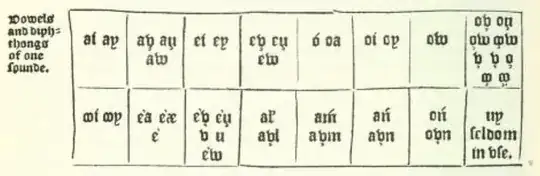
enter image description here

herisson
  • 81,803
2

it's a dark l

note that the l in lab and the l in ball are distinct

the second includes a raising of the base of the tongue

the two sounds map to one phoneme in English, in many other languages they are separate sounds/letters/basic units

there is to my knowledge no other separate term in English, and the term dark l refers to the sound not the glyph

chris
  • 123
  • regarding sumelic; yes it clearly is more complex than I realized

    I wonder if it has something to do with syllable weight? perhaps for poetic metre?

    – chris May 15 '16 at 00:52
  • I think it's serving double duty as a symbol for syllabic l, and as an abbreviation for the two-letter sequence "ul" in other contexts such as after "a." I don't know why Bullokar uses spellings like "eĺḿ" though. – herisson May 15 '16 at 00:58
  • What was Bullokar's context? This is the first I have heard of him. – chris May 15 '16 at 01:01
  • I don't know much either! Stoney B left a useful comment: http://english.stackexchange.com/questions/325007/any-idea-about-this-ul-glyph-from-1580s-book-on-orthography/325747?#comment739860_325007 – herisson May 15 '16 at 01:09
  • Thx that helps somewhat. I have always had trouble with the Elizabethan grammarians. – chris May 15 '16 at 01:16