I would like to know what is the name of the area within a trace italienne fortification, i.e. item 38 in the image here below (which unfortunately was omitted in Wikipedia):
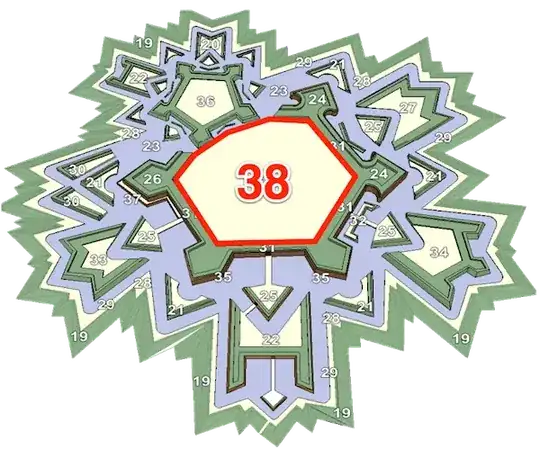
I would like to know what is the name of the area within a trace italienne fortification, i.e. item 38 in the image here below (which unfortunately was omitted in Wikipedia):


I think this area is called a bailey. A bailey can refer to the courtyard or the defensive wall that surrounds it.
Or it might be considered a ward, since it is inside the curtain walls.
And apparently, a ward and a bailey are the same thing.
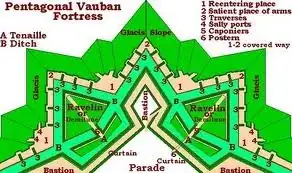
Or it seems that it can be called a parade ground, as @F'x indicated and in agreement with this diagram:
UPDATE:
I was talking about this with a Dutch friend and he helped me find this page, which identifies area 38 as the vesting or fortress. Additionally, the entry identifies the flat terrain within the bastion, fort, or fortress as the terreplein. However, this is apparently the Dutch definition, since the English definition of a terreplein is substantially different.

A lot of these terms come from different languages and are used in different places for slightly different things.
It's hard to define the "inside" of castles because most of them are not neat, simple polygons. Some use natural cliffs as part of their structure, and most have several areas of defense. The basic idea was that beleaguered defenders in the outer areas could fall back in an orderly fashion to inner areas with their own perimeters; usually, the process was more chaotic.
Castles had to be operating trade, construction, and logistics centers most of the time, and this affected their defense design. For example, more gates make trade easier, but increase vulnerability. Having fewer gates improves security, but less trade and thus less money made means that a mercenary army cannot be hired to take the fight away from the castle altogether.
That said, the term I've read most often (in English language books) is "ward".

