0

If 'horizontal' follows the horizon, and 'vertical' ascends from the horizon, is there a word for a line from the viewer to the horizon? Otherwise, is there a broadly accepted business term for describing data where there are two horizontals, but one is an iterative representation of the first?

Specifically, this word would be used in a business sense to represent a second horizontal of accompanying data that would be something of a Y axis to an X axis. (This is not immediately for purposes of verbal presentation.) Is there a specific term that describes this relation in a business context? I want a word that won't alienate listeners unfamiliar with unrelated fields of study.

While 'longitudinal' is helpful in describing spatial relations, this does not differentiate itself from 'horizontal', which is a common term used in business to describe a broad area, as opposed to a 'vertical' describing a focused area of specialization.

Alternatively, is there a business construct that addresses horizontality, verticality, and adds the ability to describe depth that can be utilized instead that relies on these concepts?

mfg
  • 2,554
  • Horizontal follows a specific plane. The line that extends from the viewer to the horizon would all depend on where the viewer is standing. Are you looking for a diagonal line that goes from the Y axis to the X axis or just another horizontal line? It's not 100% clear. Could you be looking for oblique? – Hank Jan 10 '17 at 21:39
  • 4
    If you're talking art and illustration, that's a perspective line. If you're talking data presentation with 3 axes, then that's X, Y, and Z, and there are a couple different ways of portraying that on 2-dimensional paper. – John Feltz Jan 10 '17 at 21:45
  • 2
    AFAIK, the concepts of horizontal and vertical go out the window once you go beyond two dimensions. You are better off describing your business data in different terminology, perhaps use "axis/axes" and give each axis a descriptive name. – cobaltduck Jan 10 '17 at 21:45
  • @sumelic this is specific to business language, not geometric space. I've already pored over that question. "Longitudinal" is helpful, but not complete. – mfg Jan 10 '17 at 21:57
  • 1
    I see. If you'd already seen that question and didn't find it helpful, it would have been useful to link to it in your question and explain why you think your question will have a different answer. – herisson Jan 10 '17 at 21:58
  • 1
    "This business plan shows how our product line will extend over two horizontal market segmentations (X and Y)" – John Feltz Jan 10 '17 at 22:10
  • 1
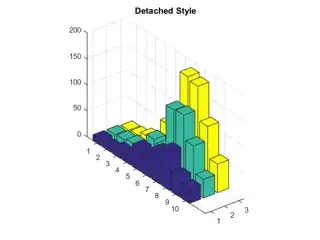
    What do you mean by "data"? Do you mean some type of graph, like this one? – Laurel Jan 10 '17 at 22:11
  • @cobaltduck I've expanded the question to allow for a better word to describe this relation that might fit; I am not familiar with any established business terminology / concept that fits this though. Adding idiosyncratic descriptors would probably just be unclear. – mfg Jan 10 '17 at 22:11
  • @Laurel yes, that would be a good example of what im trying to describe – mfg Jan 10 '17 at 22:12
  • @mfg So, in Laurel's image, "horizontal" would describe all three data fields and you're looking for individual names of each one that exists on the horizontal? Can you use that image in the post to explain more if I am still missing it? – Hank Jan 10 '17 at 22:28
  • @Hank I am trying to describe a 'horizontal' presented over time. That is why words like 'depth' and 'longitudinal' are helpful, but don't represent iterative data. The graph is helpful because it is presenting exactly that; the same horizontal – mfg Jan 10 '17 at 23:14
  • 2
    We are essentially talking here about height (vertical), width (horizontal) and depth (?) aren't we? The best thing I can think of is penetration. Or should it be penetrative? The vertical axis, the horizontal axis, and the penetrative axis. How about that, if it's not too Freudian? – WS2 Jan 11 '17 at 00:21
  • @WS2 It's an interesting answer. There's a lot of corollary descriptors, as spatial relations and art critique also have similar constructions. Do you have any basis for referring to those as business terms? I don't think I would be comfortable being in front of a group of people presenting data and referring to it as penetrative; even if I were comfortable, I expect some in the audience may squirm. – mfg Jan 11 '17 at 00:26
  • 1
    I can't speak to business terms but in my line of work (Landscape Architecture) and talking about literal horizons, we would talk about the landscape being layered and refer to 'intermediate horizons'. – Spagirl Jan 11 '17 at 10:54

1 Answers1

2

This graph is called a 3D bar graph:


MathWorks

There are a number of terms you can use to verbally navigate one of these. Generically, you can say the 7th column in the third row has a height of almost 200.

It would be even clearer to have labels on the graph. Then, it would be clear what you mean when you say "7th graders in school three read almost 200 books".

Laurel
  • 66,382
  • This is not immediately for purposes of verbal presentation. Do you have a specific term that describes this relation in a business context? – mfg Jan 10 '17 at 23:17
  • @mfg, in a business context, these are 'tiers' or 'ranks', that is, "second tier sales" or "second rank business line", "third rank ...", etc. The difference between 'tier' and 'rank' will be that 'tier' has a sense of systematic increase or decrease in 'verticality', while 'rank' has no such implication. – JEL Jan 11 '17 at 07:13