6

I wanted to learn more about phonetics and I stumbled across this website:

http://www.oxfordlearnersdictionaries.com/us/about/english/pronunciation_english

However, I couldn't get what the difference is between the pronunciation of /i/ in the word happy /ˈhæpi/ and /ɪ/ in sit /sɪt/ and also between /ʊ/ in the word put /pʊt/ and /u/ in the word actual /ˈæktʃuəl/. This strangely only appears in the online Oxford and Cambridge dictionaries, and I couldn't seem to find it in any other.

tchrist
  • 134,759
Firdaus
  • 63
  • Not everybody pronounces English words the same. There are lots of vowels in English, and variant pronunciations of vowels are common. Some people use the same vowel in happy and sit. And some people use the same vowel in put and actual. – Peter Shor Feb 13 '17 at 02:05
  • In "standard varieties" (General America, Received Pronunciation), /i/ lies somewhere between /i:/ and /ɪ/, and /u/ between /ʊ/ and /u/. Depending on dialects, /i/ can be closer to either /i:/ or /ɪ/, and the same principle applies to /u/. /i/ and /u/ are "special" phonemes (sounds that you can discriminate) as their inclusion in phonetic (more precisely, phonological) notations in dictionaries is mere convention. According to Peter Ladefoged, as /i/ and /u/ only occur under strict conditions and they barely contrast with /i:/, /ɪ/, /ʊ/, /u:/... – Vun-Hugh Vaw Feb 13 '17 at 06:42
  • one can consider /i/ a variant (an allophone) of /i:/ or /ɪ/, /u/ of /u:/ or /ʊ/, and ignore their specific qualities altogether; but doing that just doesn't feel "right" according to him, as people may disagree in that whether /i/ is an allophone of /i:/ or /ɪ/; therefore, they've been conventionally included in dictionaries. tl;dr, basically you don't have to bother with the differences between /i/ and /ɪ/, /u/ and /ʊ/. – Vun-Hugh Vaw Feb 13 '17 at 06:45
  • Also for what it's worth, /i/ occurs unstressed before a vowel ("India"), represents certain morphemes such as -y ("happy", "easy") and even be- ("begone", "belittle"). /u/ only occurs unstressed before a vowel ("actual"). – Vun-Hugh Vaw Feb 13 '17 at 06:58

2 Answers2

5

The tense–lax distinction

As shown there, the vowel at the end of happy /ˈhæpi/ is what we call the FLEECE vowel. It is a tense vowel, sometimes called the close front unrounded vowel. The vowel in sit /sɪt/ is the corresponding lax vowel, the one that we call the KIT vowel, or sometimes the near-close near-front unrounded vowel.

The difference between your other pair is again that of tense /u/ for the GOOSE vowel versus lax /ʊ/ for the FOOT vowel.

You need to learn to hear the difference between these tense/lax vowel pairs, because hearing the tense–lax distinction is critical to understanding English. Until you can hear it, English will always sound confusing to you.

Here's the chart for all twelve simple vowels (monophthongs) of American English:
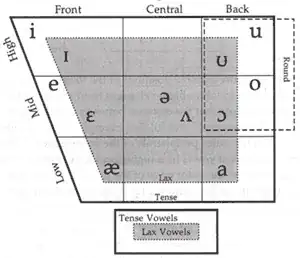
tense-lax vowel chart for American English

Notice how there are contrasting pairs of vowels:

  • tense /e/ versus lax /ɛ/, so FACE versus DRESS
  • tense /i/ versus lax /ɪ/, so FLEECE versus KIT
  • tense /o/ versus lax /ɔ/, so GOAT versus THOUGHT
  • tense /u/ versus lax /ʊ/, so GOOSE versus FOOT

In materials for young children, the tense vowels are often called “long” and the lax ones “short”, but this is not a good way to talk about them because vowel length is not phonemic. Plus if you were talking about length, you would have to mention that all three phonemic diphthongs (/aʊ/, /aɪ/ and /ɔɪ/) take longer to say, too.

All that said, the word happy does not always end with a tense vowel in all speakers. In those with happy tensing, it does, but in others it does not. Happy tensing is the more common variety.

tchrist
  • 134,759
  • 1
    is the chart the same as in British English? – Firdaus Feb 13 '17 at 02:29
  • @Firdaus Mostly, yes. The biggest difference is that many dialects in the British Isles have a thirteenth monophthong, the rounded /ɒ/ known as the CLOTH vowel. That sound occurs in American English as [ɒ] but it is not phonemic; it’s just a way of saying /ɔ/. The exact positioning of each phoneme on the trapezoid varies across the British Isles, but it also varies a lot over North America. Their non-rhotic speakers construe almost uncountably many phantom diphthongs. This is a very high-level synopsis. – tchrist Feb 13 '17 at 02:59
  • It might be worth noting that "face"/"dress" is not an exact [e]/[ε] comparison, as "face" is pronounced [feɪs] by many NAmE speakers, while "dress" is simply [dɹεs]. Likewise, "goat" is [goʊt], – wchargin Feb 13 '17 at 04:56
  • @wchargin Actually those are minor off glides that should be written as superscripts at most. They can be ignored for most purposes, especially by beginners. They are not full diphthongs in any event, nor are they phonemic. Not all speakers even have them. – tchrist Feb 13 '17 at 05:08
  • -1 This answer doesn't address what the OP asked, because conventionally, /u/ as in "actual" and /u:/ as in "goose" aren't the same. The OP is confused about the differences between /u/ and /ʊ/, not /u:/ and /ʊ/. – Vun-Hugh Vaw Feb 13 '17 at 06:51
  • @Vun-HughVaw They are the same for me, and for most of the rest of the continent, since American English doesn’t have phonemic vowel length. We find those extra length markers to be distractingly over-detailed when you're talking about phonemes because there are no minimal pairs. There is a reduction in unstressed syllables, of course, but that happens to all vowel. Consider the /i/ in the unstressed syllable of behind. – tchrist Feb 13 '17 at 14:23
  • @tchrist I'm aware of what you're saying about the nonexistence of phonetic length in American English (which is what notations on Wiktionary represent) and of minimal pairs. There are no minimal pairs I can think of that help contrast /u/ and /u:/, /i/ and /i:/ (though there could theoretically be one for /i/ and /i:/). But like I said, conventionally, they're still distinguished in typical dictionaries from Britain (Oxford, Cambridge, Longman, etc.), and given the very specific examples given by the OP, those distinctions seem to be what he or she was concerned about. – Vun-Hugh Vaw Feb 14 '17 at 02:51
  • 1
    @Vun-HughVaw Non-existence of phonemic length, not of phonetic length. Minimal pairs always show phonemes in action. Were they merely allophones the pair would not comprise two words with contrasting phonemes, only two variant pronunciations of the same word under alternate phonetics. I don't know if UK speakers have minimal pairs differing in length alone, only that Americans do not. Too often people go confusing phonemic notation in dictionaries with actual phonetics. – tchrist Feb 14 '17 at 03:16
  • Pardon me for using the inaccurate phrase "phonetic length". Of course phonemic length is abstractly "perceived", as even a "short" /ɪ/ can be phonetically longer than a "long" /i:/; "length" is just a way to discern tenseness and laxness. But you can see the gist of my point: "phonetic notation" is chiefly conventional rather than purely phonological, as contrasts between /i/ and /i:/, /u/ and /u:/ are very non-phonemic. But at the end of the day, the differences in quality brought about by such contrasts are still what the OP was concerned about. – Vun-Hugh Vaw Feb 14 '17 at 03:30
3

There doesn't have to be a difference. It's perfectly fine to use the "sit" vowel in "happy", and the "put" vowel in "actual".

The reason Oxford dictionaries use a different transcription is simply to account for multiple accents. In some accents, "happy" instead has the vowel sound of "fleece", and "actual" has the vowel sound of "goose". This is called "happy-tensing"; it occurs for nearly all North American and Australian speakers, and for a number of British English speakers.

This may be a little confusing, but in fact it's good news for a learner: you don't have to worry about differentiating /iː/ and /ɪ/ in words like "happy", unlike "sheet" and "shit" or "beach" and "bitch". You can use whichever vowel sound is easier for you to pronounce in words like "happy" and "actual" (although as I mentioned earlier, most North American speakers are more accustomed to using and hearing the "fleece" and "goose" vowels in words like this).

herisson
  • 81,803