18

I saw a post on The daily What which links to a video where a person counts from 1 to 100,000.

Is he saying a large portion of the numbers wrong?

Back in high school my algebra teacher was extremely picky. If we were going to say the number 135, we would say one hundred thirty-five. If a person said one hundred and thirty-five my teacher would interpret that to mean 100.35. Was my algebra teacher wrong, or did Jon just waste over 80 hours counting to 100,000 incorrectly.

I tried searching the web, but searching for ‘numbers and’ doesn’t work very well. Can you point me to a reference or style guide that describes how to properly say large numbers?

LWTBP
  • 724
Zoredache
  • 281
  • How do you say 25, five and twenty or twenty five? – Pratik Deoghare Aug 15 '11 at 07:52
  • @Pratik In Standard English it is twenty five, in old British (Scottish?) English it was five and twenty. – ApprenticeHacker Aug 15 '11 at 07:58
  • 1
    @IntermediateHacker Exactly. My point was how you say numbers depends on many things like culture, background, upbringing etc. – Pratik Deoghare Aug 15 '11 at 08:02
  • 27
    I don't understand your teacher. 100.35 is definitely not pronounced "one hundred and thirty five". – Chris Burt-Brown Aug 15 '11 at 09:04
  • 1
    "One hundred point thirty-five" = 103.5; 100.35 = "one hundred point three five". My maths teacher was punctilious about that. – TRiG Aug 15 '11 at 12:02
  • And how did you teacher say 135.35? "One hundred thirty-five and thirty-five?" The only thing I can think of in UK English which would approximate 'and as point' would be old-style money ("six and ten" = 6s10d) – Benjol Aug 15 '11 at 12:44
  • 1
    Ooops, make that ten and six :) – Benjol Aug 15 '11 at 12:52
  • 9
    @TRiG I would never interpret "One hundred point thirty-five" as 103.5 – ghoppe Aug 15 '11 at 13:35
  • 1
    Usage of "and" is regional! This happens quit a bit on EL&U: Declaring something "wrong" when it is perfectly correct on the other side of the Atlantic. Or even just elsewhere on the same island. – GEdgar Aug 15 '11 at 14:42
  • 100.35 = "One hundred and thirty-five hundredths" if you were being pedantic or scientific about the English phrasing of such a number. In conversation it would be "One hundred point three five." In the case of the former, the word "and" is used to establish the decimal place. – JYelton Aug 15 '11 at 16:13
  • @JYelton: In your first example, "and" doesn't establish the decimal place, "hundredths" does (though you probably can't put the "and" anywhere else and still make sense). – John Bartholomew Aug 15 '11 at 17:06
  • 1
    @John: To my ear, "and" serves to tell the listener that there is to be an addendum. I've always been taught that to say "one hundred and thirty-five" for 135 is incorrect. In this case "and" means an addendum of a decimal or partial. Hundredths establishes the number of places, just as thousandths would. To omit "and" would be awkward indeed: "One hundred thirty-five hundredths." 1.35? – JYelton Aug 15 '11 at 19:41
  • 2
    @TRiG, I'm sorry, but you also had a weird teacher :( could you find a citation for that, since I think it's just wrong. And I have just tested Microsoft Speech Recognition and Dragon Dictation and both render "one hundred point thirty-five" as 100.35. – Chris Burt-Brown Aug 15 '11 at 20:21
  • 2
    @JYelton: "One hundred and thirty-five" versus "One hundred thirty-five" (for 135) clearly varies, as the range of responses shows (I thought it was just a British/American difference, but it may be even more complex than that). I agree that "One hundred (and) thirty-five hundredths" sounds silly without the "and". My only disagreement was with your original statement "In the case of the former, the word "and" is used to establish the decimal place.", where in fact the use of "hundredths" clearly makes the decimal place explicit. – John Bartholomew Aug 15 '11 at 20:47
  • By the way, essentially the same question has been asked at least once before: english.stackexchange.com/questions/17540/reading-out-numbers-in-english (and if I remember right, more often). But given how many interesting answers and comments this has garnered, there was clearly space for it to be asked again! – PLL Aug 17 '11 at 02:51

13 Answers13

26

"One hundred and thirty-five" is perfectly correct, although the "and" tends to be removed in American English. It makes sense mathematically, since "and" is synonymous with "plus" — two apples and three apples makes five apples. One hundred, and thirty-five, makes 135.

The "and" is particularly useful when articulating a series of numbers. "One hundred one, one hundred two" could easily be misheard as "one hundred, one, one hundred, two" whereas using "one hundred and one, one hundred and two" removes that ambiguity.

Ultimately though it depends on location and culture. In the UK the "and" is always used; in the US there are a mixture of usages.

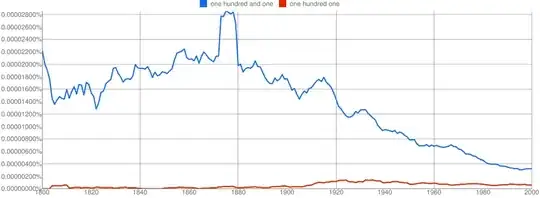
Looking at this ngram, it seems that skipping the "and" has only gained popularity over the last hundred years or so but using the "and" is still far more prevalent: Relative popularity of "one hundred one" versus "one hundred and one"

F'x
  • 38,736
Waggers
  • 7,298
  • 2
    That is not the question; the question is - from ngrams, is the blue line supposed to mean 101 or 100.1? (same for red) – Unreason Aug 15 '11 at 08:56
  • I agree with the "and" usage. I am not a native speaker, but for what it's worth, I use it. – Alenanno Aug 15 '11 at 09:19
  • 5
    @Unreason I beg to differ. The question was, if a person includes the "and", (and I quote), "Is he saying a large portion of the numbers wrong?" The supposed alternative meaning of "one hundred and thirty five" being interpreted as 100.35 is a side issue. – Waggers Aug 15 '11 at 12:39
  • @Waggers, let's leave it to the OP to clarify - to me what you call a side issue is exactly what is referred to in the quote "Is he saying...wrong?" – Unreason Aug 15 '11 at 13:12
  • 16
    One hundred and thirty-five never means 100.35. Nor does one hundred thirty-five. – Peter Shor Aug 15 '11 at 13:30
  • "The "and" is particularly useful when articulating a series of numbers." - so, what about "thirty-five" vs "thirty, five"? – Random832 Aug 15 '11 at 13:30
  • @Random832 Good point! It was just an idea :) Perhaps we should adopt the German system where it would be "five and thirty" - but perhaps not... – Waggers Aug 15 '11 at 14:26
  • @Random832 - It is usually obvious from the cadence of the sentence, "thirty" pause "five" would be two numbers, and is more than enough to differentiate it from "thirty" no pause "five" which would be a single number. – Mark Booth Aug 15 '11 at 15:12
  • Even if we do assume and to mean plus, then in a positional numeral system one hundred and thirty-five would be interpreted as 100 + 35, or 135. – Mark Booth Aug 15 '11 at 15:22
  • 4
    Unfortunately the graph doesn't proove anything, as +Unreason points out: this graph can perfectly show that "101" is losing popularity and that "100.01" (cent) is gaining popularity. – rds Aug 16 '11 at 12:48
15

Your algebra teacher, if s/he ever in fact claimed that, is wrong. While it's common [at least for math teachers] to say that "and" must not be used except to separate the integer part from the fraction/decimal part, the usage is "One hundred and thirty-five hundredths" for 100.35, and the "hundredths" is not optional. This rule makes "One hundred and thirty-five [stop]" meaningless; it does not assign it a meaning of "100.35".

Random832
  • 689
10

I've never heard the digits following the decimal point to be pronounced like the questioner describes. It's always "something-point-three-five". The digits to the right of the decimal point are named individually. I've worked a lot with accountants and statisticians.

Ken
  • 311
8

American math text books and math manuals (e.g.: Math At Hand published by Great Source Publications) tell students that they don't say 'and' as they are speaking a number.

From page 5 of that text: How would you read 905,346,521? Say: nine hundred five million, three hundred forty-six thousand, five hundred twenty-one.

That is an American text.

As a British person, I find this cumbersome and I am sorry, but very American.

I now live in Canada and a teacher told me recently that 120 must be pronounced 'one hundred twenty', because if children say 'one hundred and twenty' then it means one hundred POINT 20.

Of course I said that it does not. In fact, either with the 'and' or without is acceptable, but 'and' does not mean 'point'. The teacher tried to tell me that it did. This is worrying for what is going to go down the line in our kids' education and declining numeracy abilities. Additionally, we don't say 'twenty' after the decimal point, we say 'point two zero', or better yet, 'point two'. You can put as many zeroes as you like after a decimal digit with a value and it doesn't change its value. 0.1 is the same as 0.1000000. So don't bother with the extra zeroes.

American math manuals and teachers seem to want to express the decimal fraction in terms of relating it to the place value chart, so a decimal part is named so many tenths or hundredths or thousandths or ten thousandths or hundred thousandths or millionths. Really? It is essential to understand the place value chart, but if you express a decimal number as a fraction you are going to get a bunch of kids stopping in their tracks in confusion. I looked on the web this morning and there are some people actually saying that 1.2000 is 'one and two thousandths'. Really? Why not bung in another few zeroes and decide to call it 2 millionths instead? I kid you not. People, if you're going to teach it, you'd better understand it.

I believe it is acceptable to choose to say 'and' or not in your expression of numbers - either is fine but as a British person I always say 'and' when speaking a number such as 1,256. However a decimal point must ALWAYS be clearly stated as either 'point' or you could say 'decimal'. Anything else will cause confusion. Following a decimal point, each digit is to be read individually: 1.234 is said aloud as 'one point two three four'. It leaves no room for ambiguity or mistake. Bottom line.

If a student is given a mixed number or mixed fraction (same thing, slightly different name) such as 57 20/100 (fifty seven and twenty hundredths) then you say it as a fraction, using 'and', as I just wrote it in words. However, when you transform that fraction into a decimal number kids should first reduce it (so they can comprehend it better) and twenty hundredths is actually the same as two tenths, so the number becomes 57.2 Knowing the place value, you know that the first column after the decimal point is tenths, the second column is hundredths the third column is thousandths. If you have two hundredths, the two belongs in the hundredths column (col. 2), but two tenths, the 2 belongs in the first column.

There is lots of room for confusion if you don't know what you are doing, and trying to tell kids that 'and' means 'decimal point' is one big fat way of adding further to the confusion they are going to have. Teachers: please don't do that.

7

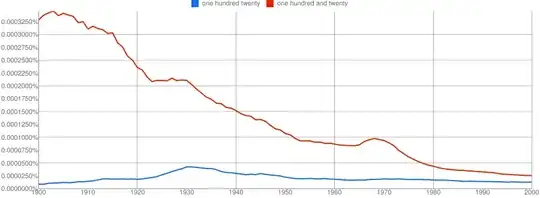
Here are a couple more charts. Firstly, to show even Americans still use and more often than not... enter image description here

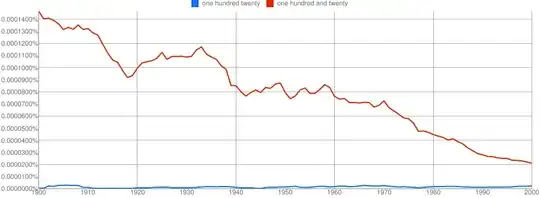
And secondly, to show that Brits remain impervious to such pedantry... enter image description here

Personally I think it's potty to rant about one or the other being more "correct", and it's positively disturbing to see people thinking this leaves scope for confusion between 120 and 100.20. I don't know who thought up dropping the "and" (though Noah Webster has "form" on such issues), but I'm sure they'd be aghast to find it's apparently led to more misunderstandings, not less.

TL;DR: Go with the usage you were taught, but please don't assume others are wrong.

On behalf of the Brits and Walt Disney, I must just say I never heard even an American refer to One Hundred One Dalmatians.

FumbleFingers
  • 140,184
  • 45
  • 294
  • 517
6

Depends on your background but, in Greek speak (at least), the word "and" is used to describe decimal places. So one hundred "and" thirty five means 100.35, unlike one hundred thirty five, which means 135. In English speak, however, the word "and" is not used to describe decimal places. The word "point" is used instead. Thus, one hundred "and" thirty five becomes 135, while one hundred "point" thirty five is 100.35.

Bill
  • 946
3

"One hundred and thirty five" should definitely be interpreted as 135, not 100.35. "One hundred thirty five" is more acceptable in the U.S., especially in technical settings, although the former is also frequently used. Leaving out the "and" has the advantage of being less ambiguous, in the sense that "one hundred and thirty five" could mean "135" or "100, 35".

xpda
  • 1,696
2
  • If you accept Wikipedia http://en.wikipedia.org/wiki/101_(number) is pronounced "one hundred and one", "a hundred and one", "one hundred one", "a hundred one", or "one oh one".
  • WebMath and Wolfram both writes "one hundred one"
  • WebMath says 100.01 is one hundred and one hundredth
rds
  • 296
-1

I was taught (and it seems logical to me) that 100.35 is read " one-hundred point three five," 135 is read "one-hundred thirty-five" and to say "one-hundred and thirty-five" should be left for instances where you are speaking of two distinct numbers: 100, and 35

-1

In American English, 135 is pronounced one-hundred thirty-five. 100.35 would be pronounced one-hundred and 35 hundredths.

4rkain3
  • 566
  • 1
    That seems to be the case only in American English. In the UK, 135 would be pronounced as one hundred and thirty five. 100.35 would be pronounced as one hundred point thirty five. – Tristan Apr 10 '13 at 23:17
  • @Tristan Yes. Hence I stated, "In American English" at the beginning of my answer. – 4rkain3 Apr 10 '13 at 23:20
  • 1
    I’ve lived in America all my life (quite a few years), and if I heard “one-hundred and 35 hundredths”, I would say, “Wait. What?” I may have heard that a few times in my life, but, as far as I can recall, not since I’ve been in school.  … … … … … … … … … … … … … … … … … … … … … … … …  P.S. How do you think we pronounce a hyphen?  Since you’re talking about pronunciation, why don’t you just say, “In American English, 135 is pronounced one hundred thirty five.” (without the hyphens)? – Scott - Слава Україні Sep 20 '16 at 03:20
-3

I'm a first grade teacher and I teach my students to leave out the 'and' because I am a former bookkeeper and when working with money one hundred and thirty five is one hundred dollars and thirty-five cents. Please teach it the correct way !!

  • What is correct, seems to depend on whether someone speaks American English, or not. – Tristan Nov 11 '13 at 16:35
  • How would you say, $135.35? One hundred thirty-five and thirty-five. Or one hundred and thirty-five dollars and thirty-five cents. – Mari-Lou A Nov 11 '13 at 23:14
  • 1
    @Mari-LouA Interestingly, I’d say neither—I’d say “one hundred and thirty-five thirty-five”, just like I’d say something costs “nineteen ninety-nine” or “thirty-four ninety-five”. With money, the usage of and seems to be precisely the opposite of what the asker’s math teacher and user57131 are advocating. – Janus Bahs Jacquet Sep 11 '14 at 19:40
  • 1
    And I'd just say "One thirty-five thirty-five" to mean 135.35. – Robusto Sep 11 '14 at 19:45
-5

Saying and in a number is a huge pet peeve of mine. I despise it. Lazy and incorrect. One hundred and one dalmations. Not one hundred and one dalmations. It's sloppy to add an "and" in there. Takes more time it's the matgh equivalent to "um". Slang.

Cindy
  • 1
  • 8
  • This is a Q&A site, not a forum to air your peeves. 2) Your ‘correct’ and ‘wrong’ Disney titles are the same. 3) It’s neither. Whether or not you include and, the dogs in question are dalmatians, not dalmations. 4) ‘Sloppy’ or ‘lazy’ would be leaving something out (like the punctuation missing in your last sentence). Adding an entire extra word to a phrase can never be considered ‘sloppy’ or ‘lazy’. 5) Read the other answers to see why including and is not* ‘incorrect’. You’re free not to like it, but it’s not ‘incorrect’. 6) Um is not slang.
  • – Janus Bahs Jacquet Sep 11 '14 at 19:46
  • 1
    ... and spelling "math" with a "g" is sloppy. – Scott - Слава Україні Sep 20 '16 at 03:31