I want to know, can I use hero in this sentence to refer to someone who is female? Does it make sense?
Mom you are my hero.
Or is it better to say
Mom you are my heroine.
I want to know, can I use hero in this sentence to refer to someone who is female? Does it make sense?
Mom you are my hero.
Or is it better to say
Mom you are my heroine.
Heroine is a word of the feminine gender, so it is applicable to your mother and the meaning of the word is applicable, so I would not strongly object to using this option. However, hero is probably preferable here.
It is worth note that since mom adequately signifies gender, there is no need to signify her gender twice. Noah Webster wrote the following on page 31 of A Philosophical and Practical Grammar of the English Language, which was published over two centuries ago in 1806:
- In all cases, when the sex is sufficiently indicated by a separate word, names may be used to denote females without a distinct termination. Thus, altho females are rarely soldiers, sailors, philosophers, mathematicians or chemists, and we seldom have occasion to say she is a soldier or an astronomer yet there is not the least impropriety in the application of these names to females when they possess the requisite qualifications for the sex is clearly marked by the word she or female or the appropriate name of the woman as "Joan of Arc was a warrior." "The Amazons, a nation of female warriors."
He did not revise this provision in a later edition of this work, retitled to An Improved Grammar of the English Language (1931), which was written after his American Dictionary of the English Language (1828). An American Dictionary of the English Language included words like soldieress (although he marked that as unused), and warrioress, so the mere existence of feminine alternatives was not enough to sway his opinion. As such, we can presume that a sentence such as the one you grant would have been acceptable since the early 19th century, meaning that there are no grounds for objecting to this, even on a traditionalist basis.
As a matter of fact, popular usage suggests that there is not any significant usage of the heroine variation:
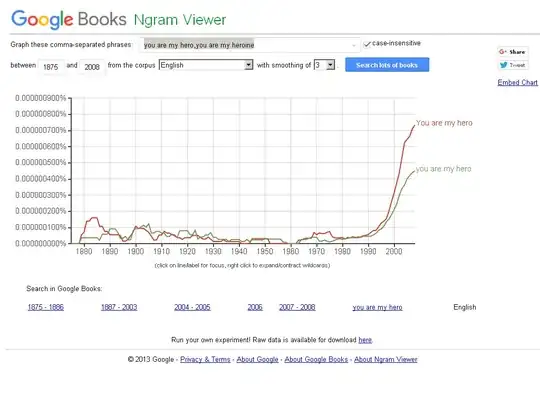
This also seems relatively rare online. Personally, I can only see four up to four pages of results from Google, and that is only after I enable the option to see possible repeat results when you reach the last page.
There are also some reasonably contemporary considerations, such as the use of of a homophone, heroin, which is the name to a drug, causing potential (albeit unlikely) confusion in actual speech: It could be taken as metonomy for addiction, rather than heroism. Moreover, the fact that the gender neutrality movement often has a tendency to try to completely emasculate words of the masculine gender when there is no neuter alternative, in an attempt to correct societal preconceptions regarding gender roles, as is the case in the "Are Heroes Always Men?" section of American Heroes in a Media Age by Susan J. Drucker and Robert S. Cathcart (©1994), as seen on page 24:
Current Dictionaries include both male and gender neutral definitions for hero. In Webster's Third New International Dictionary (1964) the first definition is gender-neutral, the second male, the third male, and the fourth gender-neutral. The term hero is not exclusively used for males, but heroine is just used for females. As noted above, recent guidelines for nonsexist language stress the elimination of needless gender terms. Gender neutral terms such as letter carrier, waitperson/server, flight attendant, and so on, are required in job descriptions. Hero should be a gender-neutral word that is used for both men and women. If hero continues to be the term for males and heroine for women, gender stereotypes will continue.
In isolation, I might not personally consider these contemporary factors so especially convincing of the need to eschew heroine in and of themselves. However, since there is no need to do otherwise here, because mom already signifies femininity, they do add to the persuasiveness of choosing hero in its stead.

"[is/are] my hero" is a stock phrase -- it's a somewhat humorous way of praising a person. It's a bit more natural to use "hero" in this sentence, regardless of the subject's gender.
That being said, both words make perfect sense in this sentence. Neither one is wrong.
English usually uses the male form of titles when referring to general roles, or mixed gender groups of a role.
e.g.
"Actor" = A general title for anyone who acts, regardless of gender
"Actress" = A specifically female actor
"Actors" = A group of male actors, or a group of male actors AND female actors
"Actresses" = A group of female actors only
In this context, I'd say "hero" is being used to refer to a general role, so it's unnecessary to specify that the "hero" in question is female.
However, both "hero" and "heroine" are grammatically correct.


