21

A common euphemism for the toilet in the spoken Welsh of north Wales is "lle chwech", literally "six place" ("chwech" being "six" in Welsh). Note this refers mainly to the room rather than the porcelain throne itself.

Geiriadur Prifysgol Cymru (the Welsh equivalent of the Oxford English Dictionary) states here that this is a borrowing from the English slang six "a privy".

There is a reference to six with this meaning in The Routledge Dictionary of Historical Slang here. It states:

six A privy: Oxford University: ca 1870-1915. ?origin

I'm not sure to which Oxford publication the date range above refers. I've looked in the New English Dictionary ... under six and found nothing relevant.

In conversation, someone has suggested a link to the French "sis" from "soeir" meaning "to sit", which seems plausible semantically but I'm no expert on French.

Another possibility is that it may have cost sixpence to visit a toilet at some point. However, this seems expensive considering "spend a penny" is apparently from the 1850s and that it was only 2p to visit the lavatory in 1977 according to A Dictionary of Slang and Unconventional English.

Any thoughts on the origin of six in this context?

Hot Licks
  • 27,508
PrettyHands
  • 423
  • 2
  • 9
  • 3
    The date range probably refers to the time period when the slang was in use at Oxford University, not to a publication. – Rob K Jul 06 '17 at 13:58
  • @Rob K Thanks for the clarification. Interesting. I'm not sure what the connection between the Welsh of north Wales and Oxford University slang would be! – PrettyHands Jul 06 '17 at 19:07
  • 1
    If it "refers mainly to the room," shouldn't the title be "to refer to a bathroom," not "to refer to the toilet"? – Azor Ahai -him- Jul 06 '17 at 20:21
  • 4
    @Azor-Ahai When it comes to the name of the room, different words are used in different regions and by different social classes. I chose toilet because in north Wales it is not uncommon for the toilet to be situated in a separate room to the bathroom. During the 1870-1915 period referenced, bathrooms were a rare luxury, especially in rural areas, and it's quite likely that the "six" could have referred to an outhouse rather than a room found within the dwelling. – PrettyHands Jul 06 '17 at 20:51
  • Sure, but you said it doesn't apply to "the porcelain throne itself," so shouldn't a different word be in the title? – Azor Ahai -him- Jul 06 '17 at 20:52
  • 3
    In UK English the word 'toilet' can refer to the room or the receptacle itself. According to oxforddictionaries.com the word originally referred to the cleaning cloth, then the room, and then the item. – PrettyHands Jul 06 '17 at 21:06
  • 3
    PrettyHands - Not a cleaning cloth, but a cloth covering a dressing table, then the process of getting oneself ready for the day, which came to include washing etc. – Kate Bunting Jul 07 '17 at 07:45
  • 2
    @Kate Bunting You're right, I managed to mangle that pretty badly! The main point about toilet being used to refer to the room still stands, however. – PrettyHands Jul 07 '17 at 08:29
  • 1
    I can't document it yet, but use of 'six' or 'the six' to refer to a privy derives from euphemistic Oxford slang referring to "the six Gentlemen of the Privy Chamber" (who should be, not incidentally, "well-languaged"), personal attendants: *An inquiry into the place and quality of the gentlemen of His ... (see bottom). At present, my evidence is only circumstantial. – JEL Jul 07 '17 at 19:31
  • @JEL Interesting! I can see it working in the context of Oxford University, but it would take some explaining for it to have spread to general use in north Wales Welsh without there being more evidence of its general use in English. Still, it's a lead! – PrettyHands Jul 07 '17 at 19:49
  • 1
    @PrettyHands I can imagine the following process: Oxford students use it, then go on to become nobility, and still use the term. Then plain folk emulate them. It might or might not stick, and it happened to stick in Wales. – Barmar Jul 10 '17 at 17:28
  • The word "bog" is used in English slang to refer to a toilet because it was originally used to refer to a "British or German [standard of]" motorcycle, and then wheel and then round opening for a toilet. Perhaps six has a similar origin? – adrianmcmenamin Jul 12 '17 at 21:41
  • @Barmar The problem is that you'd expect to find historical evidence of six being used more widely during the period it was in use. – PrettyHands Jul 12 '17 at 22:14
  • @adrianmcmenamin is bog not derived from the similarity of cesspools to boggy ground? – PrettyHands Jul 12 '17 at 22:23
  • @adrianmcmenamin Just checked, and the OED derives 'bog' (=privy) from "wet spongy ground", from Irish or Gaelic 'bogach'. – PrettyHands Jul 13 '17 at 11:03
  • @adrianmcmenamin You knew last year that the 'British or German' for the bog in 'Bog standard' was a post hoc backronym, did you just forget? https://english.stackexchange.com/a/321282/168678 – Spagirl Jul 13 '17 at 11:19
  • @Spagirl Not sure that someone on Duolingo has quite the same credibility as Geiriadur Prifysgol Cymru, but you're right that it is perfectly possible that "lle chwech" was formed within Welsh.

    Other purely Welsh possibilities include: it being an euphemism for "lle rhech" (="fart place"); that 'six' might represent the shape of a person defecating; that quarry latrines had spaces for six.

    I avoided going into these possibilities above as the aim of the question was to gain information about the attested use of 'six' in English slang as an euphemistic term for 'privy'.

    – PrettyHands Jul 13 '17 at 11:33
  • @PrettyHands I certainly did not intend to suggest that Duolingo was an authority. Hence making a comment rather than an answer. Was just exploring the possibilities and perhaps misunderstood the motivating force behind the question. never mind. – Spagirl Jul 13 '17 at 12:11
  • apologies all - I got this all back to front by mis-remembering it – adrianmcmenamin Jul 13 '17 at 17:48
  • Just a suggestion, does a possible similarity of sound between "six" and "cess"; particularly in a languid 19th century upper class drawl or even a mock Irish accent, have anything to do with it? I include the mock Irish because the curse "Bad cess to ye" appears to have been a curse in 19th century Ireland from some versions of the traditional song Black Velvet Band. This might even explain the Welsh version. – BoldBen Jul 14 '17 at 10:21
  • @Spagirl No problem - thanks for your interest! :) – PrettyHands Jul 16 '17 at 10:52
  • @BoldBen Interestingly https://en.oxforddictionaries.com/definition/cess suggests that cess might mean [tax] assessment in an Irish context! – PrettyHands Jul 16 '17 at 10:55
  • 2
    The Routledge Dictionary of Slang is just an abridged version of Partridge's A Dictionary of Slang and Unconventional English, which has the same entry for six as the one quoted from Routledge from at least as early as 1938 (the second edition of Partridge). Partridge in turn may have drawn on Farmer & Henley, Slang and Its Analogues Past and Present, volume 6 (1903), which has this entry: "Six, subs. ... 2. (Oxford Univ.),—A privy." – Sven Yargs Dec 21 '17 at 03:30
  • I'd never heard this meaning of "six", but now in my head I'm mashing it up with "check your six" ("watch your back", referring to six o'clock on an imaginary dial). I realize that they're not actually connected, but from now on every time I hear "check your six" I'm going to make sure we're not out of bog roll. – MT_Head Dec 21 '17 at 06:15
  • I answered this question and it was flagged as offensive? Why is that? Certainly it wasn't offensive. It's a question about toilet slang... – Evan Carroll Dec 27 '17 at 03:34
  • @EvanCarroll you should flag your answer to the mods, the OP cannot help you. I think the problem is that you mentioned "poop" and "pee" in the same post, and the system (community/mod?) automatically flagged it as vulgar, or low quality or whatever. – Mari-Lou A Dec 27 '17 at 13:28
  • @EvanCarroll Yes, sorry, Mari-Lou is correct. I can't see your answer, or do anything about its flagged status. One for the mods I think. – PrettyHands Dec 27 '17 at 13:53

3 Answers3

8

The best reference I could find is from British Library Sounds web page:

lle chwech≠9 (source of well-known Welsh joke that toilets are more expensive in Wales than in England as “chwech” also used for ‘six’, i.e. five pence more than “spend a penny”, possibly thought to derive from “rhech” Welsh for ‘to fart’)

see Geiriadur Prifysgol Cymru (online)

9See also Robert Penhallurick’s The Anglo-Welsh Dialects of North Wales (1991, p.226) Cl1 Llanfair Talhaiarn.

http://sounds.bl.uk/related-content/TEXTS/021T-C1190X0041XX-0501A0.pdf


Another possible explanation I've found is that lle chwech (which translates to "six place") refers to the workers toilets which commonly have six seats. I've found this explanation in three different sites (two of them are answers in a forum and one of them is a comment in a blog page). The people who provided the explanation appear to be of Welsh origin.

It's kind of our version of 'outhouse' - comes from workers' toilets, where you'd commonly have six seats in a row

https://forum.saysomethingin.com/t/tresaith-bootcamp-sept-2014/674/15


Welsh: Y posibilrwydd arall (fase'n esbonio pam fod y term yn bodoli mewn rhai ardaloedd gogleddol yn unig) yw fod e'n dod o ardaloedd y chwareli a mwynau copr, lle roedd cwt 'ty bach' gyda lle i chwech person yn unig.

English translation: The other possibility (explaining why the term exists in some northern areas only) is that it comes from the areas of quarries and copper mines, where there was a 'small house'(toilet) cabin for just six people.

https://maes-e.com/viewtopic.php?f=38&t=11463


The Welsh euphemism for ‘toilet’ is a literal translation of “little house” (tŷ bach) the standard word you’d see for example on public signs would be “toiledau” (toilets). There are other Welsh euphemisms for ‘toilet’ but the common North Wales dialect one is “lle chwech” which translates as “six place” usually explained as referring to workplace toilets where you’d commonly have six seats in a row?

https://stancarey.wordpress.com/2015/08/27/the-place-for-toilet-euphemisms/

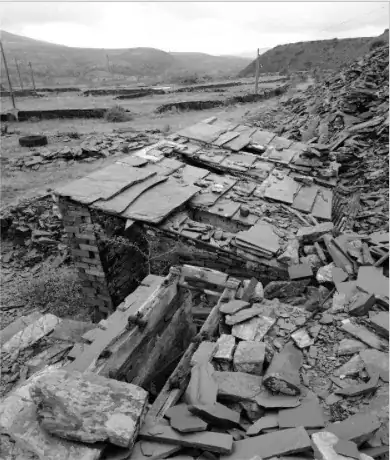
Furthermore, I've found a supporting evidence for the second theory in an archaeology book written in Welsh. It provides a reference to a six-seater privy in a quarry in north Wales. Here is the excerpt and the image from the book Llechi Cymru: Archaeoleg a Hanes (by David Gwyn):

Anaml iawn y gwelwyd toiledau tan yr ugeinfed ganrif. Mewn rhai mannau, mae seddi dwbl o slabiau wedi goroesi dan ddaear, fel yn chwarel Cambrian yng Nglyn Ceiriog a oedd, fwy na thebyg, ar un adeg yn gysylltiedig â chlosedau pridd, er ym Maenofferen, defnyddiai'r dynion blanc dros sianel ddŵr a redai'n gyflym tan 1996. Yn chwarel Oakeley rhoddai rhes o gabanau heb ddrysau arnynt olygfa arbennig o dref Blaenau Ffestiniog. Mae magic flute chwe sedd wedi goroesi ym Mhen yr Orsedd. Cai hwnnw ei fflysio gan fwced y byddai dŵr yn cronni ynddi nes bod digon o bwysau ynddi i'w gwagio (Ffigur 163). Roedd closedau dŵr canolog ar gael yn y Penrhyn erbyn y 1950au.

English translation: Privies were few and far between until the twentieth century. In some places double-seater slab seats survive underground, such as at the Cambrian quarry in Glyn Ceiriog, which presumably at one time were associated with earth closets, though at Maenofferen the men used a plank over a fast-running water channel until 1996. At Oakeley quarry a row of door-less cabins commanded a magnificent view of the town of Blaenau Ffestiniog. A 'magic flute' six-seater survives at Pen yr Orsedd, flushed by a tipping bucket in which water accumulates until the weight empties it (Figure 163). Penrhyn had acquired centralised water closets by the 1950.
enter image description here

Ffigur 163. Lle chwech ym Mhen yr Orsedd, Nantlle, gyda dull fflysio awtomatig yn yblaendir.

English translation: Figure 163. Pen yr Orsedd privy, Nantlle, with automatic flushing mechanism in the foreground.

PrettyHands
  • 423
  • 2
  • 9
ermanen
  • 62,797
  • Thank you for sharing your wonderful research! I'd heard the six-seater latrine explanation, but only now does it seem plausible. I certainly feel it is more likely than a borrowing from Oxford U. slang (cf. GPC).

    Unfortunately I'm afraid I can't accept your answer, even though I would like to do so. You may have answered the question that motivated the question above, but the question I posed was about the origin of six as a word for the toilet in English. It would therefore only be appropriate accept an answer to that question.

    Thank you very much for your answer all the same!

    – PrettyHands Dec 26 '17 at 21:38
  • @PrettyHands: In the end, you would say that it comes from Welsh lle chwech (six place) and shortened as "six" but I couldn't find a reference that says this. I tried to explain where the number six comes from. I will check "Chambers Slang Dictionary" if I can find time to go to the library. – ermanen Dec 26 '17 at 22:02
  • Ah, I see what you have in mind. Unfortunately, borrowings from English into Welsh are far less common than from English into Welsh, and I'm afraid it would be quite a stretch for the students of Oxford to appropriate the slang of the quarrymen of North Wales. – PrettyHands Dec 27 '17 at 13:47
  • I went to the library today and I've checked all the dictionaries I could (Slang, non-slang, new, old, etymology; Oxford, Webster's, Times, Chambers, Collins etc.). I could only find the entry "six: a privy" in Eric Partridge's slang dictionary without any origins (which Sven Yarg's provided in the comments also). I couldn't find it in Eric Partridge's etymology dictionary though. – ermanen Dec 27 '17 at 19:03
  • 1
    Found this also: "outdated Oxford University slang for a privy." Numberpedia/Herb Reich – ermanen Dec 27 '17 at 19:54
  • 1
  • 1
    Chilthorne Domer Manor has a six-seater privy also: "In the garden about 70 feet (21 m) south of the house is a six-seater privy built about 1720, which in regular use until 1939." - Wikipedia – ermanen Dec 27 '17 at 20:20
  • 1
    Thanks ermanen for an excellent answer built on fantastic research. – RaceYouAnytime Dec 27 '17 at 23:52
3

Just wondering whether the Oxford undergraduates' "six" was inspired by poor/deliberately bad Latin pronunciation.

In Italian, the word cesso (/'tʃɛs:o/ pronounced ‘chesso’) is a very informal expression for gabinetto (cabinet--->toilet). The word is derived from the Latin past participle of the verb cedere, cessus, in modern Italian “cessare”, which means to cease, withdraw from, stop doing something. Could the hard c in Latin have been mistaken for a soft one by English schoolboys? Moreover, the x in many Latin words was later represented by the letters ss.

An exchange of the sounds ss, or s and x, took place in axis for ‘assis’, laxus for ‘lassus’; […] In the later language of the vulgar, the guttural sound in x disappeared, and s or ss was often written for it; as vis for “vix*. vixit for ‘visit’. unsit for ‘unxit’, conflississet for ‘conflixisset’, in late Inscrr. (v. Corss. Ausspr. I. p. 297 sq.); hence regularly in Italian, and frequently in the other Romance tongues, the Lat. x is represented by s or ss.

A Latin Dictionary by Charlton T. Lewis and Charles Short.

NB.
This is just an idea, and I am not an expert in Latin, so please feel free to correct my conjectures in the comments below. Yeah... and downvote the answer if it's really off the mark.

Mari-Lou A
  • 91,183
  • Interesting - I suppose a visit to the cesso ceases the need to go! I still think @JEL's suggestion of a play on the term privy six is the more likely explanation, however. – PrettyHands Dec 27 '17 at 13:42
  • @PrettyHands the idea behind it is you have to stop doing (cease) an activity because you need to go somewhere. – Mari-Lou A Dec 27 '17 at 13:45
  • Ah, I see! Perhaps the rest in restroom is analogous. – PrettyHands Dec 27 '17 at 13:51
  • Yes, pretty much, just as "to powder one's nose" was a euphemism. Moreover, "cesso" is quite vulgar in Italian, it is also used as an insult, = "crap" "disgusting" – Mari-Lou A Dec 27 '17 at 13:55
  • @PrettyHands the words privy, throne, House of Commons, chamber, latrine, lavabo (a washbowl) and closet which later became water closet were all, at one time or another, used to mean toilet. – Mari-Lou A Dec 27 '17 at 14:00
  • 1
    Interesting - I wonder if privy chamber and House of Commons were used as a way of disrespecting the Establishment. I've just found the following relevant pages in New Perspectives on English Historical Linguistics: Lexis and transmission: https://books.google.co.uk/books?id=O2uulPdAOWIC&lpg=PA97&ots=3XgZvoqN5m&dq=House%20of%20Commons%20meaning%20%20toilet&pg=PA98#v=onepage&q=House%20of%20Commons%20meaning%20%20toilet&f=false – PrettyHands Dec 27 '17 at 14:16
  • @Mari-LouA thank you for an incredibly thoughtful answer and an interesting original theory. +1 – RaceYouAnytime Dec 27 '17 at 23:56
1

A complete "stab in the dark", but could it meant he sixth room of a home? First two could be the formal front rooms (lounge/sitting room), then adult and child bedrooms, a kitchen makes five and six might be an outhouse or bathing room with a toilet? Water closet is another term used.

Brittgow
  • 11
  • 1
  • Believe it or not, someone else suggested the same thing to me a few days ago. However, the reference to six with the meaning of privy in The Routledge Dictionary of Slang dates back to 1870-1915, before the layout of the modern house was common. I like the inventiveness of the suggestion, but I feel that counts against it too. – PrettyHands Jul 16 '17 at 10:50