37

Which is the most appropriate/correct usage?

  • Are you angry on me?
  • Are you angry with me?
  • Are you angry at me?
RegDwigнt
  • 97,231
highbeta
  • 473
  • 8
    I've never heard "angry on me" before. – Urbycoz Sep 29 '11 at 09:41
  • Nor I; it seems rare according to ngrams and except for a brief rise in usage ca. 1780, is less commonly used than angry about, to, or for. – James Waldby - jwpat7 Sep 29 '11 at 14:45
  • I am a South-Indian and I was recently confused about this usage - "angry on" vs "angry with" vs "angry at" someone. I understand that "angry with" someone is the correct usage. However I realized that "angry on someone" is a direct translation from Tamil, a South Indian language. – MediumOne Nov 16 '15 at 11:06

3 Answers3

52

I have never heard the phrase "angry on" used before.

Regarding the other two, I would say that it depends upon the context.

If directed at a person "angry with" should always be used.

e.g. I was very angry with her.

If directed at a situation I believe "angry at" would also be acceptable.

e.g. I was very angry at how rainy it was.

The key is who the anger is aimed at. "Angry at" is not really aimed at anyone.

So in the example you give, "Are you angry with me?" is correct.

Not sure how much use Google NGrams is here. It does at least show that "angry on" is used very rarely:
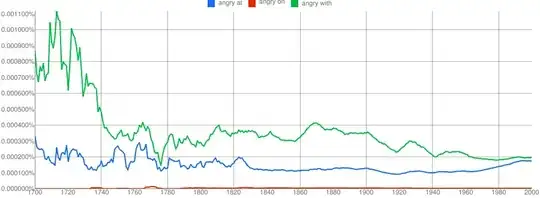
enter image description here

Urbycoz
  • 15,698
  • 2
    It could even be angry on is a literal translation from, for example, Dutch. "Boos zijn op" lit. "being angry on". – Zsub Sep 29 '11 at 10:20
  • I'm surprised "angry at" got so many hits. If my anger is directed towards something other than a person, I'd say "angry about" or "angry that." –  Sep 29 '11 at 11:46
  • This NGram suggests angry at [someone] has gained currency is US usage over recent decades (there's no such increase on the British side). I can't help feeling this is down to conflation with mad at [someone], as noted in @Andrew Vit's answer. – FumbleFingers Sep 29 '11 at 17:24
  • 1
    One of my asian friends uses "angry on" quite frequently, which I always thought was totally weird. Thanks for such a detailed answer. I am changing my acceptance to your answer. – highbeta Oct 03 '11 at 05:01
  • 1
    Almost all the dictionaries say that you can say either angry with a person or angry at a person, though the use of with is more common and idiomatic. According to Collins, the use of at was formerly considered to be incorrect, but it's acceptable now. – Khan Jul 14 '16 at 10:14
  • I grew up only having ever heard "angry at", and is only recently that I started hearing "angry with" all the time. Very interesting – insaner Nov 07 '18 at 01:19
8

The second one:

Are you angry with me?

is correct. Curiously, we also say "are you mad at me?" which can cause some confusion.

Andrew Vit
  • 1,960
1

Both angry at and angry with are correct. But 'angry on' is incorrect.

angry at/with somebody -

Are you angry with me? Are you angry at me?

References-

angry with (sometimes at) a person - Basic English Usage by Michael Swan

https://dictionary.cambridge.org/dictionary/english/angry -

He's really angry at/with me

https://www.oxfordlearnersdictionaries.com/definition/american_english/angry

  • angry with/at somebody

Please don't be angry with me.

https://www.ldoceonline.com/dictionary/angry -

My parents were very angry with me.

You can say that someone is angry at someone

Please don’t get angry at me.

https://www.youtube.com/watch?v=GTEailc5QSI -

Don't get angry with him. (Don't get angry at him)

  • If you can provide reliable sources that support “angry with / at someone ” it's an upvote from me. Great answers should either provide detailed explanations or references – Mari-Lou A Aug 11 '23 at 08:20
  • angry with (sometimes at) a person - Basic English Usage by Michael Swan/// He's really angry at/with me... - Cambridge dictionary/// angry with/at somebody- Oxford Learner's Dictionaries/// You can say that someone is angry at someone- Please don’t get angry at me. - Longman Dictionary of Contemporary English – Mohammad Farukh Ahmad Aug 16 '23 at 14:33
  • I should have said, the references (preferably with links) should go in the answer, not in the comments. Adding the dictionary links should be easy enough. – Mari-Lou A Aug 16 '23 at 15:03