0

Text to the left is said to be "leading" the text to our right, and text to the right is said to be "trailing" the text to our left. We also say the text to our left is "in front of" the text to our right.

I'm not sure I've ever heard someone say the text to our right is "behind" the text to our left, and I don't know if when someone says the text to the left is "before" the text to the right, means it as "coming sooner" or "is in front of".

Anyway, this paints the picture of characters having fronts pointing to the left and moving forward to my left. Why is this? Why would characters have fronts and move and move leftwards?

EDIT: Here are some examples (EDIT 3: To further clarify, these are not questions I'm making, these are examples I've found on the SE network of usages of the terms I'm asking for):

EDIT 2: Just to clarify. This question has nothing to do with shapes. I'm asking about why text has a sense of direction that faces leftwards.

JoL
  • 263
  • 2
    This has absolutely nothing to do with the nuts and bolts of the English language, and it applies to any left-to-right language using the Latin alphabet. – Andrew Leach May 31 '18 at 22:50
  • 1
    @AndrewLeach I just checked with my spanish-speaking co-workers and they have no idea what it means for one word to be "in front of" another or "leading" or "trailing" another. This seems to be a feature of english. – JoL May 31 '18 at 22:53
  • In that case, the last paragraph is irrelevant and misleading. The question needs to be better focused, and examples of the use of leading and trailing will help greatly, because (as a native speaker in England with some experience in graphics as well) I don't think I've ever heard that usage. – Andrew Leach May 31 '18 at 22:57
  • 1
    @AndrewLeach I've added some examples. The last paragraph is the question. If I remove it then it wouldn't be a question. How would you like me to revise? – JoL May 31 '18 at 23:08
  • Either you are asking about the words in front of and behind (on topic), or you are asking about the shape of the letters and the way they "face" (off-topic, because it's not confined to English). If you want to ask whether the use of the words is derived from the shape of the letters, then you will need to demonstrate which way they face. I reckon the most-used face right: b c e f h m n k p r s t. – Andrew Leach May 31 '18 at 23:15
  • 1
    @AndrewLeach I'm not talking about shapes. I'm using "face" to make sense of "in front of". Like something "in front of" a building is so because it's next to the "face" of the building. Would it be better to switch "face" for "front"? – JoL May 31 '18 at 23:19
  • No, because the "front" of the letter is ambiguous in exactly the same way. The letters b c e f h m n k p r s t have their front on the right, because that's the way they face. – Andrew Leach May 31 '18 at 23:22
  • 1
    I tried the switch. Ambiguous indeed. I didn't know letters also had fronts based on their shapes. Makes this even more confusing. Any advice? Would you like to move to chat? – JoL May 31 '18 at 23:27
  • @AndrewLeach I've stated twice that I'm not talking about shapes and I've added a clarification to the question. I've explained to you that my use of "face" or "front" has nothing to do with shapes. Movement has nothing to do with shapes. Leading and trailing has to do with movement. How do you mean, then? – JoL May 31 '18 at 23:40
  • 3
    My house has a front and a back, but that does not at all imply that it is moving. It has a front because that is the way from which it is normally approached to enter into it, not because that is the way it is moving. Letters (and words, paragraphs, pages etc.) can be in front or behind others because that is the way we read them. Specifically, you will read this letter “a” before you read this letter “b”, so the “a” is in front of the “b”. Naturally the whole text will have a sense of direction that faces left because that is the way text is meant to be read (from left to right). –  May 31 '18 at 23:41
  • 1
    @Lambie Obviously, I'm not making myself clear. I'm not asking about spaces specifically, nor sentences. I'm asking about the use of "lead", "trailing", and "in front of" with arbitrary pieces of text (characters/words/sentences/paragraphs/etc). You can't translate such usage literally to spanish (I don't know about other languages). In spanish we use "before" and "after". I was just curious about the reason it does make sense in english. Is that not ok? – JoL May 31 '18 at 23:49
  • @PaulDirac The sense of movement comes with the use of "leading" and "trailing", not "in front of". – JoL May 31 '18 at 23:51
  • Haven’t read all the comments, but isn’t this obvious? When you read a sentence which word do you read first? And which word comes after that one? – Jim Jun 01 '18 at 00:10
  • @Jim It's obvious for "after" and "before", which both languages share in usage. I've already addressed in another comment that such usage of "in front of", "leading" and "trailing" are meaningless for a group of spanish speakers. For the sake of guessing, one even guessed incorrectly. It's not obvious outside of english, and the question is why is it obvious? – JoL Jun 01 '18 at 00:28
  • A horse leads a cart. A cart trails the horse. If you see a horse and cart go by you you see the leading horse first and then the trailing cart. When you see words on a scrolling marquee go by, you see the leading words first then you see the trailing words. – Jim Jun 01 '18 at 01:14
  • In a queue, the ‘front’ person is the one who got there first. The same logic can be applied to text. The problem is that in other contexts, the order is reversed: seniority takes a back seat to novelty. That might be where the feeling of ambiguity comes from. – Lawrence Jun 01 '18 at 02:10
  • It is unclear what your question is. Are you asking why in writing, words written to the left are considered 'before'? And do you have evidence that other left-to-right written languages do not use the same metaphor? If that is or is not the case, either way please edit your question to simplify. – Mitch Jun 01 '18 at 15:11
  • Comments are not for extended discussion; this conversation has been moved to chat. – Yoichi Oishi Jun 06 '18 at 00:31

1 Answers1

1

Text layout:

  • A leading space= whitespace in front of a printed word or text.
  • A trailing space= whitespace after a word or at the end of printed text.

leading and trailing spaces in Microsoft Word

This idea of leading and trailing spaces comes from airfoil terminology where a wing on a plane is said to have a leading and trailing EDGE. The leading edge is the edge that faces into the wind and the trailing edge is obviously the other edge that does not face the wind and onto which the wind is swept over as the plane moves forward. I can't prove that but I can see no other origin from this idea.

leading space

BUT CAREFUL: In typography, leading (/ˈlɛdɪŋ/ LED-ing) refers to the distance between the baselines of successive lines of type. [taken from Wikipedia]

Pronunciation: A leading space is not the same pronunciation as leading, the distance between baselines of text. Leading is like the word metal. A leading space is like leader.

Example of leading from Adobe's InDesign:
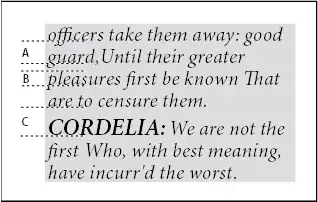
enter image description here

Explanation from Adobe:

The vertical space between lines of type is called leading. Leading is measured from the baseline of one line of text to the baseline of the line above it. Baseline is the invisible line on which most letters—that is, those without descenders—sit.

The default auto-leading option sets the leading at 120% of the type size (for example, 12‑point leading for 10‑point type). When auto-leading is in use, InDesign displays the leading value in parentheses in the Leading menu of the Character panel.

leading from Adobe

Leading, the space from one baseline of type to another, is standard for a size of typeface: 12-point; 14-point, etc.. BUT: you can increase and decrease it for effect. Most people think that in Microsoft Word only the number of line returns will increase or decrease white space between lines. That is not true. You can also increase and decrease the leading but Microsoft no longer calls it that. They call it: line spacing. And you can see it here: Microsoft line spacing, aka leading If you look in the Adobe example, you will see that the letters A, B and C mark three different leadings (spaces between baselines of the printed lines)

Whitespace Whitespace refers to the empty space around objects or text, and can take the form of margins, padding, or just an uncluttered area. It creates a pleasing visual experience and can even draw attention to text. In the first box below, the text is crammed against the bounding box, making it hard to read. In the second box, the text has breathing room and the design even looks more stylish.

Basic typographical terms

Also: Computer language:

In computer programming, white space is any character or series of characters that represent horizontal or vertical space in typography. When rendered, a whitespace character does not correspond to a visible mark, but typically does occupy an area on a page. For example, the common whitespace symbol U+0020 SPACE (HTML ), also ASCII 32, represents a blank space punctuation character in text, used as a word divider in Western scripts.

whites space character

I will not bother with a reference for: write a lead, which is a journalistic term and does not have anything to do with what I explained above. A lead is the first sentence in a news article.

Lambie
  • 14,826
  • 1
    I would guess we had leading and trailing text long before we had airplanes – Jim Jun 01 '18 at 04:28
  • You might want to review spaces and how they were made prior to software doing it all. http://widespacer.blogspot.com/2012_12_13_archive.html – Lambie Jun 01 '18 at 13:39