We say 'hundreds of', 'thousands of', 'millions of', even 'tens of thousands of', but not 'tens of'. The usual expression is 'dozens of'. Does anyone know why?
Asked
Active
Viewed 4.0k times
22

-
1We do say 'forties of' however. For example "We drank a few forties of..." – Oct 12 '11 at 14:32
-
3Usually we say "scores of" to capture multiples of 20. – The Raven Oct 12 '11 at 14:37
-
3Related: How to use “tens of” and “hundreds of”? – RegDwigнt Oct 12 '11 at 14:43
-
11Errr...I find "tens of" fairly common. – Oct 12 '11 at 14:48
-
1Of the first ten pages of a Google search I ran before posting the question about 90% of the hits were 'tens of thousands', with a few 'tens of millions/billions'. There were only 2 'tens of' (Bush supporters / dollars). – Shoe Oct 12 '11 at 14:58
-
1@ Erc Naslund. Do we? I don't. – Barrie England Oct 12 '11 at 15:00
-
@EricNaslund is making a joke: in the United States, very inexpensive "Malt Liquor" (fortified beer) and beer are sold in forty ounce bottles, often referred to as "forties." So, "We drank a few forties of Old E[nglish, a brand of beer]." urban D – Stop Slandering Monica Cellio Oct 12 '11 at 15:12
-
1@BarrieEngland: ...it is a joke, I am referring to slang for alchohol. When you say a forty, it refers to 40 oz, which is a possible size for a bottle of liquor. There is the connotation of drinking just to get drunk, and it is almost never used to refer to high class alcohol. (Note: I am from Canada, and even though we don't use the archaic imperial system and the ounce, this expression is still valid) – Oct 12 '11 at 15:24
-
Some versions of the Bible include the phrase "tens of thousands." The New International Version, for example, uses that expression a number of times, as in 1 Samuel 18:8; 21:11; and 29:5. See also Psalm 68:17 and 144:13. – rhetorician Jan 25 '18 at 12:09
5 Answers
13
We don't say tens of unless we are referring to larger numbers (tens of thousands, tens of millions, etc.). As pre-metric as it may be, here in the U.S. we say dozens for quantities between ~40 to ~100, which is approximately where tens would be appropriate if it were used.
That said, there is nothing wrong with referring to "tens of" something. It just sounds funny.
Update
For whoever downvoted me, here is a little perspective on the NGram issue brought up by onomatomaniak:

You can clearly see that when you compare dozens of to tens of for a couple of these identical constructions, the usage of dozens far outstrips tens. The only anomaly is when the noun modified is "miles," which is interesting but probably an outlier.
This illustrates the problem with Google NGrams. If you don't look at the orders of magnitude on the left, the "big jumps" can look very compelling. In fact, by comparison here the "tens of" lines, so compellingly vertical in the above graphs, vanish into flatlining insignificance.
I conclude from this graph that "tens of" is, as I say, falling out of usage, and is being supplanted by "dozens of."


4
We do say "tens of." Or at least, I and other English speakers do. It may not be as common as dozens of, but it's hardly unheard of.
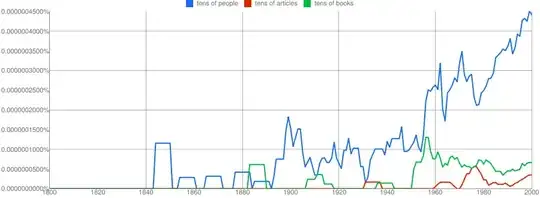
Here's an Ngram of three phrases I chose rather randomly. Note that all exhibit increasing usage in recent decades.
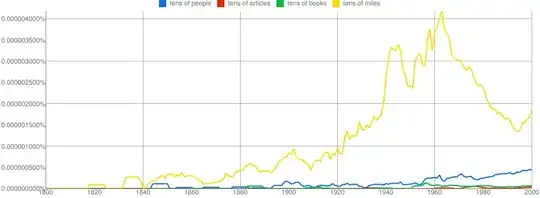
On second thought, I realized tens of miles was probably the way I've heard it used most often, so I added that in. The result:
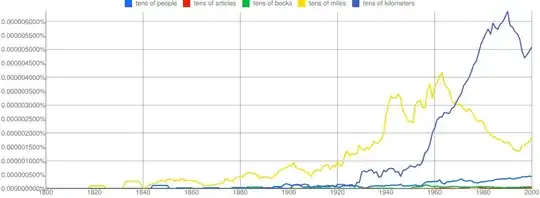
And, not to leave the metric system out, here's that graph plus tens of kilometers.
-
1Don't care what the stats say, "tens of" still sounds very strange, awkward, and unidiomatic to me. – Marthaª Oct 12 '11 at 15:32
2
Counting in 12s is a lot older than 1000s or millions. The traditional units based on 12 and 60 go back to the Babylonians, while 1000s mostly date back to the C18 metric system.
Indians also count in lakhs (100,000) and Crore (10,000,000)

mgb
- 24,191
-
3Add some references and you've got yourself an upvote. – Stop Slandering Monica Cellio Oct 12 '11 at 15:00
-
UK currency used to have 12 pence in a shilling. (But we also had twenty shillings in a pound.) – Barrie England Oct 12 '11 at 15:01
-
My question was about the reason for the relative rarity of 'tens of' as opposed to 'dozens of'. This answer hints at an explanation. The 12 pence to a shilling in former British currency may also be part of the reason, plus the fact that eggs were always sold by the dozen. – Shoe Oct 12 '11 at 18:52
-
@Shoe, and inches in foot and originally 12 ounces in a pound. It's mainly because it's easier to divide up 12 of something into 2,3,4,6 than it is to divide 10 – mgb Oct 12 '11 at 18:59
-
Add the etymonline link which clearly says that "dozens" is Middle English. I would like to upvote this answer https://www.etymonline.com/word/dozen You might even find references of "dozaines" or other spelling variants in 15th or 16th century literature – Mari-Lou A Feb 04 '18 at 12:39
0
I really like the idea to use NGram and I played with it a bit. It revealed one thing all the answers before missed: "Are you using British or American English?"
The phrase "tens of" is only one half as popular as "dozens of" in American English, but it's use is the same in British English. Check for yourselves.
So I believe it is related to the use of metric system and other cultural habits. To me as a European non-native speaker "tens of" sounds perfectly fine and possibly preferable inn certain cases. Unless referring to eggs, of course, where dozen is the only and ultimate way to count them.

Petr
- 203
- 1
- 2
- 7
-
You need to check the results more carefully. Ngrams are very deceptive at first glance. Yes, "tens of" is commonly said but coupled with tens of thousands; tens of millions, and several tens of metres to name but a few. – Mari-Lou A Mar 13 '14 at 06:33
-
Thanks for the note! You are right, I did not realized that. I chacked again, and you are right, the use other than "tens of thousands" is rare. – Petr Mar 13 '14 at 16:21
-1
We do say "tens". The OED:
B. n. (With plural tens; and (less usually) possessive ten's.)
A set of ten things or persons. ten of rupees, a unit of account in Indian money.
OE Rule St. Benet (Corpus Cambr.) xxii. 47 Tynum and twentigum on anum inne ætgædere restan mid heora ealdrum.
1539 Bible (Great) Gen. xviii. 32, I wil not destroye them for tens sake [1885 Bible (R.V.) for the ten's sake].
1611 Bible (A.V.) Deut. i. 15, I‥made them‥captaines ouer tennes.
1894 Field 9 June 839/1 They came forth in their tens, for thirty-eight members turned out on the occasion of the first meet.
1895 Westm. Gaz. 4 Sept. 5/1 The revenue was better by 74,000 tens of rupees.
1897 C. M. Flandrau Harvard Episodes 94 One never said of Wolcott, as is said of some fellows, ‘He made the first ten of the Dicky’.

morphail
- 1,229
-
1I think by do you mean did. The usage has pretty much died out. Also, the 1897 citation is not plural and does not have the same meaning. – Robusto Oct 12 '11 at 15:12
-
1
-
-
Do you mean a translation of Hindi? How do you know that the fifth citation is a translation of Hindi? It's from the Westminster Gazette. – morphail Oct 12 '11 at 15:22
-
-
@morphail - sorry typo. I meant that by saying 74,000 * tens they were translating a local usage where you count in 10,000s or 100,000s – mgb Oct 12 '11 at 23:14
-
It might be Indian English. But it was in the Westminster Gazette, so it might not be. – morphail Oct 13 '11 at 00:00