5

For instance, take the following sentence (from a real email exchange):

it is entirely possible that one WebEx is not enough

Is it correct? Should it be

it is entirely possible that one WebEx be not enough

?

My reasoning is as follows:

(1) it is necessary that you be here -->
(2) it is necessary that one WebEx be here --> 
(3) it is necessary that one WebEx be enough --> 
(4) it is necessary that one WebEx be not enough --> 
(5) it is entirely possible that one WebEx be not enough --> 

Is it true that the grammatical context is preserved throughout the entire transformation, starting with a sentence known to require the subjunctive (1) and ending with my example (5) ?

I have performed a few simple Google searches and the results are quite confusing:

  • "it is necessary that he be" yields 170,000 results
  • "it is necessary that he is" yields 342,000 results
  • "it is possible that he be" yields 985,000 results
  • "it is possible that he is" yields 4,040,000 results

Of course, no conclusions can be drawn from these results ...

Hugo
  • 67,535
mark
  • 367

4 Answers4

7

The phrase it is possible that can be followed by just about any tense you please. The adverb entirely has no bearing on the matter.

It is entirely possible that he was here yesterday.

It is entirely possible he's sitting in the library as we speak.

It is entirely possible that it will rain tomorrow.

etc.

It is necessary that is an example of an indirect command, which I got into some trouble by describing as a form that demands the subjunctive here.

It is possible that, though, is grammatically no different from it's likely that or it's unlikely that, forms which don't necessitate the plain, unconjugated verb (whether that's something you call the subjunctive or the "infinitive minus to").

  • 1
    Let me summarize it in one simple statement - using subjunctive is wrong in my context. Right? – mark Oct 12 '11 at 21:00
  • I wouldn't say wrong, but I would say nonstandard and, as an answer to your original question, certainly not required. –  Oct 12 '11 at 21:45
  • 2
    I was astounded at this crusade against the subjunctive earlier. Ordinary people (non-linguists) call it a subjunctive, and linguists have no right to prescribe us to stop using any word. – Cerberus - Reinstate Monica Oct 12 '11 at 23:09
  • Can you name one who does? – Barrie England Oct 13 '11 at 06:57
  • 1
    I think they're gunning for me, @BarrieEngland. Ordinary people mostly don't call it a subjunctive, because most ordinary people have never heard of a subjunctive. People with some traditional learning call it a subjunctive, and I haven't really got a problem with that, except that in the particular construction it seems an unnecessary complexity in a description of present-day English. – Colin Fine Oct 13 '11 at 10:37
  • @ColinFine I'm far too much of a pacifist to be gunning for anyone. I actually think you were probably right about the last one (particularly given Cerberus' useful note that the use of him and not he changes the situation quite a bit). The link was just laziness - I didn't feel like explaining what indirect commands were again. –  Oct 13 '11 at 10:56
  • @Colin: I still owe you a reply, or a comment, rather. I don't think I was mainly thinking of you: I know many modern linguists do not like the term subjunctive so much any more in certain (or, sometimes, all) constructions. I can accept that, as long as they don't unreasonably criticize those who still use it consistently in the traditional manner. // As to the "ordinary people" I referred to: I mean those who would analyse grammar at all, which, as you say, excludes many people who have never heard of the term. ... – Cerberus - Reinstate Monica Jan 11 '12 at 02:09
  • ... An advantage of the term subjunctive is that it makes connections with older English and other modern languages clearer; I personally don't understand why synchronic linguistics should push other people to use terms that obscure other branches of linguistics and common knowledge. I see this happen with other grammatical terms too; sometimes it almost seems as though they want to modernize for modernization's sake, or to surprise people and get more attention. But that is perhaps an unreasonable theory. – Cerberus - Reinstate Monica Jan 11 '12 at 02:09
  • @Cerberus: But, apart from the very few examples that can reasonably be called a (syntactic and morphological) subjunctive in English, what is the value in making connections with older English and other modern languages? English achieves the function in different ways, and unless you are studying another language, or studying English from another language, the fact that said other language uses a particular form or construction is at best irrelevant, and at worst positively misleading. – Colin Fine Jan 12 '12 at 18:41
  • @ColinFine: So you think there are no connections whatsoever between the subjunctive in modern English, older English, and other languages? You're basically saying that historical and comparative linguistics are completely irrelevant in choosing terms for phenomena in language? I don't think you actually mean that, but this is what it sounds like to me. I think diachronic, comparative, and synchronic linguistics, and the study of literature, work best in unison. How is (semi-)interdisciplinary research irrelevant? – Cerberus - Reinstate Monica Jan 13 '12 at 01:40
  • I'm not talking about research. I'm talking about explaining how the language works to a (relatively) uninformed person. If you're writing a theoretical paper it may be entirely relevant and indeed important to consider the diachronic relationships. If you're trying to explain how the language works practically, talking about the subjunctive is nearly (though not quite, I admit) as irrelevant as talking about grammatical gender. – Colin Fine Jan 16 '12 at 00:16
5

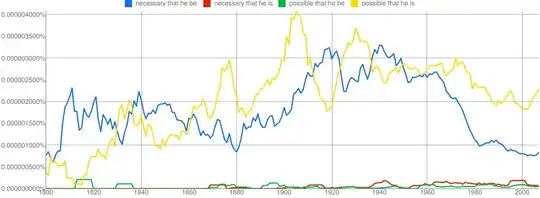
Traditionally, "necessary that he be" takes the subjunctive, as it is a demand; "impossible that he be" takes the subjunctive, as it is a counterfactual. The phrase "possible that he is" does not take the subjunctive, as it is neither a demand nor a counterfactual.

Remarkably1, for "necessary that" and "possible that", most sources used by Google Ngrams get it right:

enter image description here

The phrase "impossible that he ..." is much rarer than either of the above phrases, to the point that I don't trust Google Ngrams's graph because a sentence break often appears in the results I've checked. However, both the indicative and subjunctive moods seem to be used reasonably often with "impossible"

1 Particularly for a mood which has often been declared dead.

Peter Shor
  • 88,407
  • We must always bear in mind that nGrams, like many other resources, tell us only about the language as it appears in print. – Barrie England Oct 13 '11 at 19:56
1

The reasoning is based on a false premise. Contemporary English, at least contemporary British English, doesn’t use constructions like It is necessary that you be here in other than the most formal contexts. The normal expression would be You need to be here. It follows that It is entirely possible that one WebEx be not enough would also be appropriate only in the most formal contexts, so formal, in fact, that they would be unlikely to be the ones in which a thought such as this might be expressed. The normal way of saying it, again in BrEng, and depending on the time frame, would be It is entirely possible that one WebEx won’t be enough.

Barrie England
  • 140,205
  • Thanks. BTW, do I have to use the future tense? – mark Oct 12 '11 at 21:01
  • 1
    Google Ngrams shows "necessary that he be" is used much more often in the U.S. than in the U.K. by a factor of 5 (probably even larger because of misclassification errors on Google's part). – Peter Shor Oct 12 '11 at 21:15
  • @mark, it may be more natural to say "will not be enough" (future) in many contexts, but there might be a slight nuance too. While we're thinking ahead, I thought I'd mention it's possible that one spy won't be enough for our devious plot! or Now that I've laid the plan on the table, it occurs to me: it's possible that one spy isn't enough for our devious plot! both sound fine to me :) – aedia λ Oct 12 '11 at 21:18
  • 1
    As I said, Mark, the form of the verb you use in the 'that' clause depends on the time frame. (In any case, English does not have a future tense, but uses several constructions to express the future.) – Barrie England Oct 13 '11 at 05:54
  • @BarrieEngland: +1 for "English does not have a future tense". – Colin Fine Jan 12 '12 at 18:32
1

Aside from "be not enough" sounding archaic, there are some shades of difference between your first two example sentences; which, ignoring irrelevant words, might mean "Maybe one x won't suffice" and "Maybe we have to require multiple x's".

In terms of modern English, the derivation goes wrong between steps 2 and 3 or 4. I'd expect to hear "... one WebEx won't suffice" or (as Barrie suggests) "... one WebEx won't be enough" instead.