55

I know that Google got its name from the word googol (10100), and that Google/google referring the search engine/using the search engine are recent additions to the dictionary. Their definitions are easily found for such meaning (example).

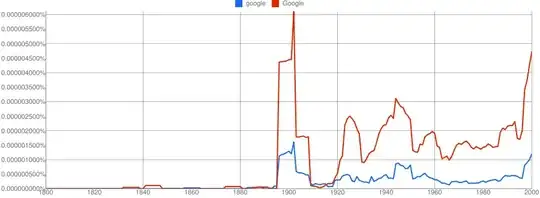
However, just for kicks, I did a Google Ngram search for the word "google" and "Google" and got some interesting results:

enter image description here

There is a drastic spike in the use of the word "google" around 1900, well before the website, or even the internet, existed. There is then some use throughout the next hundred years, where it starts to climb (because we now have Google).

Clearly this word had some meaning in the past ‒ does anyone know what it was?

Hugo
  • 67,535
yoozer8
  • 8,752

7 Answers7

66

Here's an attempt for an answer drawing from credible and/or official sources. The best sources we have are the books themselves that create the Ngram in the question. If we click through to some of the results between 1898 and 1902 (for example), we can categorise them as follows:

Variation of goggle-eyed:

  1. "Gilded, gilded o'er, gilt edge on, glorious, google eyed, got a big head, got a bundle'jsgot a drop in the eye, got a smile on, got the gravel rash, greetin fou', groatable, groggy, gutter legged, guzzled. "
  2. "He was google-eyed and spiflicated."
  3. "Say, Mr. Pierce, couldn't you swipe that google-eye from Mrs. de Rutyer. She makes me so nervous when she points it at me that I feel like dropping."
  4. "On, say, drop dat google-eye, said Rade, in disgust."
  5. "Aha! And so you'd like to call my son after that google-eyed idiot you were engaged to before I met you !"
  6. "His tongue was much too large for his mouth, his legs were much too weak for his body, and his dull google-eyes stared and rolled like an idiot's."
  7. "It made him google-eyed and he walked off the Curb."
  8. "I'm sure that archers google-eyed"
  9. "Common Rock Bass ; Red-eye ; Google-eye" aka goggle-eye

Synonym for surf-scooter duck, aka goggle-nose:

  1. Popular synonyms: Surf Duck. Sea Duck. Horse-head Coot. Surf Coot. Google-nose. Gray Coot, etc."
  2. Popular synonyms: Surf Duck. Sea Duck. Horse-head Coot. Surf Coot. Google-nose. Gray Coot, etc."
  3. Popular synonyms: Surf Duck. Sea Duck. Horse-head Coot. Surf Coot. Google-nose. Gray Coot, etc."

Onomatopoeic gurgle noise:

  1. "He broke into a light Irish song, dancing the baby up and down until the little one bade fair to google itself out of breath."
  2. "A hurried visit to the cellar and the peculiar "google-google" sound led to a barrel which had been full of No. 1 Coach varnish"

Definite OCR error:

  1. "Goods manufactured."
  2. "Congleton"
  3. "1. O E. French, Lura Phillips, WF Chevalier, OE Klingeman, Carrie Coogle FE Buck, David Williams, ATS Owen,"

OCR is optical character recognition, the method of scanning pages and automatically attempting (not always successfully) to convert it to plain searchable text.

Unknown:

  1. "And vowed a most tremendous vow, By the great Google Tree,"
  2. "It 's right over yander at de head er de dreen — A-wish, wish, wishin' — Whar de branch runs google, an' de leaves is green— Des a-wishin'." Possibly nonsense/onomatopoeic from a child's lullaby.
  3. "It 's right over yander at de head er de dreen— A-wish, wish, wishin'— Whar de branch runs google, an' de leaves is green— Des a-wishin'."
  4. "Googie, George E" a soldier's surname, is it Googie or Google? Probably the same as the surnames below.

Unknown, Google Books image illegible, probably OCR error:

  1. "A. B "Google", John Carr, George Courtright", OCR error of a soldier's surname
  2. "OE KUngeman, Carrie Google. FE Buck, David Williams". Another surname.
  3. "Google Chas. W. Griffin Ivan Grimm Wm. F. Harris Krnest". Another surname.
  4. "FB Clayton, JP Google and others", OCR error of a surname
  5. "so they sit under the trees making merry over "google" and cake"
  6. "Googie, splendid color and markings, beat a nice housebred cat, not as clear or distinct in color." I think this says Googie and is the name of a cat in a list.
  7. "Not one of the pets Ever quarrels or scolds; They sleep and they wake And they crow and they coo And they talk in the language Of Google -goo-goo, (And they all take In Babyville there Are animals. too; tjaby kittens and bears". Probably nonsense word.

Unknown, no preview:

  1. Link
  2. Link
  3. Link, possibly OCR error from Matlese text
  4. Link
  5. Link
  6. Link
  7. Link
  8. Link
  9. Link
  10. Link
  11. Link
  12. Link, from a Spanish-English pronouncing dictionary
  13. Link

Summary:

  • So the most common by far is google-eyed, a variation of goggle-eyed. The next is a variation of google-nose as a synonym for a duck that's also known goggle-nose.
  • Next comes goggle as an onomatopoeic gurgle noise.
  • There are some clear OCR errors (Goods, Congleton).
  • There are quite a few surnames, at least one is an OCR error of the American Coogle, another could be Googie and I suspect the others were misspelling in American documents.
  • Other uses appear to be either nonsense, onomatopoeic, made-up rhyming words or simply unknown.

Finally, although we didn't encounter them in this sample, the OCR often gets the published date wrong and a recent book about the Google search engine may appear in the results as if it were published in the early 1900s.
RegDwigнt
  • 97,231
Hugo
  • 67,535
  • 10
    Comprehensive response, nice work. – Ashley Oct 24 '11 at 10:22
  • 4
    +1. I wanted to make this answer and then I decided to check whether anyone else had. ;-) – jprete Oct 24 '11 at 12:27
  • 2
    +1, Great answer; you cover it all. Regarding the wrong published date - there are also instances when the book is classified according to the first published date and it has introduction or references that were written later. – Unreason Oct 25 '11 at 09:13
  • @Unreason: Thanks. Yeah, I was expecting more onomatopoeic gurgle noise, but at least it got the baby noise and the liquid gurgle :) Douglas Harper from etymonline.com doesn't cite from Google Books snippets, only full-view, because of Google's unfortunate habit of running book files together and mis-dating sources. – Hugo Oct 25 '11 at 09:26
  • It was also the surname of the 20s comic strip character Barney Google (with the goo-goo-googly eyes!) by Billy de Beck. There was a song "Barney Google", recorded by Edison 1923 (and also by Spike Jones in the 30s). –  Jul 03 '12 at 11:25
  • 2
    In Australia a googie is an egg, as in "How do you want your googie, hard or soft?" It is an expression I used most of my life and so did everyone I knew. So it wasn't a family thing. Also as an expression full as a goog or full as an egg. Pronounced like would, not as in goulg, but it is not spelt like would. Maybe it was an expression modified by a cricketer, I don't know. –  Jan 26 '13 at 12:45
  • Hugo, I clicked on the search link (google in the period of 1898-1902) you gave. I got this message - Your search - "google" - did not match any book results. Did you get different results that time? – user13107 Jul 14 '13 at 08:14
  • @user13107: Yes, I had lots of results back then, at least the 42 that I categorised in the answer, but it appears broken now. The link came from the Ngram, I repeated it now, and get nothing. Google must have broken something because at least were valid "google" words (and not OCR errors), such as the onomatopoeic gurgle noise. – Hugo Jul 14 '13 at 09:21
  • The links must have changed since you posted them last. I've clicked on all of them and there was not a single instance of any citations you have written. I even tried googling some of the quotes but received negative responses. – Mari-Lou A Dec 18 '13 at 23:28
  • @Mari-LouA: How strange. It appears Google has changed the format of the links and the ones I used are no longer valid. For example, here's a working duck synonym from a fresh search. – Hugo Dec 19 '13 at 03:29
  • I'm sorry, I hadn't read the previous comments. Invalid links were something that you were already aware of. – Mari-Lou A Dec 19 '13 at 06:33
  • Just a note on the "nonsense" form in the lullaby. Uses like "the branch runs google" means where it forks, crooks or kinks. My grandfather used to say a few phrases like this, usually for when something regular changes dramatically ("gets all google" or "goes google"). Fits right in with other phrases like "kajiggered", "wompy-jawed", and some uses of "fanagle". – zxq9 Feb 14 '16 at 08:19
22

Google's Ngram database is built automatically from scanned books. This is an error-prone process. Google blames words occurring too early on scanning (OCR) issues, i.e. the original book contains a word similar to "Google".

Spikes at 1900, 1905 are common in ngram searches. Google does not give an explanation, but it seems likely that books which could not be dated were accidentally filed under 1900 or 1905.

Jan
  • 363
  • 1
    Wow! I checked some of those 1905 "internet" spikes and they're really ""interest", "Internat.", Infernet", "spina interna" or a 2007 book. Also there's real use of "google" as an onomatopoeic gurgling word. – Hugo Oct 21 '11 at 23:18
  • and yahoo can refer to an unruly person. – Peter Olson Oct 22 '11 at 00:11
  • 1
    @Peter Yahoo:http://en.wikipedia.org/wiki/Yahoo_%28Gulliver%27s_Travels%29 – Dr. belisarius Oct 22 '11 at 01:51
  • 1
    In the interest of comprehensive research: http://www.imdb.com/character/ch0007147/ – JeffSahol Oct 22 '11 at 17:22
  • "Congressional Record - Page 5304 Etats-Unis. Congress - 1935 - ‎ It is available on the Wide Area Information Server (WAIS) through the Internet and via asynchronous dial-in. Internet users can access the database by using the World Wide Web;" In actual fact the document is dated January 16 1999. How did 1999 get confused with 1935?! – Mari-Lou A Dec 19 '13 at 08:42
16

First thing I thought of was "googly eyes", but your ngrams search also pulled up a lot of hits on Barney Google, a comic strip character. Check out the Googly Eyes article in Wikipedia and links from there.

JeffSahol
  • 18,696
12

I had a look in the OED and it says that google has been used when to speak of a cricket ball as a verb since the early 1900's as a back-formation from googly (−> A ball which breaks from the off, though bowled with apparent leg-break action.)

google, v. Cricket.

[Back-formation from googly n.]

intr. Of the ball: to have a ‘googly’ break and swerve. Of the bowler; to bowl a googly or googlies; also (trans.), to give a googly break to (a ball). Hence 'googler, a googly bowler.

1907 Badminton Mag. Sept. 289 The googlies that do not google.

1909 Westm. Gaz. 5 July 7/4 Mr. Lockhart, having ‘googled’ to no purpose from the ‘nursery’ end.

1923 Daily Mail 9 July 11 In R. H. Bettington they have a googler who might triumph over the best of wickets.

1928 Daily Tel. 12 June 19/2 Constantine..was out to a semi-yorker, which also ‘googled’.

1930 Ibid. 25 Apr. 8/5 Grimmett..can spin the ball and google it.

None
  • 4,216
6

As @Hugo points out OED has a mention of 'google eyes' from 1540.

This comes from the 'The Byrth of Mankynde", the English translation of Eucharius Roslin's Der Rosengarten, a very popular book on childbirth and care of infants first published in German in 1512.

The relevant section describes a cure for strabismus in children:

"Of google eyes, lokynge a squynt

Yf the chylde have google eyes or that it loke a squynt, then fyrst set the cradel in such a place that the lyght maye come directelye and ryght in the chyldes face neyther in the one syde neyther in the other, neyther above the heade, leste it tome the syghte after the lyght. Also marke on whiche syde that the eyes do gogle, and let the lyghte come unto it on the contrary syde so to retorne the syght. And in the nyght season set a candell on the contrarye syde so that by this meane the goglynge of the eyes may be retorned to the ryghte place. And farther it shall be good to hange clothes of divers and freshe coloures on the contrary syde and spetially of the coloure of lyght grene or yelowe for the chylde shall have pleasure to beholde these strange coloures, and in retornynge the eye syghte towarde suche thynges it shalbe occasion to rectifye the syght agayne". (quoted in Rick Bowers 1999, "Thomas Phaer and The boke of chyldren (1544)" page 75)


'Google eye' and 'google eyed' in the more descriptive sense can be found almost as far back, though with spellings like gogle or goggle:

  • A book of instructions of how to teach and learn Latin from 1570. :

    "And as a foote of woode is a plaine shew of a manifest maime, even so feete, in our English versifiing, without quantitie and joyntes, be sure signes, that the verse is either borne deformed, unnatural or lame, and so verie unseemlie to look upon, except to men that be gogle eied them selves."

    - Roger Ascham The scholemaster. (1570)

  • A play performed in 1601 :

    "Give him warning, admonition, to forsake his sawcy glavering grace and his goggle eie"

    - Ben Jonson Poëtaster, Or, His Arraignement: A Comical Satyre (played 1601, print 1616)

  • A Dutch-English dictonary from 1665

    "Puyl.oogen, Swoln Eyes, or standing out, or goggle eyed
    Puyl oogende zijn, To be Goggle-eyed"

    - Henry Hexham/Daniel Manly: A copious English and Netherdutch Dictionary (1665)

  • A Treatise on Astrology from 1712

    "Persons that are born under Leo, are generally of a full large Body, Courageous and Stout, Hair of dark Flaxen, or yellowish; great Head, gogle Eyes, of a generous Disposition, an aspiring Brain, and an active Body."

    The Universal Library: Or, Compleat Summary of Science (1712)

  • And less commonly the verb: to goggle

    No sooner dit the Knight percieve her,
    But streight he Fell into a Fever,
    Inflam'd all over with disgrace,
    To be seen by her in such a place;
    Which made him hang his Head and scoul,
    And wink, and goggle like an Owl

    Samuel, Butler Hudibras 1684 (quoted from edition of 1704)

  • Interestingly Webster1828 has an entry for this verb, together with adjective and noun:

    GOG''GLE, v.i. [L. celo; or from gog.]
    To strain or roll the eyes.
    And wink and goggle like an owl.
    GOG''GLE, a. Having full eyes; staring.
    GOG''GLE, n. A strained or affected rolling of the eye.

Mario Elocio
  • 2,187
5

Google was never a word as such before the eponymous search engine.

As @JeffSahol notes, there was the comic strip character Barney Google. Also it was sometimes used as an onomatopoeic variant of goo goo ga ga for pre-speech babies' vocalisations. Which I suspect was a factor in the 1930s coinage googol (leading to googolplex), since it ostensibly came from a child.

Unsurprisingly, the "mis-spelling" googleplex now outnumbers googolplex by a factor of 10 on Google!

FumbleFingers
  • 140,184
  • 45
  • 294
  • 517
  • 19
    The "Googleplex" is the name of the Google headquarters. – Simon Richter Oct 21 '11 at 19:03
  • oic. Well I suppose they would assiduously index that one, wouldn't they? But actually, in GoogleBooks the -gol form is 2-3 times more common. – FumbleFingers Oct 21 '11 at 19:09
  • 1
    @FumbleFingers But if you include post-2000 and both upper and lower case, Google HQ has taken the lead. – Hugo Oct 21 '11 at 23:11
  • 1
    Except that it was.

    'Google' is used in Enid Blyton's 'The Magic Faraway Tree' series, published between 1938 and 1951. In the books, the characters eat delicious cakes called 'Google Buns'.

    – AMc Dec 08 '22 at 17:07
  • @AndrewMcCombe: Don't leave us hanging, then! Somewhat disappointingly, it seems Enid Blyton and/or whoever now owns the publishing rights aren't particularly generous spirits (unsurprising, given the somewhat shocking experience I had a couple of nights ago watching the biodrama / horror movie Enid). I can't find any instances of google bun[s] in Google Books - none in Blyton's actual books (because they're not indexed), but none in any other sources either. Whatever - imho it's still not really a word* as such* if no-one else used it! :) – FumbleFingers Dec 08 '22 at 20:42
2

An erroneously marked "first instance" of Google in written text is in 1903.

It was used because hobo had class connotation that caused such offence "that it would hardly be safe to repeat" (repeat from his last work).

So Google was a nonsense or nonce word coined to create a class of person outside the current (at the time) class system.