0

I enjoy socialising with people!

How do you pronounce “th” in “with”? It’s too confusing for me. When I looked it up in a dictionary, it was with a voiced sound like in "brother or the," but it sounds difficult when the word “with” is followed by consonants, such as “with people.” In such cases, how should pronounce "th"? Should I pronounce it with unvoiced sound as in "think"?

I don’t have problems while saying the word "with" alone or followed by vowels, such as, in "with you"; It should be voiced like in "the," but the problem is when followed with consonants I heard natives pronounce "th" in "with" as you would in "think and thing."

herisson
  • 81,803
  • 1
    You can use this website to compare the pronunciations of words with different accents. – ParaH2 Sep 11 '18 at 20:35
  • I presume you mean consonant. The issue, however, is not that complicated: when pronouncing with people, the ending sound with the first word requires you to use your tongue, whilst the beginning sound with the second requires you to do so with your lips. The problem you may be facing is due to your mother tongue and, as a result, it's taking you time to work with certain combinations. – Schwale Sep 11 '18 at 22:09
  • 2
    The th is not voiced in with. If you have difficulty with certain consonant combinations, say the first word normally, stop (but don't breathe), then start the next word, reducing the time you pause. With the th sound, concentrate on getting the tip of your tongue back in quickly — think of the darting tongue of a lizard or snake. – KarlG Sep 11 '18 at 23:00
  • 1
    @KarlG While many American speakers always have a voiceless /θ/, the th in with IS voiced /ð/, at least in RP and in terms of phonemes. See my answer for more. – Nardog Sep 12 '18 at 06:58
  • 1
    @Nardog Another example of something I'd never have imagined that RP and AmE are so different in this one small thing. My first reading of the question is that that's crazy, everyone says /wiθ/. Does this generalize to other words ending in 'th'? – Mitch Sep 12 '18 at 12:12
  • @Mitch I don't think it can be generalized because obviously RP speakers can still distinguish teeth/wreath and teethe/wreathe. That said, LPD reports 58% of British speakers preferred /ð/ in bequeath. Also apparently some speakers pronounce loath with /ð/ in both AmE/BrE, though /θ/ is more common in both. – Nardog Sep 12 '18 at 12:33
  • @Nardog also there's the sound change like wolf -> wolves for th: bath /bæθ/-> bathe /be:ð/, path /pæθ/-> /pæðz/ (the latter seems to be not as common in the US anymore) – Mitch Sep 12 '18 at 13:00

1 Answers1

3

The phonemic, i.e. prototypical, pronunciation of the word with in British Received Pronunciation is /wɪð/, with a voiced /ð/, as in the.

However, in contexts like "with people", with may be pronounced with a voiceless [θ], as in think, even in RP. This is because the word people starts with a voiceless consonant, /p/. Unless followed by a voiced sound such as a vowel, the voiced obstruent phonemes of English /b, d, ɡ, dʒ, v, ð, z, ʒ/ at the end of syllables are partially or wholly voiceless, which are then distinguished from the voiceless phonemes /p, t, k, tʃ, f, θ, s, ʃ/ only by when the preceding vowel ends. (See this blog post and the answers to The pronunciation of ending "s" and Are "whores" and "horse" homophones?.)

So if you want to speak RP, it wouldn't be incorrect to use a voiceless [θ] in with before words which start with a voiceless consonant, like people. Strictly speaking, since it ends phonemically with /ð/, the vowel /ɪ/ in with must be slightly longer than that in e.g. myth, which ends in a voiceless /θ/, but since with is a function word, which is most often unstressed and pronounced very quickly anyway, the distinction in vowels is most likely irrelevant in this particular case.

Meanwhile, many American and Scottish speakers pronounce with consistently with a voiceless /θ/, even when followed by a voiced sound. From Longman Pronunciation Dictionary by John Wells (source):
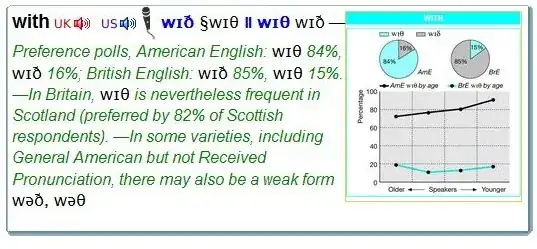
Pronunciation of "with" from Longman Pronunciation Dictionary

Nardog
  • 1,732