60

This is hard to describe, but I'm curious about what the proper word is for these thingies in English.

So I searched for a picture on Google and circled what I'm referring to with red:
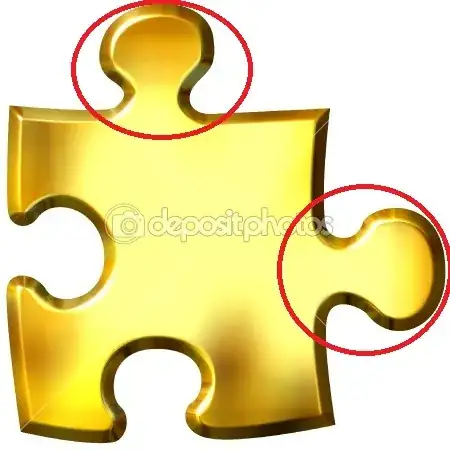
Puzzle piece with the questionable parts circled with red.

Brian Nixon
  • 3,281
Venemo
  • 989

8 Answers8

56

This kind of puzzle is called a jigsaw puzzle, and the corresponding Wikipedia page uses the terms tabs and blanks. (The parts you've circled are the tabs.)

Looking further throws up many citations for "tabs": this book on DNA computing calls them jigsaw tabs (and pockets), this book on programming also mentions interlocking tabs, this issue of Make magazine calls them jigsaw tabs (and slots), and there are lots of other books. There seems to be more consensus on what to call the circled pieces you want (tabs) and less on what to call the other kind (blanks, pockets, slots, indents...).

You can also trawl through search results for jigsaw (tab OR tongue OR outie), to compare the answers suggested. (Need to look at each result individually to make sure the word is used in the right context. In fact most results aren't about the context we want. :-))

However, it is also a fact that there is no universally accepted terminology. For instance, this book on the history of jigsaw puzzles says on page 10 that

Despite a few attempts at a comprehensive classification of piece shapes and cutting designs, there is still no generally accepted nomenclature. Manufacturers use a variety of terms, as do puzzlers. Puzzle pieces can have "loops" and "sockets", "knobs" and "holes", "tabs" and "slots", "keys" and "locks", or any of several other alternative designations.

ShreevatsaR
  • 27,572
  • @Venemo: Unfortunately, I just updated my answer to show that blanks may not be universal. :-) But tabs seems to be used widely. – ShreevatsaR Nov 08 '11 at 12:07
  • How do you call the act of connecting the pieces, i.e. "some repeating patterns makes it harder to compose the puzzle"? – Shimmy Weitzhandler Jul 16 '13 at 14:21
  • Well according to the wiki link you provided, I've learned it's "assembling puzzles" – Shimmy Weitzhandler Jul 16 '13 at 14:23
  • 1
    Just as a curiosity - I have never, ever, ever heard them referred to as either tabs or blanks ..... and I work in a related software engineering field. – Fattie Mar 27 '14 at 09:24
  • @JoeBlow: What does software engineering have to do with jigsaw puzzles? And what have you heard them referred to as? When I did the search back when I posted the answer, I did find an overwhelming majority of sources use "tabs", as I said in the answer. – ShreevatsaR Mar 27 '14 at 09:28
  • 2
    Hi Shree! - every single jigsaw puzzle (since perhaps 1995, I'm not sure) is made using software. The only engineers working in "jigsaw construction" are, indeed, programmers. Other than a handful of hand-made wooden jigsaw cutters, the only people who would use "jigsaw terminology" are programmers. (Note you reference a programming book?) Are you a native English speaker by the way? Regarding google searches, I find they have no relation at all to actual-usage on the street; you tend to find a few formalish references. Also, see my comment on Matt's answer below. – Fattie Mar 27 '14 at 09:42
  • It would be interesting to indeed just telephone ravensburger and ask them what the hell word they use! (I bet for the new spherical technology they have come up with something typically german and accurate! :) – Fattie Mar 27 '14 at 09:45
  • @JoeBlow: You didn't answer: What have you heard them referred to as? :-) And in any case the number of people playing jigsaw puzzles is much larger than those constructing them, so it's not clear that the terminology used by programmers should be taken more seriously than that used by those marketing, playing, or studying jigsaw puzzles. – ShreevatsaR Mar 27 '14 at 09:47
  • Hi Shree, like I said I'm wondering if you are a native English speaker? Regarding what I have heard them referred to as, as I have repeated a number of times (also see my loooong answer), that even amongst aficionados, even in the games industry (eg, at Hasbro, etc), there is no term and they are referred to in an adhoc manner (exactly as JustinY pointed out, way back when). (Regarding the last sentence of your comment, it's a non-sequitor; I'm not saying anything should be "taken more seriously" [as opposed to sarcastically? what?] I'm just discussing how different groups use it. – Fattie Mar 27 '14 at 09:53
  • @JoeBlow: Sorry I didn't notice you had posted an answer: I was only notified of your comments here, and I additionally looked at your comment on Matt's answer because you pointed me to it, and in neither place did I see your view that there is no consistent term. That may well be the case, but as the answer above shows, at least one term that exists is "tabs", and it has enough support in books. Other terms may also have some support. To take X more seriously than Y is to give it more importance than Y. – ShreevatsaR Mar 27 '14 at 10:34
  • @JoeBlow: Finally, I'm not sure why you're seeking personal information about me. (You can look at my profile to see my other answers on this website.) If you really need to know, I can tell you (English is the medium of all my education, the language I'm most comfortable in, and I find the notion of "native speaker" one that imperfectly captures one's proficiency in a language, e.g. given that it's native speakers who make more mistakes of the your/you're, their/they're type), but this is a strange question to encounter on the internet. – ShreevatsaR Mar 27 '14 at 10:36
  • Hi Shree - you may have misunderstood me, I was wondering what if any the common term is in your native language! :) – Fattie Mar 28 '14 at 05:19
  • @JoeBlow: Ah ok. :-) Sorry for any misunderstanding; I wasn't in the best mood yesterday. I actually agree that there aren't any common terms in English either: I've updated the answer to say that. – ShreevatsaR Mar 28 '14 at 05:35
  • I am never in a good mood, and I think pretty much EVERYTHING ever said on the internet is misunderstood :) Cheers! – Fattie Mar 28 '14 at 09:06
  • If an "innie" is a "blank", what do you call a side with neither innie nor outie? – Davo Jun 26 '17 at 11:45
  • Please lets all make this "Loop & Socket". That is just super catchy. Moving forward, lets all agree that is the correct terminology!!! – Paul Ishak Jul 02 '20 at 13:49
  • 1
    Not having thought of this before, I would have guessed tabs and notches (they aren't really slots, which are what tabs are often inserted into). – Drew Jan 30 '21 at 00:21
  • I have never heard ''tabs'' and ''blanks'' before, I would just call them ''links'' as they are used to link several pieces together and link is common English. – Hollis Williams Jan 31 '23 at 19:56
25

Speaking as a fully-qualified jigsaw puzzle solver, I can say that the standard word is an outie. Terminology shared with belly-buttons, except normally only jigsaw outies interlock with innies.

According to this glossary people also call them tabs or knobs, but the problem there is they don't have an obvious term for the corresponding innie, so I'd stick with outie. A jigsaw is a game anyway, so there's nothing wrong with using childish terminology.

FumbleFingers
  • 140,184
  • 45
  • 294
  • 517
  • 2
    Innie and outie sounds a bit more casual than tab and blank. – Venemo Nov 08 '11 at 12:06
  • 1
    Oh, before your edit I thought that "fully-qualified jigsaw puzzle solver" meant that you had participated in some state-/national-level jigsaw puzzle-solving competitions or something like that. :-) I would be disappointed to learn that no such thing exists. – ShreevatsaR Nov 08 '11 at 12:19
  • 1
    @ShreevatsaR: Nah - my qualifications aren't quite so formally-recognised. But I did spend a lot of time in hospital throughout my childhood, and there wasn't much else to do there for several weeks every year! – FumbleFingers Nov 08 '11 at 12:59
8

All I can suggest is tongue, as in the joint in carpentry known as tongue and groove.

Barrie England
  • 140,205
  • You make me think, "dog" wold be a great term here. (Since it is, exactly that, a dog.) I wonder does anyone know, what's the female version of a dog called? Probably a sailor or old-days carpenter would know this? – Fattie Mar 27 '14 at 09:44
  • A 'female version of a dog' is surely a bitch @Fattie – Arm the good guys in America Aug 13 '17 at 20:06
  • You know @Clare "dog" also means (ask, say, a sailor or engineer), a "projection" that is used to grab or stop something - picture something like, oh, a coat-hook or a stick of metal poking out. Example, imagine a shuttle or something that whips along on some steel rail: at each end there's like a lump of metal sticking out (think like a dowel) that stops it moving at the end, you call that thing a "dog"........ indeed it occurs to me the opposite of that type of "dog" would be a "notch" probably. – Fattie Aug 13 '17 at 21:55
7

I believe 'tenon' and 'mortice' are the appropriate technical terms.

  • That's interesting, considering everything else suggested on this page doesn't mention either. What leads you to this conclusion? – Matt E. Эллен Mar 14 '12 at 21:25
  • 2
    @MattЭллен: I don't know about jigsaw puzzles, but these are the preferred terms in woodworking http://en.wikipedia.org/wiki/Mortise_and_tenon. I, personally, would find it natural to borrow terms from woodworking (if they didn't exist already). And so, I +1'd it. But that's just what I'm inclined to do. – prash Mar 14 '12 at 21:31
  • but then, I'm not an expert at woodworking either. Though "mortice and tenon" is a very specific kind of joint, the same terms are used for a few other types of joints. – prash Mar 14 '12 at 21:53
  • 2
    +1: Given that jigsaw puzzles originated in woodworking, I think this is a plausible conjecture. I am used to seeing it spelled mortise, however, but either is correct. – Robusto Apr 08 '12 at 14:29
  • It is exactly, precisely correct that tenon and mortice are appropriate technical terms. I don't know if you can say they are "the" technical terms. – Fattie Mar 27 '14 at 09:26
4

Looking at the Wikipedia article on jigsaw puzzles, they use the word tab:

Some fully interlocking puzzles have pieces all of a similar shape, with rounded tabs out on opposite ends, with corresponding blanks cut into the intervening sides to receive the tabs of adjacent pieces.

(emphasis added)

  • 1
    Who cares what someone writing on Wikipedia, used to describe the issue? So what? The person writing there is not saying "the word usually used is 'xyz', the person writing there is simply describing them. (Exactly as the OP describes them in some other way.) – Fattie Mar 27 '14 at 09:25
3

There's a very important point here:

In English, it's reasonably common that - strangely enough - there IS NO WORD for a certain fairly common thing.

(There's possibly actually a term for this phenomenon - like "grasp words" or "thingy words" or something.)

Note for example, Justin's first comment on the question - which is totally correct and typical.

I have never, ever, ever heard them referred to in any way, in English, other than something like "the thingy that sticks out" "the hole thing on the edge" "the whatever tonguey thingy"

Note that even if you look at software (like the actual computer code, in c# of whatever, relating to machines that cut puzzles) you just seeterms like TheOutThingy OneOfTheHoleThings and so on.

Again - in my opinion - among English speakers it's reasonably common that - strangely enough - there IS NO WORD for a certain fairly common thing. We stick with "thingy phrases" and sort of deliberately don't settle on a word. IMO the - thingies - on jigsaws are a perfect example of this.

So, IMO, there is literally no word for these in English - even among jigsaw aficionados or in the games industry.

{A small point: Note too that the jigsaw-puzzle industry is largely German, as it happens, so you could possibly look to the German language for guidance here, if you're trying to "decide on" what we should all call these thingies.}

{Another small point - note that, wildly confusingly, "jigsaw puzzles" are called "jigsaw puzzles" in certain English speaking areas, BUT, are called .. wait for it .. "puzzles" in other English speaking areas.}

Fattie
  • 10,520
  • Thanks, nice thought! I've already settled with 'tab' and 'blank' (because they were shorter), but it's always nice to see more insight into English :) – Venemo Mar 27 '14 at 12:05
  • 1
    Right. In my family (British English) we've always called them "the sticky-out bits". Although there might be specific terms which are technically correct, they're not likely to be widely recognised. – A E Oct 20 '14 at 11:50
  • yeah "sticky-out bits" is the highly technical term :-) – Fattie Oct 21 '14 at 12:11
  • German is just as confused: Noppe, Nase, Knopf, Zapfen, Ausbuchtung for 'outies' [~bobble, nose, button, tongue in the woodworking sense, bulge] and 'Loch (Nasenloch, Knopfloch), Einbuchtung' [hole x3, indentation] for the other one (I'd go with tab and hole myself). – green_knight Mar 06 '20 at 14:07
  • I would just call them ''links'' if I had to use a word in English. – Hollis Williams Jan 31 '23 at 19:54
3

Another way of calling it would be male plug or male connector.

I'm coding a puzzle game right now and I've found this thread while searching for an appropriate variable name. I've decided to go with plug, because I was looking for a generic term that describes both tabs and blanks, innie and outie, ricky and morty etc. Plugs can be male or female, where male corresponds to tab and female to blank.

And here's a little code for fellow software developers:

enum PlugType {
    MALE, FEMALE
}

enum PlugSide {
    TOP, BOTTOM, LEFT, RIGHT
}
Kamil Latosinski
  • 507
  • 1
  • 4
  • 9
  • While this is interesting, it does not answer the question. – Davo May 03 '19 at 12:44
  • In my humble opinion it does, as one way you can call this thing is a plug (which answers the question). Maybe it's not a correct term as far as manufacturers call it, but I know a lot of software developers visit this site for the same reason I did and I wanted to help them. Maybe I went to far with placing the code here :) – Kamil Latosinski May 03 '19 at 13:00
  • 1
    The question was specifically about the extended, or male portions. If you edit your answer to clearly indicate the coupled terms male or female plugs, I would upvote it. But not as it is, with just plugs. And I actually liked your coding example. – Davo May 03 '19 at 13:03
  • OP here. My original question was also for a puzzle game that I coded. :) If you're interested, you can find it here: https://github.com/Venemo/puzzle-master/ I went with the accepted "tabs" and "blanks" but I guess "plug" could also work as a more generic term. – Venemo May 03 '19 at 15:36
  • 1
    Funny That you ended up here for the same reason as me... Here is my Enum: Public Enum EdgeType As Integer None = 0 Male = 1 Female = 2 End Enum – Paul Ishak Jul 02 '20 at 13:46
  • or "boy" and "girl". or in psychology, "extraverted" and "introverted". or in alchemy, element 1 (fire) is male and element 2 (earth) is female, which is more obvious with the roman numerals I and II. – milahu Nov 29 '23 at 08:02
2

I am a woodworker and I often happen to explain that I craft puzzles without those joints. Native speakers do not assimilate those Wikipedia's tabs and blanks. So forget them if you want a layman to grasp the meaning the first time. Instead, I use figurative onion or bulb or protruding onion-shaped bulge.

Edit. Another comparison is a peninsula contrasted to the bay or fjord to which it fits.

  • Hello, Przemyslaw. Please check at the Help Center and on ELU.Meta. ELU deals with standard (widely recognised) usages only, not novel suggestions, however ingenious / appealing. If you can find a reasonable reference supporting your figurative usages here, it will make this a valid answer. Note that 'thumbs' and 'bays' looks a reasonable suggestion ... but they're not idiomatic terms (with jigsaws ... they are with lakes), so off-topic. – Edwin Ashworth Jan 29 '21 at 16:15
  • @EdwinAshworth No, I have learnt these usages through paving my way to the clearest explanations to others. But if it stays here maybe it will become a source for reference:-) BTW I do not have such a visual inverse-bulb term for the female socket. The suggested "bay" seems one of my favorite. – Przemyslaw Remin Jan 29 '21 at 16:28