3

I'm a junior high school student from Taiwan.

I've been studying English in Canada ever since I was a toddler. I came back to Taiwan three years ago to study my primary language, Chinese. Throughout these years, I realized that my English has become rusty, and I am unable to point out mistakes as quickly as before.

Due to there not being any native English speakers around me, I decided to take this question to the internet.

Please look at the question given below. I wrote the answer (C), but the answer is (A). The more I reread it, the more I think that (A) works as well, but at the same time, answer (C) doesn't sound wrong to me either.

Do both answers work, or is there really only one?

Please try to be as detailed as possible! Thank you very much!

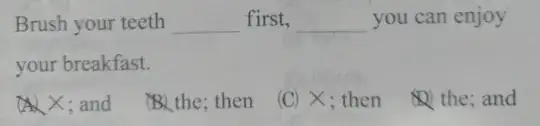
enter image description here

Brush your teeth "_____" first, "_____" you can enjoy your breakfast.

(A) X ; and (B) the ; then (C) X ; then (D) the ; and

  • Could you transcribe the relevant text rather than including an image? Not everyone is able to see the images and they are not searchable in the same way that text is, so it makes the question more useful for other people in the future and widens your pool of people to answer it if you include the text in question. – Spagirl May 13 '19 at 13:11
  • I've edited the post now. Sorry about that! – anonymous May 14 '19 at 11:16

4 Answers4

2

Ugh.

Ask a bad question...

I'm a British English speaker, so to me neither of these options are "good" sentences. Also, neither of them are "wrong" either, but they sound like something a non-native speaker would write. Note that I'm talking only about writing here - native speakers say both of these things all the time, but speech is always more grammatically fluid than writing, and I'd get the intended meaning from intonation.

I think the root of the problem is that it's not even clear what the sentence should mean. If it's the most logical "completion of brushing your teeth is a prerequisite for eating and enjoying your breakfast", then the correct written form is:

  • Brush your          teeth first, and then you can enjoy breakfast

American English speakers please correct me, but I believe this is natural in both British and American writing.

The problem is that the question-setter hasn't given you this answer as one of the choices, so you're left with the dubious task of choosing the "least bad" answer.

If this was a piece of speech, the "and then" could be elided two ways: either drop and, or drop then, and this will give you your two possible answers, but it's worth noting that they now have two slightly different meanings, and both have problems:

A. Brush your teeth first, and you can enjoy breakfast. - less consequential: the act of brushing your teeth allows you to get more enjoyment from your breakfasts; you've lost the "prerequisite" sense.

C. Brush your teeth first, then you can enjoy breakfast - this emphasises the consequence: you're not going to be allowed to enjoy your breakfast until you've brushed your teeth. But here the comma is also wrong: it should be a semicolon.

As a British English speaker, I think C is "less bad" than A, but really neither of them is a good written sentence. Also, I'm assuming that consequence was what the original sentence was trying to convey. Maybe it wasn't.

So you've been left to second-guess what the question-setter actually meant to ask you, which sucks.
KrisW
  • 1,999
0

In England, every option provided is a little off (in writing) for one distinct reason.

The use of the semicolon is not properly established - given the choices. Semicolon separates two complete sentences (S+V+O) that are related to each other.

For example: The baby cried a lot; he wanted to be fed.

In terms of spoken language, I reckon you can 'kind of' say: "Brush your teeth first, then you can enjoy your breakfast", but I have never heard it to be honest. There's a first for everything, right? :)

Parents would probably say: "Go brush your teeth, so you can enjoy your breakfast." - I said 'probably' because mine used to shout: "Breakfast is ready!"

I hope it helps.

pilp
  • 44
0

The test question is focused on punctuation rules.

Absent punctuation, your intuition is right. For (A), and is a coordinating conjunction that connects two independent clauses in a single sentence. For (C), First and then are both sequence adverbs or connective adverbs. They often occur in a sequence in successive clauses:

First, then

First, next, then

First, next, then, finally

In terms of syntax, either is fine. "And then" is fine. Other combinations are probably fine.


However, the question introduces distinct punctuation that requires (A) rather than (C). Without either word, the example introduces a comma splice, or a comma that connects two independent clauses without a coordinating conjunction. Three ways to "fix" this include introducing a coordinating conjunction like "and," making the comma a period, or making the comma a semicolon.

According to these rules, these examples are wrong.

x Brush your teeth first, you can enjoy your breakfast.

x Brush your teeth first, then you can enjoy your breakfast.

However, this example works without a punctuation change.

Brush your teeth first, and you can enjoy your breakfast.

Furthermore, these examples work with a punctuation change.

Brush your teeth first. Then you can enjoy your breakfast.

Brush your teeth first; then you can enjoy your breakfast.

Since the test does not allow change in punctuation, (A) must be right.


We can debate the merits of a question that focus on punctuation and connective words but not context. This is not a question I would ever write. However, the combination of concerns about punctuation and proper conjunction explain why (A) is considered correct and (C) isn't.

-1

A) with "and" is correct.

It seems that in the mind of the person who prepared the test, the answer C) is wrong, because "then" is an conjunctive adverb that should be, according to Grammarly.com preceded by a semicolon (and not comma as in the test).

But, C) "then" could be also right, because, there can be comma before "then," according to American Herritage Dictionary::

Sticklers for grammar sometimes assert that then is not a coordinating conjunction, and that the sentence She took a slice of pie, then left is thus incorrect; it must be rewritten as She took a slice of pie and then left, in which the then acts as an adverb and the halves of the compound predicate are linked by the coordinating conjunction and. But this use of then as a coordinating conjunction is actually both widespread and widely accepted.

Jan
  • 545
  • I Googled for this usage. All the examples I found were prior to 1900. – Hot Licks May 13 '19 at 11:57
  • What do you mean? I'm saying, "then" would require a semicolon before it, so it can't be a correct answer. – Jan May 13 '19 at 11:59
  • 2
    I'm saying that you're wrong. – Hot Licks May 13 '19 at 12:00
  • Wrong about what? The question is if A or C or both are correct. What do you think which is the correct answer and why? – Jan May 13 '19 at 12:02
  • 2
    C is far more idiomatic. – Hot Licks May 13 '19 at 12:04
  • C) ("then") would require a semicolon before it, but there is comma in the prewritten text. So, what are you claiming - which is correct - A or C? I say C is wrong, because of a semicolon. – Jan May 13 '19 at 12:06
  • As I said, the semicolon is rarely used in modern English. – Hot Licks May 13 '19 at 12:07
  • 1
    That's just not true. – Jan May 13 '19 at 12:09
  • The most natural version to me (UK) would be 'Brush your teeth first, and then you can enjoy your breakfast'. – Kate Bunting May 13 '19 at 12:09
  • Yes, that's what I'm saying. – Jan May 13 '19 at 12:12
  • So, find an example of this usage (newer than 100 years). – Hot Licks May 13 '19 at 12:12
  • 3
    Is this a punctuation test or a grammar test? Because then is clearly better grammar-wise. – Peter Shor May 13 '19 at 12:53
  • I don't know; this is a question for the OP. – Jan May 13 '19 at 12:54
  • Both halves of this sentence are independent clauses, so you need a semicolon or a coordinating conjunction. "Then" is not a coordinating conjunction; "and" is. I'm quite baffled as to why this is being so hotly debated.

    Relevant: https://english.stackexchange.com/questions/356497/can-then-be-used-as-a-coordinating-conjunction

    – geekahedron May 13 '19 at 13:05
  • @geekahedron: "then" can be a coordinating conjunction in modern English. I think the many and varied answers in your link support this. – TonyK May 13 '19 at 13:18
  • @Tony K, but do you think "then" could be the right answer in the test, because it clearly connects two independent clauses. Wouldn't be a comma splice then? It's true, it can be a coordinationg conjunction and you can write: "I showered, then combed my hair." (link). But these are not two independent clauses. – Jan May 13 '19 at 13:20
  • 1
    I should have said "complete" clauses, not independent. The second is dependent on the first, not just a simple statement of sequence. Consider the difference between this and "I brushed my teeth, then I enjoyed my breakfast." – geekahedron May 13 '19 at 13:24
  • 1
    For me (UK), C is natural and doesn't involve a comma splice, whereas A is unnatural at best. I'd probably say , and then, but that's not a possible answer. –  May 13 '19 at 18:52
  • I, too, would prefer and then. But since I'm forced to choice between just and and just then, just then sounds far better to me. Just and here sounds unnatural. – Jason Bassford May 13 '19 at 19:11