31

Someone recently posted a question about the pronunciation of Wednesday, which reminded me of a different question about pronouncing the days of the week I've had floating around in my head for a while.

In Standard American English, the word seems to be pronounced "Wensday" [wɛnzdeɪ]. However, I occasionally hear people say something like "Wensdee" [wɛnzdi], and in general the days of the week are Mondee, Tuesdee, Wensdee, Thursdee, etc.

What puzzles me about this is that I haven't been able to associate it with one particular dialect or region - I've hear people say it in (to give three examples) Arizona, Minnesota, and New York. My question is: What US dialects characteristically use this pronunciation - where does it come from? Also, I feel like I often hear older folks using it - could it have something to do with age?

alcas
  • 4,902
  • 7
    If it helps, this is also quite common in the UK and again seems more of a generational thing than a regional one. – Waggers Dec 09 '11 at 22:59
  • 10
    I'm in South-East England, where it seems to me -dee is more common than -day for all age groups. And everybody knows "Solomon Grundy was born on a Mondee", not a Monday. – FumbleFingers Dec 09 '11 at 23:17
  • @FumbleFingers As soon as I saw this question, I thought of dear old Solomon Grundy. –  Dec 09 '11 at 23:20
  • 3
    I can't really answer the question but I did want to comment that I've lived a lot of places in the US and never heard this commonly. It might be an individual thing rather than a dialect, per se. – Lynn Dec 10 '11 at 00:52
  • I found this page on the linguistic geography of the US, and it doesn't mention "-dee" vs. "-day" as a distinctive in any of the regional dialects. I'm inclined to agree that it's generational rather than dialectal. – Gnawme Dec 10 '11 at 01:05
  • 3
    I think a lot of people say -dee in casual/rapid speech, but tend to switch to -day when speaking more carefully. For me personally, it's like glottal stops and dropped aitches. – FumbleFingers Dec 10 '11 at 04:26
  • This question really intrigued me, so I posed a similar one on linguistics.stackexchange in hopes of a good answer there. – Mark Beadles Dec 29 '11 at 19:36
  • Ditto to what @FumbleFingers said about casual/rapid speech. I am originally from the Philadelphia area and can say it's part of that region's dialect, but it does drop out when people are speaking more formally and/or slowly. – JeffSahol Dec 29 '11 at 23:26
  • 3
    Stephen Fry says in "Moab is My Washpot" that it's an example of U vs non-U: "A gentleman does not pronounce Monday as Monday, but as Mundy". – Mark Beadles Dec 30 '11 at 01:58
  • 1
    @MarkBeadles A distinction: Fry doesn't actually himself quite say that. The quotation attributed to him is actually him quoting a stuffy professor in Moab is My Washpot. – sarah Jan 04 '12 at 07:30
  • @MarkBeadles Sorry for the repetition--I see now that you probably saw my comment on this below. – sarah Jan 04 '12 at 07:44

6 Answers6

21

The short answer can be found in these maps from Professor Bert Vaux's Dialect Survey:
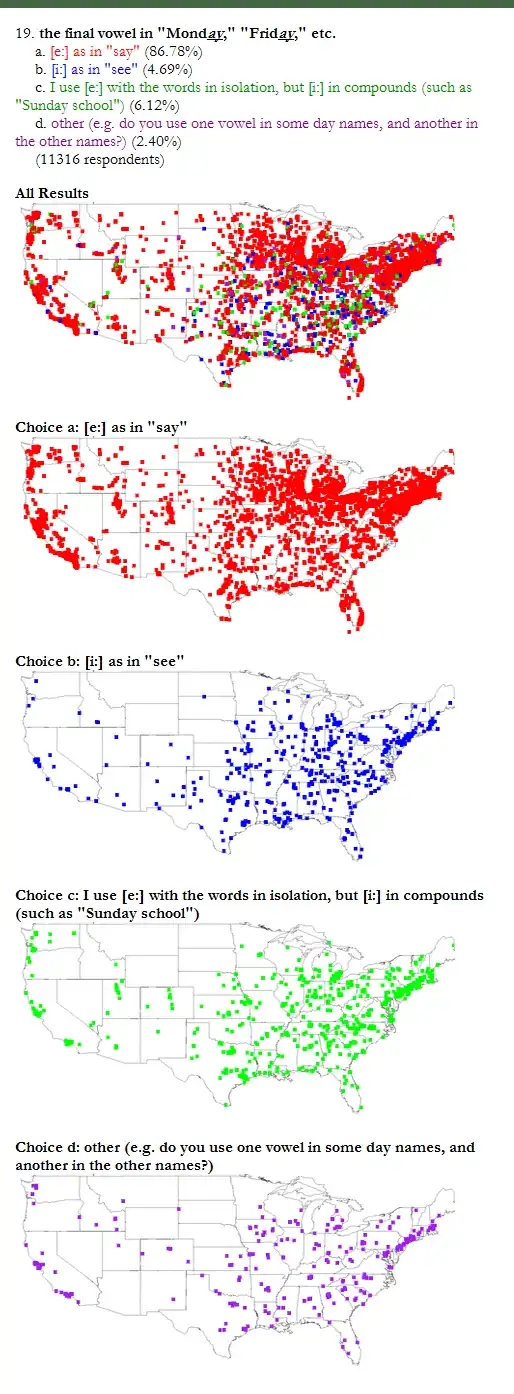
the final vowel in "Monday," "Friday", etc.

The speech accent archive, suggests that the -dee ending is popular in the American Southeast, particularly in Louisville, Kentucky; Atlanta, Georgia; Belmont, Mississippi; Plantersville, Arkansas; Elmore, Alabama; and Pensacola, Florida.

Additionally, I invite you to google mondee tuesdee or mondy tuesdy, or similar. The eponyomous search engine will return many thousands of hits. Depending on how many and which of them you investigate, you are likely to learn one or more of the following things:

  • The Mundee-Tuesdee people are a hardy lot. While a large group of them may be oldsters and on the way out, they are alive and well in many regions of the good ol' US of A. You'll find them in Baltimore, Phuldulphia, Pittsburgh, Utah, Misouri, Fort Worth, Houston--in fact, all of The Drawling South. I can't find a link to prove it, but Midwesterner and radio personality Garrison Keillor is a Mundee-Tuesdee person. And, I wouldn't link to her if I could, but guess how Alaska's Sarah Palin pronounces the days of the week.

  • The Mundee-Tuesdee people are often disdained for a perceived lack of intelligence. (As a native of Ballmer, Merlin myself, I bear the shame of Mundee-Tuesdee heritage, though I have renounced it.)

  • It's difficult to find online academic sources addressing this topic by googling mondee tuesdee or similar pronunciation approximations.

Most online dictionary entries, including Cambridge Dictionaries Online and Dictionary.com give both pronunciations, with the -day ending listed first.

A post by expert at usingenglish.com offers this partially contrary but more detailed entry from Longman Pronunciation Dictionary:

Although Received Pronunciation and General American are both traditionally considered to prefer di, most speakers in practice use both pronunciations for this suffix, often in a strong form—weak form relationship. The deɪ form is generally preferred in exposed positions, for example at the end of a sentence: I’ll do it on Monday ˈmʌn deɪ ; the di form is preferred in close-knit expressions such as Monday morning ˌmʌnd i ˈmɔːn ɪŋ ǁ -ˈmɔːrn-

Extensive investigation of the Google results for the related IPA symbols may yield a precise answer to the OP's query: What US dialects characteristically use this pronunciation, however, a nearly identical question is asked and not definitively answered at the Linguistics Stack Exchange site. Excerpts include:

There's lots of anecdotal information on this, like this English.Stackexchange question, which is interesting enough, but I'm curious if anyone knows of scholarly work on the subject. -Dec 24 '11 at 5:08 by Mark Beadles

I have found one scholarly work on the subject, K. Wheatley in American Speech, Vol 9 No 1, Feb 1934, pp 36-45, "Southern Standards". Author writes:

Yesterday, Monday, Tuesday, etc., always have [i] in the final syllable in Southern speech while [ei] is often heard in these words in the linguistic West.

It is not clear what dialects she means by "Southern" and "Western" other than that these are American dialects.

Mark Beadles, the author of the excerpts has provided this information in his answer here as well.

As I know from personal experience, and as I've demonstrated with the evidence (albeit anecdotal) at the links above, the distribution of these pronunciations is far more complicated than this Southern vs Western dialectical dichotomy can easily account for. I can vouch for a strong preference for the -dee ending in a certain group of native Philadelphia area and Baltimore area English speakers.

I also believe that the following linguistics.stackexchange comment, especially regarding the influence of socioeconomic factors, is accurate.

@MarkBeadles -- It may well not be a dialectal matter. Individuals vary a lot in how their final vowels get reduced in rapid speech, even from hour to hour, or mood to mood. Not to mention that socioeconomic factors like class, income, education, race, and status are more often correlated than geographical location. Except of course where there's cross-correlations already. – jlawler Dec 24 '11 at 19:27

sarah
  • 2,688
  • 1
    Arguably the reason googling mondee tuesdee might give you the impression it's difficult to find online academic sources addressing this topic is simply because academic sources aren't likely to write those two spellings consecutively in the first place. They'd probably use IPA notation anyway, or just write mundy. In short, googling those two "words" is bound to pick up more drivel on Facebook than anything serious. – FumbleFingers Dec 29 '11 at 23:50
  • 2
    @FumbleFingers Actually, only a tiny percentage of the hits returned on the mondee tuesdee search were from Facebook--drivel or otherwise. Most of the results do provide information relevant to the question at hand, though certainly none individually provides an answer. As I note in my revised answer, using IPA notation in the search didn't lead me, or the experts at linguistics.stackexchange.com, to an answer either. I think I've exhausted any skills I have that might lead to one, but I'm still hoping someone, here or there, will be able to provide an answer. – sarah Jan 01 '12 at 16:43
  • As @Mark Beadles comments to OP, Stephen Fry says "dee" is actually a mark of "upper-class" speech. I'm sceptical that the converse applies, but I certainly wouldn't argue with him of all people. As regards your google search, I just followed the link, noticed a lot of references to facebook, and appended -facebook to the search term. That immediately halved the results, prompting me to post my comment above. – FumbleFingers Jan 01 '12 at 17:14
  • @FumbleFingers Just now mundee tuesdee returned 5,090 results, and appendiing -facebook diminished it to 4,080. However, the majority of the results of a mundee tuesdee (+) facebook search are not from Facebook, and facebook is an unrelated or meta term on the linked pages. – sarah Jan 02 '12 at 05:27
  • 1
    @FumbleFingers Two things on the Fry: 1. He doesn't himself say that. The quotation attributed to him is actually him quoting someone else in Moab is My Washpot. I haven't yet determined if he is agreeing with that quoted sentiment or not. – sarah Jan 02 '12 at 05:42
  • 1
    @FumbleFingers 2. The quote from Moab is referring to British dialects. I can assure you that this does not strictly translate to American English dialects. Please note the OP's apparent focus on American dialects. The Philadelphia and Baltimore "accents", which feature the ˈmʌn dɪ pronunciation, are definitely not "upper class." (As noted above, I am talking about my friends and relatives here, so I don't say that disparagingly. They'd tell you the same themselves.) In fact, I'd expect the opposite to be proven, though I obviously don't have the academic prowess or credentials to prove it. – sarah Jan 02 '12 at 05:51
  • 2
    @FumbleFingers “I had had good teachers. At Prep school an English master called Chris had awoken my first love of poetry...His predecessor, Burchall, was more a Kipling-and-none-of-this-damned-poofery sort of chap, indeed he actually straight-facedly taught U and Non-U pronunciation and usage as part of lessons: ‘A gentleman does not pronounce Monday as Monday, but as Mundy. Yesterday is yesterdi. The first 'e' of interesting is not sounded,’ and so on.” —Stephen Fry, Moab Is My Washpot, (Soho Press, 2003), pp. 280-1. – sarah Jan 02 '12 at 05:57
  • wd you! I have a paper copy of MIMW, but I certainly wasn't going to trawl through to find the reference! The google hits are weird - your link gives me 5840 hits, but when I type it myself I get 8090 (or 2660 if I put the search term in quotes). Whatever - I endorse @John Lawler's position. I use both pronunciations freely, same as with either/neither ("iː" or "aɪ", depending on any number of effectively random factors). I don't really care if some people only ever use one form themselves, but I'd certainly take exception if they criticised my sporadic use of the other. – FumbleFingers Jan 02 '12 at 16:06
  • Ha, I don't know the book, but it took just a bit of internet trawling to come up with the excerpt. (Must start a new comment because I still can't get used to enter meaning post, not paragraph break and my edit time is running out.) – sarah Jan 03 '12 at 07:37
  • 1
    John Lawler obviously knows a thing or two about this subject. And no doubt using both pronunciations in the way you do is not uncommon. However, I can't ignore my personal knowledge and supporting evidence, some of which I've submitted above, indicating there are also certain dialects in which one or the other is used invariably. That is, if I understand what a dialect is, which I can't say for sure I do. I know some learn to switch, but I'd bet my Baltimore relatives and certain Philly friends do not know they say mʌndi as opposed to mʌndei, and would never say mʌnd ei. – sarah Jan 03 '12 at 07:56
  • Well, John's works in the field, so it's not surprising he knows more than most. I've only just realised that when I posted my first somewhat snarky comment I must have also downvoted the answer itself (I don't even remember why, to be honest). I've reversed that now, and tip my hat to your diligence on this one. Even if at the end of the day we can't really say much more than it's more complicated than just 'regional dialect', your answer covers things pretty extensively! :) – FumbleFingers Jan 03 '12 at 14:52
  • I'm grateful and impressed by all the research you put into this, @sarah. What fascinates me most by this question is that it's a hot button of sorts. There is a bit of regional and class-based variation to this, just the kind of thing to make it interesting and a little bit controversial. Good stuff. – Mark Beadles Jan 03 '12 at 17:30
  • I tend to agree with @sarah's observation that there are certain speakers that use one or the other invariably, and certain speakers whom use the forms in free or conditioned variation. Personally (West Michigan) I use "aɪ" invariably, and my grandmother (Ozarks) always used "iː". Others on this board evidently use one or the the other under certain circumstances, such as rapider speech or unstressed or what have you. – Mark Beadles Jan 03 '12 at 17:43
  • @FumbleFingers I'm glad I managed to win you over. :) I suspect you may have found my original answer excessively irreverent, when I meant to use just the right degree of irreverence. ;) Also, it was, and remains, a protracted jumble of the results of the inexpert research attempts of a wannabe linguist. Not having the lingo makes it difficult to investigate and report on any subject, especially this one--what with all the IPA and other symbols, phonemic mouth diagrams, etc. – sarah Jan 04 '12 at 08:21
  • 1
    @MarkBeadles I'm glad I could provide some relevant information. And to your point about this being a hot button issue, as I alluded to in my answer, it really hits home with me because I do involuntarily make value judgments based on dialects, and I come from people whose dialect includes the "i" ending in question, along with other features I tend to respond to negatively. I know better intellectually, but the instinctive reaction remains. So, looking into this was a labor of love/hate. ;) – sarah Jan 04 '12 at 08:45
  • @sarah: You're probably right about the irreverence. :) As a UK "Estuary English" speaker myself, I don't tend to make value judgements based on accents. But I do sometimes get irked by things that don't match my own current (but wildly fluctuating) position on the insouciant / scrupulous scale. So consider me well and truly won over, and I look forward to the next question you feel moved to address with such thoroughness! ps - I think one of the problems with "dialectal prejudice" is it doesn't come through much in written contexts, so we often don't get enough counterexamples. – FumbleFingers Jan 04 '12 at 13:59
  • @FumbleFingers Yes, well, while the pen may be mightier than the sword, it too cuts both ways. It's shocking how much smarter and more sophisticated my mom becomes in her emails. On the other hand, one might mistake my bright and entertaining husband for a dull, if earnest, third grade boy based on his written words. That (and the old glass house people and stones thing) ought to stop me making uncharitable assumptions about similarly afflicted writers on the internet, but it usually doesn't. – sarah Jan 06 '12 at 07:37
  • @FumbleFingers In related news...your sliding scale of insouciance tolerance/intolerence reminds me of a brilliant thing George Carlin said, "Have you ever noticed, when you're driving, that anyone driving slower than you is an idiot, and anyone going faster is a maniac? Yep, I've noticed. Henry David Thoreau said, "It is never too late to give up our prejudices." So, perhaps there's hope for me yet. – sarah Jan 06 '12 at 07:38
4

The OED gives the terminal vowel of Monday (and presumably the other days of the week, but I haven’t checked) as either /eɪ/ or /ɪ/ in both British and American English.

Barrie England
  • 140,205
3

The only academic source I could find on this topic was from 1934. K. Wheatley in American Speech, Vol 9 No 1, Feb 1934, pp 36-45, "Southern Standards". In a discussion of vowel reduction, the author writes:

Yesterday, Monday, Tuesday, etc., always have [i] in the final syllable in Southern speech while [ei] is often heard in these words in the linguistic West.

She attributes this to the tendency for Southern dialects to reduce unstressed vowels to [i] vs. the Western tendency to maintain the vowel value in unstressed position. It is not clear what dialects she means by "Southern" and "Western" other than that these are American dialects in 1934.

Mark Beadles
  • 22,642
2

I'm from Central Virginia and in my area its more common to say "dee" for the days of the week- as in Mon-dee , Fri-dee, etc. The emphasis gets place also on the first syllable of the word so its MON-dee Fri (frah)- dee. I believe this is a Southern manner of speech popular from Virginia on down.

Meade
  • 21
0

I live in the Uk and the London Cockneys say Mundee Tuesdee etc. My Mother is cockney she says it. Its a eastend of school thing but some younger and middle classes say it but they lean towards liking working class culture

Its a working class identity anti middle upper class. Like Some people of Colour from Caribean say Innit dough.

nic.
  • 1
0

I meant old school thing.

Me and friends say it for fun it really makes us laugh. See you on the Sundee. That does back to Medievil dialect from outside London maybe the north or yorkshire.

You are missing the point it's working class identity anti academic also must be why there is not much written. As middle classess tend to obsessievly dominate all media forms with very standrd thinking patterns to trap people into believing them while in reality other things around wealth go on. That is also English middle class to give a impression whilst something else is going on; a survival tech to ensure wealth but to hide ones tracks or method. So the so called classes have own mannerisms and ways of speaking.

Some Caribean british versions are. Innit dough . You get me not do you understand me. Instead of Why its Wai . A focus on A vowel replacing I. Woz I der Dough. Some Eastern European ; plenty good. Not all is good. I find speech in this way very interesting. I studied opera singing so I am very aware of sound speech. I love it.

Watch Eastenders from The uk to get an Idea.

nic.
  • 1