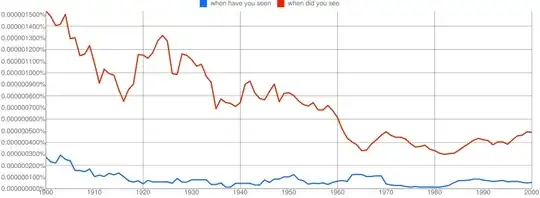
In the example offered by the OP, I would always opt for the simple past question
When did you see it?
The simple past, as Barrie England's answer explains, is used for “Identifying an event at a time in the past”. In fact the response is "Last month", that month belongs to the past, it has no connection to the "now" present. But speaker 2 could have easily replied with
[I saw it] This month.
Despite this month being still current, the first speaker remembers seeing the film at a definite moment in the past. This "moment" could be any time between the beginning of the month to when speaker 2 asked the question. However, if he had seen the film very recently, he would probably have replied: Yesterday; last night ; on Sunday; a few/couple of days ago etc.
It is rare that questions asking "when" are in the present perfect, but not unheard of.
For example:
Tom: I know Bob skips school regularly.
Anne: Oh, yes? When have you seen him playing truant?
Tom: Usually on a Friday.
Google Books provide similar examples
- On any special occasion, when have you seen him under the influence of liquor?
—I remember none.
- When have you seen a Coca-Cola ad focusing on price? Never.
- Q: Where and when have you seen your aunt write?
A: I have seen her write frequently at her own house.
Q: What have you seen her write?
A: I have seen her write letters, papers and general writing.
- When have you seen ordinary people do extraordinary things?
- And anyway, when have you seen me reading Cosmo?
And with since when...
- “No, since when have you been such a saint?”
- “What the fuck do you mean, coming here telling me you've married the woman I love! Since when have you been interested in her?”
- ‘Since when have you been a quitter?’ he asked.
- Since when have you been employed?
In the mentioned examples, the speaker might be referring to a state which lasts up to the present moment; an incomplete activity; or a repeated activity.