1

So, I preparing for this test and one of the questions is this. test screen shot

The teacher remarked that they all had done it very badly.

Why is this sentence structure wrong?

I found this question in English learner stackexchange that expands more on the position of the word all in a sentence.

xax
  • 53
  • 2
    Answered at ' ... all had taken' or ' ... had all taken'. ' ... had all ...' is/can be the unmarked (normal) ordering, but ' ... all had ...' is perfectly acceptable, putting stress on all rather than the whole sentence. – Edwin Ashworth Mar 24 '21 at 11:34
  • 1
    No: but "all" is an adjunct as is evident from the fact that when the verb is an auxiliary, as it is in your example, it preferentially follows rather than precedes it. – BillJ Mar 24 '21 at 11:42
  • The important point is that where the verb is an auxiliary, quantificational adjuncts like "all", "both" and "each" follow rather than precede it. Which explains why "They had all done something" is preferable to "They all had done something". – BillJ Mar 24 '21 at 12:22
  • @BillJ This is no adjunct according to CoGEL but a pronoun. – LPH Mar 24 '21 at 13:59
  • @LPH. Adjunct is a function and pronoun is a part of speech. You can't compare them. This "all" is a determinative in a 'fused-head NP. And of course it's an adjunct. It can't be a complement so what else could it be? Get an up-to-date grammar! – BillJ Mar 24 '21 at 14:03
  • @BillJ Can a pronoun be an adjunct? – LPH Mar 24 '21 at 14:17
  • @LPH What is the relevance of your question? – BillJ Mar 24 '21 at 14:32
  • @BillJ Obviously, if a pronoun can't be an adjunct and if "all" is a pronoun, then it can't be an adjunct. – LPH Mar 24 '21 at 14:38
  • But "all" is not a pronoun. It's a determinative in a fused-head NP functioning as an adjunct. – BillJ Mar 24 '21 at 14:40

1 Answers1

1

(CoGEL 5.16 p. 258) […] All and both can occur after the head, either immediately or in the M adverb position (after the operator, cf 8.16). For all and both we have, then, the following possibilities:
[…]
They were all accepted.
?They all were accepted.

The symbol "?" in CoGEL means that native speakers are unsure about the acceptability. This means then that "They had all done something" poses no problem of acceptability, whoever reads or hears it, but "They all had done something" might sound strange to some native speakers. This is reflected in this ngram (duplicated below).
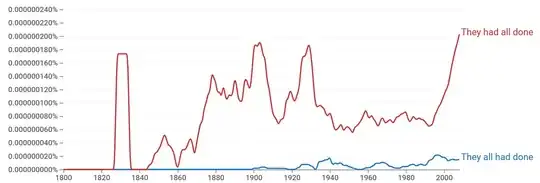
enter image description here


Clarification on the meaning of "operator"

(CoGEL 2.49 p. 80) The definition of operator as first auxiliary raises the question of what happens if the corresponding positive declarative has no auxiliary, and therefore no operator. In such cases, the verb "DO" is introduced as a "dummy" auxiliary to perform the function of operator.

More specifically, the operator is that auxiliary that is selected as a reference for the placement of the negative particle and the changes in the positions of the subject when forming negations, questions and negative questions.

  • The ship may have been sunk. — The ship may not have been sunk. — May the ship have been sunk?

  • They came yesterday. — They did not come yesterday. — Did they come yesterday? — Did not they come yesterday?

LPH
  • 20,841
  • This answer just repeats my last comment, except that it doesn't mention the useful bit about auxiliary verbs. The term 'auxiliary' is much better and more common than 'operator'. – BillJ Mar 24 '21 at 13:45
  • @BillJ I would have read your comment a little later as I was in a hurry I went on with my answer without reading them first. There is in my answer, however, the "often" required advantage of some references. – LPH Mar 24 '21 at 13:46
  • @BillJ I don't think so; the term "operator" in CoGEL has a particular meaning that goes beyond that of "auxiliary". I'm sorry the exact definition escapes me now and that I can't make you aware of it, but for the time being I'll keep to the term "operator". – LPH Mar 24 '21 at 13:55
  • 2
    Why? Virtually no one uses the tern 'operator'. It causes unnecessary confusion.The term 'auxiliary is what everyone uses. It goes to show how out-of-date CoGEL is! – BillJ Mar 24 '21 at 13:59
  • @BillJ I'm afraid that you criticize CoGEL without knowing it sufficiently. "Operator" is not a word used lightly in CoGEL, but I have to brush up on that (I told you). In CoGEL, both "auxiliary" and "operator" are use, and not in a synonymous way; the difference matters. – LPH Mar 24 '21 at 14:02
  • I know all about CoGEL, especially that is well out-of-date. I don't care how "lightly" it uses the term 'operator'; it simply won't do in 2021. – BillJ Mar 24 '21 at 14:06
  • @BillJ The CoGEL is a grammar with a revised edition (2010) currently on sale, and after all the CGEL dates from 2002. What is new, is not necessarily more exact. As there are people that believe in the grammar such as CoGEL explains it, I believe that I can also be one of those believers, as long as my sense of language agrees with theirs. Anyway, I disagree strongly with some of what appears in CGEL. – LPH Mar 24 '21 at 14:35
  • Most grammarians agree that GGEL is superior to CoGEL. Have you actually got a copy of CGEL? Give an example of something you disagree with. – BillJ Mar 24 '21 at 14:38
  • @BillJ A simple one is that question we discussed some time ago concerning wh-words that imply a question according to CGEL; I don't agree with that at all; neither do I agree with their reclassification of nouns, as explained in Pullum's "The final proof" (Lexical categorization in English dictionaries and traditional grammars). Sorry, I can't go on: I have been suspended on another site, with the consequence of not being allowed to use chat sections whatever the site I am in; as my comment here is already one too many I must stop. – LPH Mar 24 '21 at 14:48
  • I don't know much about the nuances of English grammar protocols, but this one answers my question, so I'm accepting it. – xax Mar 29 '21 at 12:22