The following explanations, found in CoGEL 1985 edition § 4.24 p. 195, provides principles of use for the past perfective in comparison with the simple past as well as with the present perfective.
The past perfective usually has the meaning of 'past-in-the-past', and can be regarded as an anterior version of the present perfective or of the simple past. Consider the following examples:
No wonder Miss Matthews French was excellent—she had lived in Paris since childhood. [1]
When we bought it, the house had been empty for several years. [2]
These can be diagrammed as in Fig 4.24a, which is a special case of the general perfective diagram Fig 4.18:
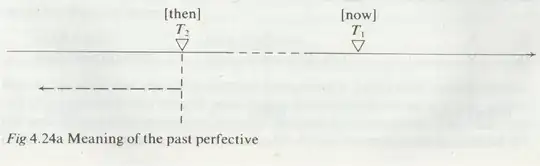
More technically, the past perfective may be said to denote any event or state anterior to a time of orientation in the past. The three meanings of 'state', 'event' or 'habit' (as described in 4.14) can all occur. Whereas [1] and [2] have illustrated the state meaning, [3] and [4] illustrate 'event' and 'habit' respectively:
The goalkeeper had injured his leg, and couldn't play. [3]
It was foolish to fire McCabe: in two seasons, he had scored more goals than any other player. [4]
When transposed into the 'past in the past' by means of the past perfective, the contrast between the simple past and the present and the present perfective is neutralized:
My aunt had lived in Italy for four years. [5]
He had died in 1920, before his son was born. [6]
In [5], the four year period could either be a period leading up to T2, or a period which has ceased before T2, as would be clear in:
In her youth, my aunt had lived in Italy for four years. That's why she spoke Italian so well.
Thus [5] could be a projection further into the past of either [7] or [8]:
My aunt lived in Italy for four years. [7]
My aunt had lived in Italy for four years. [8]
But of course, the past perfective does not have to refer to a more remote time than that referred to by the simple past. In some cases, particularly in a clause introduced by after, the two constructions can be more or less interchangeable:
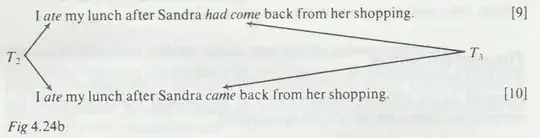
After places the eating (T2) after Sandra's return (which we may call T3), so the past perfective, which places T3 before T2, is redundant. What difference it does make is a matter of the 'standpoint' of the speaker. In [9] the 'past in the past' time T3 is identified as being earlier than T2 by the past perfective; but in [10] it is left to the conjunction after to signal this temporal relation.
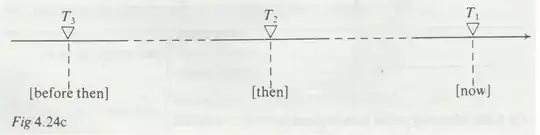
Adverbials of time position, when used with the past perfective, can identify either T2 or T3. Placed initially, they often identify T2:
When the police arrived, the thieves had run away. [11]
But in final position, the interpretation whereby the adverbial refers to T3 is more likely:
The thieves had run away when the police arrived. [12]
Hence in [11], when is likely to be equivalent to By the time that…, but in [12] the when clause is likely to be an answer to the question: 'When had the thieves run away?'
Note
[a] When in the sense of 'immediately after' behaves like after in sentences [9] and [10]. The following are therefore virtually synonymous:
I ate my lunch when Sandra had come back from her shopping.
I ate my lunch when Sandra came back from her shopping.
[b] There is one construction in which the past perfective clearly could not be replaced, as means of referring to past time, by the simple past. This is an indirect speech construction, in which the past perfective indicates backshift (cf 14.31) into the more remote past: I told her the parcel had not arrived.
[c] the past perfective can also be a backshifted equivalent of the present perfective in expressions like I hadn't noticed; I'm leaving – had you heard? In these cases, a past time of orientation T2 is implied by the context.
[d] As well as past-in-past, the past perfective can be used to indicate hypothetical past (cf 4.19, 14.23, 15.35).
- Sentence 1 : "I didn't answer your questions because I had fallen asleep early last night" or Sentence 2 : "I didn't answer your questions because I fell asleep early last night"
The adverbial "early" does not specify explicitly "T3", but, implicitly, it does: understated, "before the time when I answer question". If the adverbial was not used the second sentence would not appear as clear, but it still could be used.
- I didn't answer your questions because I had fallen asleep last night.
- I didn't answer your questions because I fell asleep last night.
(ref. 1) I don't know what Grandpa answered, because I fell asleep.
(ref. 2) I got arrested and ticketed under the absolute sobriety law because I fell asleep in my car at a gas station waiting for my ride.
Given the use of "early" in these sentences, it seems that they are interchangeable.


