2

In the book 'the Cambridge Grammar of the English Language (CGEL)', the authors propose the theoretical framework used to describe the English sentences as shown below:
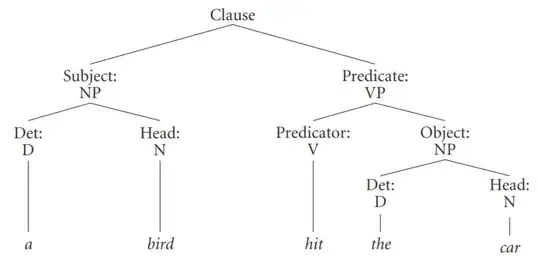
Text version:

Clause:

  • Subject: NP
    • Det: D → a
    • Head: N → bird
  • Predicate: VP
    • Predicator: V → hit
    • Object: NP
      • Det: D → the
      • Head: N → car

CGEL, page 26

To get the tree diagram above, the first step is to identify the constituents of the sentence with the constituency tests. The second step is to describe these constituents what grammatical categories (e.g.,N, D, NP) they belong to. And the last step is to further describe these constituents what grammatical functions (e.g. object, head, subject) they belong to.

The authors suggest I have to know what grammatical categories these constituents belong to before knowing what grammatical functions they belong to. However, when I try to follow this order, there seem to be some problems.

For example, I want to know what grammatical category the word 'dog' in the sentence 'the dog is smiling' belongs to. I suspect it might be a noun, so I turn to page 326 of the book where the properties of nouns are described. One of the properties of nouns is that it functions as 'head' of the noun phrase. My problem is: How am I supposed to know the grammatical function of the word 'dog' when the authors suggest that I first have to know its grammatical categories before knowing its grammatical functions?

Summary of defining properties of nouns

[Type] [Description]
i INFLECTION Nouns prototypically inflect for number (singular vs plural) and for case (plain vs genitive).
ii FUNCTION Nouns characteristically function as head in NP structure.
iii DEPENDENTS Various dependents occur exclusively or almost exclusively with nouns as head: certain determinatives (a book, every day), pre-head AdjPs (good news), relative clauses (people who work). Conversely, nouns differ from verbs and prepositions in that they do not take objects: I dislike it but not *my dislike it.

CGEL, page 326

(image of the quote above)

Laurel
  • 66,382
Mz2501
  • 29
  • Out of the many, many different properties of nouns listed, you are focussing only on one, which is that nouns may head phrases functioning as Subject. Fulfilling just *one* potential property of nouns is not sufficient to tell you anything! the fact that dog happens to be functioning as Head of a phrase functioning as Subject just tells you that it might be a noun. You need to look at all the other properties that nouns typically possess. There is no single property of nouns that it sufficient on its own to guarantee membership of the category Noun. (cont) – Araucaria - Him Oct 16 '21 at 01:17
  • Oh, and you can't not follow the grammar proposed in CaGEL. Not until there is another grammar of similar scope depth and consistency. It is widely regarded as the most comprehensive, consistent and up-to-date grammar of English there is - even by its opponents! – Araucaria - Him Oct 16 '21 at 01:29
  • So the take away points: 1) Many types of word or phrase can fulfil a given syntactic function. 2) A type of phrase or word category may fulfil many types of syntactic function. 3)Knowing the word category is not sufficient to determine the syntactic function of that word or the phrase it heads. 4) Knowing a word or phrase's syntactic function is not sufficient to tell you its phrasal category or word category. – Araucaria - Him Oct 16 '21 at 01:35
  • Thank you so much for your valuable insight! I've learned a lot. – Mz2501 Oct 16 '21 at 09:25
  • So does that mean even if I do not know the grammatical function of the word 'dog,' I can look at other properties, which are as important, to determine whether or not it is a noun, right? – Mz2501 Oct 16 '21 at 10:06
  • Spot on. Exactly so! – Araucaria - Him Oct 16 '21 at 15:00
  • I've edited your title because your question hasn't been getting many views. I think these changes may increase the chances of your getting a good answer! However, if you don't like them, you can roll them back by clicking on the "edited" button just to the left of where your name appears and then clicking on "roll back"". – Araucaria - Him Oct 16 '21 at 22:01
  • 1
    @Araucaria-Nothereanymore. Haven't you written an answer here? – Andrew Leach Oct 16 '21 at 22:27
  • @Araucaria I appreciate your works a lot! – Mz2501 Oct 17 '21 at 07:52
  • I think you're looking at this the wrong way. You don't use he sentence grammar to understand the sentence. First you determine what the sentence (and by extension all the words in it) means because you know the language. From that you can assign the words to categories. – Barmar Oct 18 '21 at 19:53
  • English (and most human languages) is too complex to parse purely syntactically. This was something discovered very early on by AI reasearchers on natural language processing. – Barmar Oct 18 '21 at 19:54
  • @Barmar Thank you! – Mz2501 Oct 19 '21 at 12:16
  • @Araucaria-Nothereanymore. Sorry for tagging you again as it is the only way to contact you through this site. I have a question regarding the weekdays case study. Thanks to it I learn how to actually apply those grammatical properties in the CGEL book to words I encounter. However, I just want to know that when you conclude in the end that weekdays is a noun, you mean it is a noun in that particular instance, i.e. in the sentence It's open weekdays only, right? So if I encounter the word weekdays in another sentence I have to apply those properties again. Do I understand it correctly? – Mz2501 Oct 20 '21 at 14:45
  • @Mz2501 In principle, yes. You might, for example, be looking at a homophone. For example, round is famous for potentially being one of many different word categories. However, it depends why you're doing it! A coupe of strong bits of evidence is often all you need. For example, if it occurs (or could) with a determiner such as a or every and has a singular and plural form, then you can be confident it's a noun! – Araucaria - Him Oct 21 '21 at 22:41
  • 1
    @Araucaria-Nothereanymore. Got it! I have to thank you again for taking your time to give me valuable information. – Mz2501 Oct 22 '21 at 20:03
  • @Mz2501 You're very welcome! – Araucaria - Him Oct 24 '21 at 16:52

0 Answers0