22

Is penultimate commonly used in English, or are its variations (such as second to last) more common?

I need to use it in conjunction with the expressions First Payment Date and Last Payment Date to name variables while programming.

In my mother language (Portuguese) Penultimate Payment Date would be fine, but it feels strange in English. (I know feels strange is not very helpful, but I'd like to know how to convey the meaning in the most natural way.)

Vitor De Mario
  • 343
  • 2
  • 8
  • 16
    Are you looking for the final word on this subject or the next-to-final word? – Robusto Feb 23 '12 at 17:34
  • 7
    "Penultimate" is commonly misused to mean "absolutely last" in my experience. – ikegami Feb 24 '12 at 04:23
  • 1
    This was a word where my high school Latin class helped, so when I first heard the word I was able to guess it's meaning immediately. "paene" is Latin for "almost", so "paene ultima" = almost last. Like "peninsula" comes from "paene insula" = almost an island. – Jay Feb 27 '12 at 14:47

7 Answers7

37

Someone I know who is a native speaker of Spanish and a professor at a university in the United States has complained that when he used the word "penultimate" in class, the students don't know what he's talking about.

The word is perfectly, unimpeachably, 100% correct. It is a bit of an upscale, literary word though. It certainly is a "term of art" in fields like linguistics, where it is used commonly to refer to syllables.

I searched for the word in the Corpus of Contemporary American English, and divided the results by section: spoken, fiction, magazine, newspaper, and academic, and got these results:

spoken:     10
fiction:    53
magazine:   55
newspaper:  36
academic:   93
total:     247

So, it is certainly used in all areas of English, with a moderate skew towards higher registers like academic writing. Depending on the intended audience, a writer contemplating using the word "penultimate" should consider that there is a relatively high likelihood that word will not be understood.

Instead of "penultimate", the phrasing in common usage is either "next to last" or "second to last". Both of those should be universally understood.
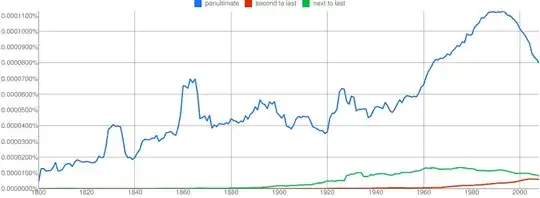
Google ngram

Interestingly, Google Ngrams shows that the word "penultimate" rose in usage (in published books) steadily from 1800 to about 1990, and since 1990 it has shown a steep dropoff, taking us back to usage levels from the late 1960s. The better-understood terms "second to last" and "next to last" are less common (again, though, in published books—Google Ngrams tells us nothing about spoken usage), with "next to last" having more historical usage but a slow tapering off of usage since 1960 and "second to last" increasing in usage from 1970 on, with both enjoying approximately the same usage today.

nohat
  • 68,560
  • 11
    Students who do not know what penultimate means probably struggle with fortnight, too. Should the professor dumb it down? What’s education for, anyway? – tchrist Feb 23 '12 at 18:08
  • 2
    I'm sure you have far better research tools than me, but looking at the "occurrence frequency" in NGrams it seems "penultimate" occurs nearly twice as often in UK than US English. I just checked my Internet Bank logon screen to see if there was a "Help" button for anyone who might not understand the word, but there wasn't. Perhaps my bank assumes their customers are more literate than the population average - or perhaps they already know this! – FumbleFingers Feb 23 '12 at 18:12
  • ...your NGram doesn't actually include the second most popular phrasing - last but one – FumbleFingers Feb 23 '12 at 18:16
  • 1
    ...also, -1 because your Instead of "penultimate", the phrasing in common usage is..., and the general tone of the answer, imply that "penultimate" is somehow "not common". But clearly it massively outranks any alternatives, and I suggest that holds good for spoken usage as well, among all but the most illiterate speakers. – FumbleFingers Feb 23 '12 at 18:21
  • 2
    NGrams are the très chic way to fire off the old lies-damned-lies-&-statistics blunderbuss. They prove nothing. – tchrist Feb 23 '12 at 18:28
  • 1
    "second to last" is definitely more popular than "penultimate" or "last but one" (which I have never even heard used), at least in modern times. Don't trust n-grams. – BlueRaja - Danny Pflughoeft Feb 23 '12 at 22:35
  • 2
    @FumbleFingers (1) The word is less common than "indefatigable", "juridical", and "metacognitive", according to COCA. Seems like a relatively obscure word to me. My advice, based on experience and statistics, is to avoid a word if the audience's understanding what it means is essential to the communication. (2) I was completely unfamiliar with "last but one", which is why I didn't include it. It's definitely not idiomatic in American English. – nohat Feb 23 '12 at 23:26
  • 1
    @nohat: I really am starting to think there's a UK/US difference here. My Chambers uses "last but one" three times under its single entry for "penult/penultima/penultimate", and gives no alternative forms of words. Your own NGram clearly shows penultimate to be far more common than your alternatives - which it still is (by far) even if you include the "Briticism". I don't understand why you, a literate person, should advise others to "dumb down" to such an extraordinary degree. – FumbleFingers Feb 24 '12 at 00:16
  • 6
    When I was a kid, I was really into typography, so I learned all about typefaces and such, including the term sans serif, and that sans meant "without". I also really didn't like mushrooms. Once, at a restaurant I ordered a dish "sans mushrooms", thinking myself quite clever. Then the plate arrived, covered with mushrooms. I thus learned a valuable lesson about considering the importance of communicating when using highbrow vocabulary. – nohat Feb 24 '12 at 00:28
  • 1
    Also regarding the Google n-grams, I think it is problematic comparing n-grams of the different cardinality. That is why I focused on the historical trends rather than the comparison of "penultimate" vs. the circumlocutions. – nohat Feb 24 '12 at 00:40
  • 2
    Just as an actual usage note, Jon Stewart of The Daily Show, used "penultimate" in his opening monologue last night. – Robusto Feb 24 '12 at 03:40
  • 2
    I would never use second to last. What on earth is that to doing there? Must be an Americanism. Favourite word: preantepenultimate. – TRiG Feb 24 '12 at 12:18
  • 1
    @FumbleFingers I think you will find that the American prejudice against penultimate is similar to the American prejudice against fortnight. These words scare them, even though these are perfectly normal words that you’ll hear in England all the time. I bet nohat♦ is an American, and that his cultural bias is showing here. ’Twas America who gave the world Dumb&Dumber, wasn’t it, where lack of education and learning was promoted as a virtue? Such folks may not have a firm grasp on what is fancy language vs what is plain language, especially outside their own little parish. – tchrist Feb 24 '12 at 12:57
  • 1
    @TRiG: I quite agree. If I was asked to give the second to last letter of my password, I'd probably end up asking whether that meant the one before the last (penultimate), or the one two away from the end (antepenultimate). – FumbleFingers Feb 24 '12 at 14:05
  • @tchrist your comment is bordering on the abusive and offensive. There are plenty of words we use here in the U.S. that aren't used much in England. There is no moral high ground to be held on cross-dialectical differences of lexical usage frequency. As for cultural products somehow reflecting the lack of highbrow linguistic virtue, I will see your "Dumb & Dumber" and raise you Sasha Baron Cohen's "Ali G" and Catherine Tate's "Lauren" characters. – nohat Feb 24 '12 at 19:11
  • 1
    @tchrist what I find most baffling is the uproar that my advice given my empirical evidence that "penultimate" is frequently misunderstand is that writers ought to weigh carefully how important it is that their readers understand what they mean before they use the word "penultimate". What could possibly be objectionable about advice to writers that they take their audience into account? – nohat Feb 24 '12 at 19:13
  • @nohat Wait, you seem to be under the odd impression that the purpose of writing is to convey information to the reader. But of course the real purpose of writing is to impress the reader with how intelligent and well-educated the writer must be. :-) – Jay Feb 27 '12 at 14:35
  • Frankly, this really makes me wonder about the accuracy of Google Ngrams. Yes yes, "penultimate" is a perfectly good word. But I I rarely see it in print, and almost never hear someone say it. It seems to me people almost always say or write "second to last" or "next to last". Is "penultimate" really EIGHT TIMES as common as either of these? Maybe so, and I'm just relying on anecdotal evidence. But this result is just so contrary to my personal experience, it makes me wonder how the statistics were collected. – Jay Feb 27 '12 at 14:43
  • @tchrist RE fortnight: I'm reminded of a comedy I once saw where a character says, "We agreed that we would all work with you on this for a fortnight. But we're going to keep on indefinately, because none of us knows exactly how long a 'fortnight' is." – Jay Feb 27 '12 at 14:51
21

Penultimate is a regular word in the normal register in Portuguese or Spanish: penúltimo. In English, however, it becomes a much more educated word belonging to a much more learnèd, or elevated, register. Therefore to translate to English and keep to the same register, you must select the more pedestrian next-to-last. (Then again, if we were linguists talking about syllable stress, we would not be afraid to use this word. It just isn’t a blue-collar world; it’s a professional one.)

It’s like asking whether you can translate PT/ES cotidiano to EN quotidian. Yes, you can, but you shouldn’t, because you’ve crossed register boundaries, which means it doesn’t sound equivalent even thought it means the same thing.

Not always, but in general, when you find a word in English that’s a close cognate with something from Romance, the register has switched, and you should look for a more Anglo-Saxon word if you want to keep to the same style. Because of the Norman occupation, Modern English often has pairs of words in different and contrasting registers, where a more purely Romance or purely Germanic language than English now is would have only one.

This gives English more flexibility and nuance by having recourse to a pair of terms instead of having one alone. But it is a perilous thing for non-native speakers, who must keep an eye out for a probably shift in register. Does that make sense?

tchrist
  • 134,759
  • It does make sense. Can't upvote yet, I just registered and asked the question, but thanks. – Vitor De Mario Feb 23 '12 at 18:16
  • I think current usage of "penultimate" is limited to laudatory descriptions of the activities of American actor Sean Penn, in which case it is often spelled "Pennultimate". – Buttle Butkus May 24 '12 at 22:59
3

No, it's not very commonly used. You're thinking that on a customer statement you would print "Last payment date: Feb 12, Penultimate payment date: Jan 9"? That would be completely correct, but I suspect most of your customers wouldn't know what it means, unless you have a customer base of above-average literacy. Most people say "second to last" or something similar.

Jay
  • 36,223
3

I don't use the word, because it is very commonly mis-understood and mis-used. People who aren't familiar with the word assume it is an emphasizer of ULTIMATE (even-more-ultimate??), so they say things like:

The magnificent costumes in "Barry Lyndon" are widely recognized in the field of costume design as the penultimate achievement in the state of the art and craft.

(From the Costume Designer's Guild)

Lots of other ludicrous examples abound.

I would use "next to last", especially in casual speech.

BradC
  • 3,924
  • 1
    Reminds me of "inflammable". – nibot Feb 23 '12 at 22:54
  • 2
    They mean something like paramount; I’ve also seen it swapped in for tantamount. It happens a lot. People use words that are bigger than their brains, and think it won’t show. – tchrist Feb 23 '12 at 23:03
  • So after "Barry Lyndon", there was one more movie that used period costumes, and now that's it? Cool. – Jay Feb 24 '12 at 14:52
  • A good general rule is, "If you don't know what a word means, don't use it until you look it up." You can make yourself look really dumb. – Jay Feb 24 '12 at 15:05
2

Yes it is in common use. I use both telephone and internet banking - if I call the bank, or access it online, I have to give three randomly-chosen (by the bank's computer system) letters from my password. If one happens to be the penultimate or last letter, that's what they're called.

I personally would have no problem with antepenultimate, or indeed preantepenultimate, but the bank obviously think that would be taking things too far!


That deals with the question implied in the title. Regarding OP's specific intended usage, I think it's of no consequence (not to mention off-topic) what the variable is called in his code. But whilst I don't think many people capable of having and reading a bank statement would fail to understand the word, I would not write it on a statement. Because it's clunky phrasing, not a "rare word".

If I were designing a statement that needed to show last and penultimate payment dates (which seems an odd requirement to me), I would simply write the legend "Last two payment dates" and trust the customer to figure out which was the last, and which came before that.

FumbleFingers
  • 140,184
  • 45
  • 294
  • 517
  • 3
    Paroxitonic words are stressed penultimately, and proparoxitonic words are stressed antepenultimately. These latter are more customarily called sdrucciolas in Italian, esdrújulas in Spanish, and esdrúxulas in Portuguese, even though the more classical words also exist, but are harder to say and type. Superproparoxitonic words—that is, sobresdrújulas in Spanish—are of course stressed preäntepenultimately, such as *indubitably* in English or *chupándomela* in Spanish. – tchrist Feb 23 '12 at 18:22
  • @tchrist I enjoyed reading your comment. :) – ErikE Feb 23 '12 at 19:03
  • 1
    Hmm. Google Books records 10 instances of paroxitonic (3 of which aren't even in English) compared to 1,800,000 instances of penultimate, a word which @nohat's answer says has "a high likelihood of not being understood". Even antepenultimate, with 141,000 written instances, looks positively quotidian relative to tchrist's vocabulary! – FumbleFingers Feb 23 '12 at 20:33
  • @FumbleFingers, well "penultimate" can apply to any ordering of things. "Paroxitone" and derived words apply specifically to stress placement in words, so the number of contexts where it can be used is much more confined. – nohat Feb 23 '12 at 23:53
  • @nohat: I expect you knew that already. I didn't, but luckily I'm on a computer so it's easy to Google (as I will doubtless repeat if I meet the word again next year, since I won't bother remembering it). What I meant to convey was that this word has virtually nothing to do with OP's question or my answer - bringing it up serves no purpose other than to falsely implicate "penultimate" as "recondite by association". – FumbleFingers Feb 24 '12 at 00:25
  • ...to which I'm saddened to see that three people are moved to upvote tchist's use of an exceptionally rare word, but not a single one is willing to agree with me that penultimate is a common word. Baffled, as well. – FumbleFingers Feb 24 '12 at 00:32
  • @FumbleFingers They might have just liked my naughty examples, you know. :) – tchrist Feb 24 '12 at 11:42
  • @tchrist: I guess. I have no idea what "examples" you mean, so I can't really comment. It does seem odd that people are "camping out" beneath my answer without even acknowledging my own contribution, but I suppose I should be grateful they're not downvoting me! – FumbleFingers Feb 24 '12 at 14:00
2

YES! Think of the other alternative: last-but-one! That will be way more awkward, in many cases. Penultimate may not be used in informal conversations. But, it is definitely used in official, formal conversations, written or spoken, not to speak of very formal, legal declarations etc..

karthik
  • 666
1

Interesting things from Ngram and Thesaurus:

  1. Ngram: Penultimate is much more used than second to last, or next to last, or last but one.

  2. Thesaurus.com says: no thesaurus results.

To name variables, penultimate (or even penult) would be just fine.

yoozer8
  • 8,752
Thale
  • 975