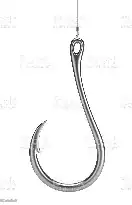
The children were practicing beautiful writing. Some letters included shapes similar to actual fish-hooks used in fishing:
The students were feeling emotional about the big changes, and about how the older people appeared to feel about the big changes. They noticed that their teacher was explaining things especially well that day, and they too wanted to do their best on their last day of schooling in French.
What I understood from the line you had trouble with was that objectively, beautiful writing in German might turn out to include the fish-hook shape too, similar to beautiful writing in French, but the students tried extra hard that day, as though the fish-hook shapes they were making were unique to the French language.
You might want to stop reading my post at this point. But if you like, you could keep going and see how I learned about the beautiful writing exercises of yore.
My mother was born in Germany in 1927. She attended first grade in Berlin before a lot of upheaval started. Here are two excerpts from a partial memoir she wrote:
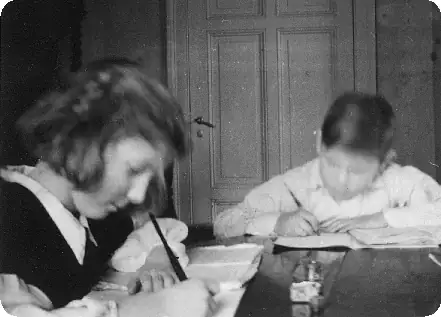
Berlin school was a cheerless, serious, full-time job. Classes
occupied mornings, homework afternoons and evenings. Every week we had
exams, and were seated, back to front, according to our previous
week’s score. I was never quite the best; that was a girl twice my
size with ten times my confidence, who more often than not had a
higher score and thus sat behind me. She was calm and pleasant, never
said a mean word, but I was a bundle of undersized nerves. Her very
presence tortured me, showing me and the world my inadequacy at being
best, as was expected of me, and I hated her. She was even good at
“Beautiful Writing,” my weekly downfall. Once a week we had to dip
pens in inkwells and copy something in the old German script Hitler
had invoked to make us more distinctively German, different from all
the other western countries using Latin script. This was really hard
for me; I would get ink all over my fingers, and often, my face and my
clothes. Sometimes I peeked, and my successful competitor’s letters
proceeded across the page in evenly curved strokes and curls, unlike
my assortment of smudges, blots, and sprays. I still have trouble
writing in ink. Most people put the caps of their pens on the ends of
their pens and then write. I still can’t manage that. The cap
overbalances my pen, and there I go, making a mess. The invention of
the ball point pen has helped reduce smudging, but I still write funny
in ink, and much prefer a pencil. Not a fine, precise accountant’s
pencil, or worse yet, a superfine artist’s 4H. No, I need a soft 2B
whose blurring hides the details of my awkward script.
In my family’s view my failure to stay consistently in the back row,
week in, week out, already threatened my preordained career as an
intellectual. Bad enough that I tended to put wrong shoes on wrong
feet, was considered too small to start school a year early like my
brother and sisters; worse that I got caught reading fairy tales
instead of essays on social revolution; now flunking Beautiful Writing
forever defined me as family idiot. In other respects life was not so
bad; the mountain-town housekeeper’s compromise breakfast followed us
to Berlin, and I was no longer obliged to share a room with my mean
big brother, alternately his shadow or his unwilling smaller twin.
Skipping ahead to a year of schooling in England:
Our school, formerly located in Germany, had catered to the children
of affluent liberal intellectuals in Germany, and when Hitler gained
power, its administrators obtained parents’ permission, and moved,
lock, stock, and children, to southern England. Most parents signed
up, glad to send their children to safety. The teachers were mixed,
half speaking German, half only English, and the children were even
more mixed. Some were German speaking, Jewish or not, and some spoke
French; together we spoke a mix of languages, a lingo we called the
“schönste Slanguage,” that is, “the most beautiful slang.”
My brother and I were separated, since the school assigned him to live
and attend classes at a cottage for older boys that was some distance
away, while I was housed and schooled with the youngest children.
Without my brother’s familiar bossing and parentally-ordered servants’
strict discipline, I was frightened and begged to leave, but after a
while, freedom grew on me. This school offered food that they thought
children would like, turned kids loose on it, and no one watched who
ate what. For the first time in my life I got really hungry. I ate and
ate, grew a foot, and outgrew much of the wardrobe bought and
pre-wrinkled with such care in Berlin. I rode a bike, played games,
learned to print in English by copying nursery rhymes, and left
Beautiful Writing and academic competition behind. It was a happy
year.
Thanks for including a link to the Daudet text. It was helpful for me to get more context.
Responding to Peter Shor's comments. Here's the original for the paragraph in question:
La leçon finie, on passa à l'écriture. Pour ce jour-là, M. Hamel nous avait préparé des exemples tout neufs, sur lesquels était écrit en belle ronde: France, Alsace, France, Alsace. Cela faisait comme des petits drapeaux qui flottaient tout autour de la classe pendu à la tringle de nos pupitres. Il fallait voir comme chacun s'appliquait, et quel silence! on n'entendait rien que le grincement des plumes sur le papier. Un moment des hannetons entrèrent; mais personne n'y fit attention, pas même les tout petits qui s'appliquaient à tracer leurs bâtons, avec un cœur, une conscience, comme si cela encore était du français...
Note the "belle ronde." That definitely refers to cursive. And note that cursive writing is in the bedrock of the French educational system.
You've written some comments about the word "bâtons." Maybe the smallest children were practicing their slant lines while the others were doing the copying exercise. If the classroom was mixed age, it would make sense that a whole-group activity would have a different version for the little ones, who would have been taking their first steps in penmanship.
Whether that seems plausible to you or not, I don't wish to continue debating the translation with you. I did not write either of the translations you've cited! So, please let's just agree to disagree. At any rate, I stand by the basic idea of my original post: slant lines or fish-hooks, the point is that the students put their heart and soul into their penmanship exercise that day, as though even the basics of penmanship were quintessentially French.


