The meaning the word 'honeycomb' must have for the image to make any sense is 'pollen sac': Caliban's legs will swell so much with the bee stings that they will look like the legs of bees when their pollen sacs are full. Otherwise, I do not see what is the thickness of a honeycomb… ? THIS looks like a comb, does it not?!
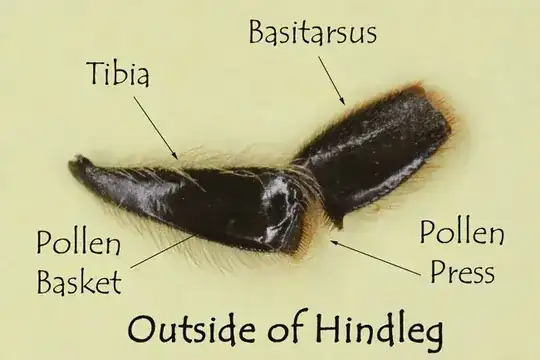
Still, I do not really understand 'comb' in 'honeycomb'… !
Online etymological dictionary:
comb (n.)
Old English camb (later Anglian comb) "thin strip of toothed, stiff material" (for dressing the hair), also "fleshy crest growing on the head of the domestic fowl" (so called for its serrations), hence "crest of a hat, helmet, etc.;" also "honeycomb" (for which see honeycomb (n.)) , from Proto-Germanic *kambaz (source also of Old Saxon and Old High German camb, German Kamm, Middle Dutch cam, Dutch kam, Old Norse kambr), literally "toothed object," from PIE *gombhos, from root *gembh- "tooth, nail."
From c. 1300 as a tool for carding wool (probably earlier; Comber as a surname is from c. 1200). Comb-paper (1866) is marbled paper in which the design is produced mostly by use of a comb.
comb (v.)
c. 1400 (implied in past participle kombid), "to dress (the hair) with a comb," a verb derived from comb (n.) and replacing the former verb, Old English cemban, which however survives in unkempt. Meaning "to card (wool)" is from 1570s. Colloquial sense "to search, examine closely" is by 1904, American English. Related: Combed; combing.
also from c. 1400
Trends of comb
adapted from books.google.com/ngrams/. Ngrams are probably unreliable.
Advertisement
Entries linking to comb
*gembh-
Proto-Indo-European root meaning "tooth, nail."
It forms all or part of: cam (n.1) "projecting part of a rotating machinery;" comb; gem; oakum; unkempt.
It is the hypothetical source of/evidence for its existence is provided by: Sanskrit jambha-s "tooth;" Greek gomphos "peg, bolt, nail; a molar tooth;" Albanian dhemb "tooth;" Old English camb "comb."
honeycomb (n.)
Old English hunigcamb; see honey (n.) + comb (n.). This use of the Germanic "comb" word seems to be peculiar to English, and the likeness is not obvious. Perhaps the image is from the comb used in wool-combing, but that extended sense of comb is not attested before Middle English. In other Germanic languages the word for it is "honey-string," "honey-cake," "bee-wafer," etc. Latin has favus, Greek melikerion.
Transferred use, in reference to various structures resembling honeycomb, is from 1520s. As a verb, from 1620s (implied in honeycombed).
unkempt
beach-comber
cam
cockscomb
comber
numb
See all related words (8) >


