6

You encounter them periodically in movies, and, in certain places, in real life. I asked people who live in a region positively studded with castles, and all they could come up with was "the peeping slidy thingy in the entrance door."

Which is amusing but doesn't answer the question.

What's it called? And the slide - does it have a separate term? enter image description here

Ricky
  • 20,450
  • 2
    Possibly a hatch with a shutter but I can't get the dictionary definitions. BTW were the spikes on the portcullis really necessary? – Weather Vane Oct 10 '23 at 21:47
  • 1
    Googling, hatch seems the best option. Spyhole, peephole, etc suggest a hole without a cover. I can't find anything authoritative, just a bunch of forum posts. – Stuart F Oct 10 '23 at 21:54
  • In modern terms, I would call it a peep window: front door with peep window. Are you looking for a medieval/historical term? – Tinfoil Hat Oct 11 '23 at 02:44
  • @WeatherVane: Probably not. I found the picture on the web - took the first one that suited my purposes here. They seem to be purely decorative since they don't cover the entire entrance. – Ricky Oct 11 '23 at 02:54
  • 1
    @TimR: Factual info would be better. – Ricky Oct 11 '23 at 02:55
  • @TinfoilHat: I'm looking for the official architectural term. Historical or otherwise. – Ricky Oct 11 '23 at 02:55
  • 2
    The sides of the portcullis are hidden by the shape of the archway; I'm sure it does have spikes all the way across, to catch any attacker who might be trying to get in just as the portcullis was being lowered. – Kate Bunting Oct 11 '23 at 08:13
  • @WeatherVane Haha I just assumed that was so if the person behind the door saw somebody they didn't like they could just drop the spikes on them... :-D – Michael Oct 12 '23 at 16:25
  • 2
    It's not much use on an English-speaking site, but the word in French for this is a 'vasistas'. It comes from the German 'Was ist das?' (meaning 'what is it'). I know it sounds like this is something I've made up, but it is absolutely true. Have a look at https://www.lalanguefrancaise.com/dictionnaire/definition/vasistas for a little more detail. – Kiloran_speaking Oct 12 '23 at 20:07
  • 1
    @Kiloran_speaking: This is fascinating. I'm not kidding. – Ricky Oct 13 '23 at 01:09

3 Answers3

12

I believe the most common term would be a peephole, even when talking about historical architecture. The one with a sliding cover could be called a sliding peephole.

enter image description here
A medieval door with a peephole covered in metal bars.
Photo by shutterstock.com / BonnieBC
traditionalbuilding.com


Speculatorium is a historical architectural term for it but it is not used today. It has the same etymons as speculate, a current word you are familiar with, which are Latin speculāri and its participal stem speculāt-. Speculārī means "to spy out, watch, examine, observe" and it comes from Latin specĕre "to see, look". The suffix -orium can form nouns with the sense "an instrument with which a specified activity is carried out".

The term is listed in the book Illustrated Dictionary of Historic Architecture by Cyril M. Harris:

speculatorium a peephole with a grating in a door for inspecting visitors.

For example, speculatorium was used in an architectural illustration of the door of S.George's Chapel in Windsor, in the book Metal-work and its artistic design by Wyatt, M. Digby, from 1852:
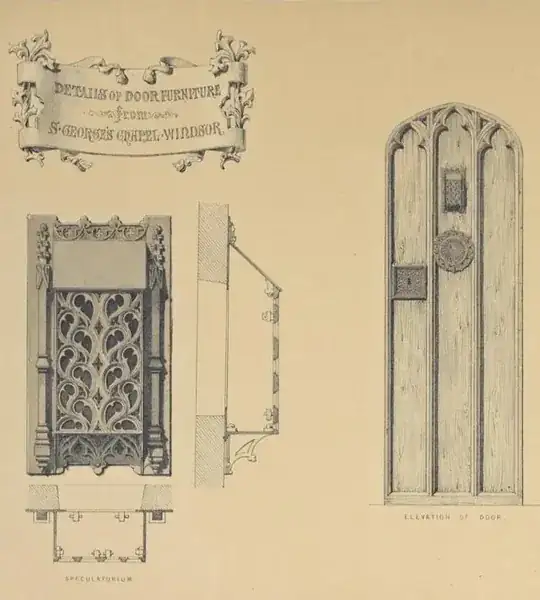
enter image description here

ermanen
  • 62,797
7

It might be called a Judas window or Judas hole. Collins Dictionary has

judas
a peephole or a very small window in a door
Also called: judas window, judas hole


Wiktionary has

Judas window
A window enabling a prison guard to see into a cell without being seen by the prisoner.

Weather Vane
  • 20,971
  • 2
    See also https://english.stackexchange.com/questions/336310/what-is-the-origin-of-judas-gate – Tevildo Oct 10 '23 at 22:26
  • 2
    Hmm... I think Judas Window applies only to the case of a prison cell rather than to the case depicted by the asker. – Jack Aidley Oct 11 '23 at 13:05
1

It is sometimes called a speakeasy window.

Examples can be found at Google Images.

In the prohibition era, they were commonly used on the doorways to speakeasy bars, and a patron would often have to whisper a secret password through the window before being allowed to enter the establishment.

Today, they are often used for ornamental effect, and perhaps in the doors of some nightclubs so that the security staff can engage with visitors safely.

Weather Vane
  • 20,971
  • Have you supporting evidence? Google images returns hits in a search for "speakeasy radiator". – Edwin Ashworth Oct 11 '23 at 18:23
  • @EdwinAshworth it does, and those products don't seem to be about "speakeasy radiators", but the individual search terms. In the link I showed, manufacturers are describing their window-in-a-door as a "speakeasy window". Therefore it is a term which is being used. One such was the source for a sentence in the answer. – Weather Vane Oct 11 '23 at 18:30