I have been around on Twitter for awhile and I regularly find people using "Please to retweet this" or "Please to help me", etc. Is this proper English? I do not think prefixing the infinitive form with a 'to' is necessary here at all.
Asked
Active
Viewed 1.5k times
9

-
The infinitive is certainly necessary here. The question is whether it should be preceded by to. – Peter Taylor Mar 20 '12 at 17:10
-
6@PeterTaylor: It's not the infinitive. It's the imperative – Armen Ծիրունյան Mar 20 '12 at 17:37
-
@ArmenTsirunyan, I suppose you could analyse it that way too, if you take please as an interjection (or maybe an adverb). I was taking please as the imperative. Offhand I can't think of an English verb which differs in the infinitive and the imperative to plug in and test. – Peter Taylor Mar 20 '12 at 20:26
6 Answers
18
Using please to help me instead of please help me is incorrect. However, the following examples are correct:
Help me, please, to do my homework.
I am pleased to help you.
We use "please" to make a request more polite.


Armen Ծիրունյան
- 17,751
-
5
-
1@FumbleFingers. Yes. One of the best albums of the 70's was Steeleye Span's folk collection entitled: Please to See the King. – Shoe Mar 21 '12 at 05:39
-
1Armen, please stop rolling-back everyone's edits. "Please" in the last example should be in quotes. – BlueRaja - Danny Pflughoeft Mar 22 '12 at 06:05
12
While other answers are technically correct in that it is not proper UK English, it appears to be a very common form in Indian English.
In UK English I lean to being prescriptive, in other Englishes I lean to being descriptive.


-
3
-
3Embarassingly enough on another forum I use a "Grammar police - to serve and correct" badge as my avatar. – Wudang Mar 20 '12 at 16:32
-
But that's correct! Speaking of embarrassing, my comment should read lean and I have lost edit privileges for it. :( – cornbread ninja 麵包忍者 Mar 20 '12 at 16:44
-
11+1 because a sentence staring with "Please to" immediately makes me assume an Indian wrote it. – Ben Jackson Mar 20 '12 at 16:50
-
@BenJackson I'm pretty sure I've also seen Russians do this a fair bit. Probably others as well. – Karl Knechtel Mar 20 '12 at 18:53
-
2Is it possible that this form originates from someone mishearing/misspelling Please, do* retweet this* ? – Martin Mar 21 '12 at 00:19
-
-
@KarlKnechtel: Hercule Poirot -- although "Please to tell me" is a misconstruction because French doesn't use an infinitive form in that clause. – Andrew Leach Mar 21 '12 at 08:42
-
9
As can be seen from most of the answers and comments, native speakers today generally feel that constructions such as "Please to give me that" are "invalid", but they certainly weren't always...
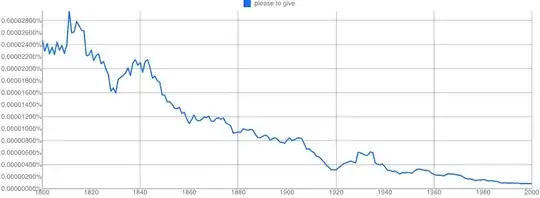
Modern usage of single-word "please" in the "polite entreaty" sense is very different to the original (a short form of "may it please you to"). We can now place it quite flexibly within a request...
Please give me that.
Give me that please.
Will you please give me that. (usually terminated with '?', though it's rarely a question!)
Will you please to give me your arm? (William Thackeray, in Harper's magazine, 1858)
Will you please to give my respects to your friends. (no '?' there in 1835!)
I ask you please to give it your support. (Albert Einstein, Collected Papers, 1090-1920)
Most people will feel that the 4th and 5th examples there are somehow "ungrammatical", but clearly they weren't considered so at time of writing, and no new rule of grammar has since been introduced. And many people will feel that Einstein's usage would be somehow "sanitised" by placing commas before and after "please". In the end though, the truth is that our current usage of the word "please" is just that; a matter of (shifting) common usage, not grammatical rules.
TL;DR: Indian English is just a bit behind the times, not ignorant as such.

FumbleFingers
- 140,184
- 45
- 294
- 517
-
1The usage in the 6th example, Einstein, doesn't support your argument: The phrase "I ask you to give it your support" is perfectly modern English. The "to" is part of the infinitive form of the verb to give, which isn't true for, say, "Will you please to give me your arm" which does. – james Mar 05 '19 at 09:38
-
@james: That's exactly the point I was making about the 6th example! You're effectively ignoring the syntactic relevance of the word *please* by supposing it to be an "optional, parenthetical" element (delimited by imaginary commas). Not that I know exactly how Einstein (not a native Anglophone himself, obviously) internalised the syntax, but it's perfectly possible he saw it as parallel to... – FumbleFingers Mar 05 '19 at 17:46
-
(someone) asked him please to (do something). Which I consider to be at least "awkward" positioning of the word today. As that chart shows, someone) asked him to please* (do something)* was always the more common form anyway, and this has become increasingly the case in recent decades. – FumbleFingers Mar 05 '19 at 17:49
5
I have noticed that sentences starting with a [Marker] + to + Infinitive pattern are very common in Asian Englishes, like some Wh-Questions like ones often posed here on ELU.SE
- How to distinguish imperfect from aorist?
- When to use gerundive?
or truncated predicate adjectives
- OK to use "will" in inchoative clauses?
- Incorrect to use apostrophe's like this?
etc. I think the pattern may be widespread in speech, and thence in informal writing. But I haven't been in Asia observing speech patterns for a long time.
In any event,
- Please to remove shoes.
is just more of the same pattern.
(I could go on about what that may mean for the future of to and other markers but I forbear.)

John Lawler
- 107,887
-
7Many native speakers of American or British English will think that people using these forms are unskilled in their use of the language. – David Schwartz Mar 20 '12 at 16:20
-
7All the examples you gave are for questions, which seem to be elliptical forms of "do you know how to use..." or "Is it OK to use...". But "Please to..." does not fit that pattern; it's not a question. – Mitch Mar 20 '12 at 16:27
-
... when in fact they are simply unskilled in the use of the local US or British dialect. This is the way things are going in Asia, at least. Check out our questions here; how many start with Marker + to + Infinitive? And how many are corrected away from it? – John Lawler Mar 20 '12 at 16:28
-
@JohnLawler: I have asked that question here on ELU and the answers suggest that Marker + to + Infinitive is OK as a title. – Armen Ծիրունյան Mar 20 '12 at 17:37
-
2But that's because it's not a question anymore- it's a statement. "When to Ask for Help" could be the title of an article that lays out the rules for determining wheh help should be sought i.e., [This is] When to Ask for Help" – Jim Mar 20 '12 at 18:08
-
I had always assumed it grew from a corruption of "Please, do remove your shoes" rather than out of that particular way chinese english speakers tend to express questions :) – Affe Mar 20 '12 at 19:22
4
You're right; it isn't necessary nor is it proper English. It's extraneous.
However, I might be pleased to meet you or pleased to help you or pleased to retweet that for you.

cornbread ninja 麵包忍者
- 18,150
- 2
- 58
- 74
0
In his 1868 mystery novel Moonstone (online copy available here, at Project Gutenberg), Wilkie Collins often has his characters addressing one another deferentially by using phrases starting with "please to..." followed by a request. Such as one of the household maids who asks "Please to let me go on with my work" or a request to one of the characters to continue an interrupted action: "Please to go back to the letter, Mr. Franklin".

Chappo Hasn't Forgotten
- 3,166
- 8
- 24
- 35
