5

I've been reading a selection of short stories by Kafka (translation by Michael Hoffmann). In one of stories The Sudden Walk, I encountered this phrase

When it seems we have finally decided to stay home of an evening.

This seems strange because I've never seen "of" used in a sentence like this elsewhere. Is this a printing error or an archaic usage?

Mari-Lou A
  • 91,183
mewl
  • 67
  • The only phrase needed is quoted anyways – mewl Jan 01 '24 at 09:42
  • 4
    It's in Merriam-Webster dictionary "11a—used as a function word to indicate the position in time of an action or occurrence: died of a Monday" – Stuart F Jan 01 '24 at 10:40
  • There's also a question about "of a (day)", and some comments mention "of an evening". – Stuart F Jan 01 '24 at 10:45
  • This is not right if this means habitually. The translator should have used: this or that evening. – Lambie Jan 01 '24 at 17:45
  • The original am Abend could be rendered as "in the evening" without reference to any particular evening, just to the time of day. Or even as "come evening time". – TimR Jan 01 '24 at 18:20
  • It's essentially "dialectal" to use *of an evening* instead of *in the evening*. But this particular dialectal usage actually has some "cachet", so you'll sometimes hear it from people who've adopted it rather than grown up with it. – FumbleFingers Jan 01 '24 at 18:26
  • Noting the answers and comments that this question has attracted, I don't believe that I've heard "of an evening" used in British conversation or in British journalism etc. – Mark Morgan Lloyd Jan 02 '24 at 08:22
  • 1
    @MarkMorganLloyd - it's a usage that's hung on in Yorkshire dialect. It doesn't feel 'odd' at all to me & is the kind of thing I might use myself, for a habitual action. I can't tell from the short quote alone whether the author meant habitual or a single event, but the other translation below makes it look like the wrong usage here.. – Tetsujin Jan 02 '24 at 08:55
  • @Tetsujin Thanks for the elucidation. – Mark Morgan Lloyd Jan 02 '24 at 09:02

3 Answers3

12

"Of an evening" is a colloquial expression that can be taken to mean "habitually in the evening" (The Shorter Oxford English Dictionary).

The Longman dictionary says something similar.

of an evening/of a weekend etc British English: in the evenings, at weekends etc
• We often used to walk by the river of an evening.

Définitions proposed by Oxford Languages

of an evening informal • British

  1. on most evenings.
    "he has a healthy diet consisting of cereal in the morning and meat and two veg of an evening"
  2. at some time in the evenings.
    "you can wear these dresses of an evening or during the day"

of a morning informal • British

  1. on most mornings.
    "I prefer to look out the window of a morning and decide then whether a coat is needed"
  2. at some time in the mornings.
    "he warned there would be fireworks if he was deprived of a brew of a morning"

The expression "in the evening" is much more current and, of course, not colloquial but standard ("habitually" is in most cases not needed as the context is sufficient to differentiate this meaning from the meaning "in this particular evening").
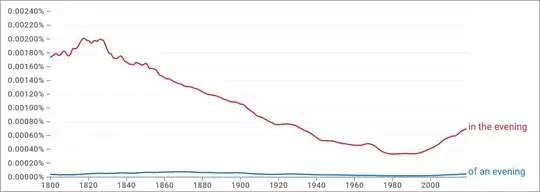
enter image description here

It appears that there is an error in this translation: the translation by I. Glatzer, Nahum Norbet, 1903 does not have "of" but "for", and that makes sense.

WHEN it looks as if you had made up your mind finally to stay at home for the evening, when you have put on your house jacket and sat down after supper with a light on the table to the piece of work or the game that usually precedes your going to bed, when the weather outside is unpleasant so that staying indoors seems natural, and when you have already been sitting quietly at the table for so long that your departure must occasion surprise to everyone, when, besides, the stairs are in darkness and the front door locked, and in spite of all that you have started up in a sudden fit of restlessness, changed your jacket, abruptly dressed yourself for the street, explained that you must go out and with a few curt words of leave-taking actually gone out, banging the flat door more or less hastily according to the degree of displeasure you think you have left behind you, and when you find yourself once more in the street with limbs swinging extra freely in answer to the unexpected liberty you have procured for them, when as a result of this decisive action you feel concentrated within yourself all the potentialities of decisive action, when you recognize with more than usual significance that your strength is greater than your need to accomplish effortlessly the swiftest of changes and to cope with it, when in this frame of mind you go striding down the long streets -- then for that evening you have completely got away from your family, which fades into insubstantiality, while you yourself, a firm, boldly drawn black figure, slapping yourself on the thigh, grow to your true stature.

LPH
  • 20,841
  • 1
    If you have just argued that "of an evening" can represent a habit and a routine (which I disagree with) why is "of an evening" an error because one translator used a different preposition? – Mari-Lou A Jan 01 '24 at 10:59
  • Is the first line in your answer a paraphrase or quoted directly from the source mentioned (The Shorter Oxford English Dictionary)? – Mari-Lou A Jan 01 '24 at 11:03
  • Thanks a lot for the answer – mewl Jan 01 '24 at 12:22
  • 1
    @Mari-LouA I haven't argued much in that sense, the fact is that "routine" is all you can get from the dictionaries (more or less "all evenings"). I'll add the remainder of this enormously long sentence; it can be seen in it that the author is referring to a particular sort of evening rather than all evenings: it is the evening of that particular sort of day, "when you have made up your mind […], when the wheather is unpleasant[…], when you have already been sitting quietly […], etc. So it must be the evening of such a very particular day (there might be a repetition occasionally). (1/2) – LPH Jan 01 '24 at 12:26
  • @Mari-LouA "For" does not confer this idea of habitual happening and thus it is proper. // The exact SOED definition is what I used. (2/2) – LPH Jan 01 '24 at 12:27
  • Naively, I wonder if one translator's choice with of is neither typo nor standard, but an artistic choice. We know prepositions are notoriously language-specific. – Yosef Baskin Jan 01 '24 at 14:06
  • "When it seems we have finally decided to stay home of an evening" for the meaning of the idiom. It does not work. BAD translation (translation error) as the meaning is clearly: this evening. – Lambie Jan 01 '24 at 17:46
  • 1
    @YosefBaskin Artistic effect at the price of confusing the reader can hardly be called an acceptable choice, and this translator has been educated in England, which makes unlikely his possible ignorance of these colloquial of-phrases (I was aware myself of their existence in English literature before reading the OP). This point of view would be less questionable had he been a specialist of American English writing for the American public. But in fact, he has to be something of an expert in that field since, (1/2) – LPH Jan 01 '24 at 19:56
  • 1
    @YosefBaskin even if he has not consecrated himself wholly to this type of translation, he translated Kafka for a "largely American readership". Perhaps, then, he was able to make abstraction of the foundation of his English and he expected that "of" would communicate something that American readers could identify. Personnally, I am unable to identify any such artistic idea, but my experience with the two languages and their subtlties is not extensive. (2/2) – LPH Jan 01 '24 at 19:56
  • As used, there is no sense of habitualness; of an evening just means in the evening or for the evening. – Tinfoil Hat Jan 01 '24 at 20:18
3

In Hoffmann’s translation, of an evening simply means in the evening or during [for] the evening:

evening noun1, adverb, & interjection

PHRASES
P.2. of an evening: in the evening, during the evening; esp. habitually in the evening, each evening. Formerly also †in an evening.
[selected samples]
1789   You know how well pleased we all are, when of an evening you tell us some pretty story.
1952   There's a ripe young lass somewhere upbank as keeps house for her father. He's usually out boozing till late of an evening.
2005   I mean I've been thinking about it a lot what with not having much to do of an evening.
Source: Oxford English Dictionary (login required)

Note that the “esp. habitually” part of the definition does not apply here. Compare these translations of Kafka’s German phrase Wenn man sich am Abend endgültig entschlossen zu haben scheint, zu Hause zu bleiben . . .

When it looks as if you had made up your mind finally to stay at home for the evening . . . (Willa and Edwin Muir)

When you seem to have finally made up your mind to stay home for the evening . . . (Joachim Neugroschel)

If in the evening you seem to have decided once and for all to stay at home . . . (Joyce Crick)

When it seems we have finally decided to stay home of an evening . . . (Michael Hofmann)

When you seem to have decided to stay at home for the evening . . . (Christopher Moncrieff)

When you seem finally to have made up your mind to spend the evening at home . . . (Malcolm Pasley)

If in the evening you seem to have definitely decided to stay home . . . (Katja Pelzer)

Source: Reddit—Prose Porn: A Sudden Stroll, by Franz Kafka (German and six translations), submitted by MilkbottleF

Also, it helps to remember that translation is an art, not science.

Tinfoil Hat
  • 17,008
3

When it seems we have finally decided to stay home of an evening.

I've never seen "of" used in a sentence like this elsewhere. Is this a printing error or an archaic usage?

No. It's quite normal although, nowadays, a little quaint or old-fashioned.

OED of (prep.)

XV.51.a. At some time during, in the course of, on. Apparently taking the place of the Germanic and Old English genitive of time. Now only implying regularity or repetition (as also in sense XV.51b), e.g. in of a Monday, of a Sunday afternoon. Now chiefly regional.

1922 See him of a Sunday with his little concubine of a wife. J. Joyce, Ulysses ii. xii. [Cyclops] 301

1959 He can start coming in of a night, or else go and live somewhere else. K. Waterhouse, Billy Liar i. 1

1999 Kippers of a Friday, roast of a Sunday. C. Creedon, Passion Play ii. 8

As the OED suggests, there is a genitive connection between

"He goes to church of a Sunday/of an evening." French Norman origin

and

"He goes to church Sundays/evenings" in which "Sundays" is an unapostraphised (is that a word?) genitive of Germanic origin.

See https://en.wikipedia.org/wiki/English_possessive

Another remnant of the Old English genitive is the adverbial genitive, where the ending s (without apostrophe) forms adverbs of time: nowadays *[= now, of a day], closed Sundays [= of a Sunday]. There is a literary periphrastic form using of, as in of a summer day. There are also forms in -ce, from genitives of number and place: once, twice, thrice; whence, hence, thence.

Greybeard
  • 41,737
  • But you omitted the rest of the entry following Now chiefly regional: of an evening: see evening n.1, adv., & int. Phrases P.2. – Tinfoil Hat Jan 02 '24 at 16:54
  • I omitted it intentionally as I'm not sure that it is "chiefly regional" (and that phrase is not helpful.) is true. I replaced it with my comment on its style (rather than use). – Greybeard Jan 02 '24 at 21:14
  • You kept the chiefly regional part. And the part you quoted is chiefly regional. – Tinfoil Hat Jan 03 '24 at 02:53
  • Must be a brain fart - I intended to omit it. "of an evening: see evening n.1, adv., & int. Phrases P.2." This adds little or nothing and requires more quotes. – Greybeard Jan 03 '24 at 12:50