22

Is the word "of" optional in this instance? Is either of these considered preferable to the other?

  • Taste all our delicious treats.
  • Taste all of our delicious treats.
RegDwigнt
  • 97,231
TecBrat
  • 3,709
  • 4
  • 24
  • 35

5 Answers5

17

If you go back a century or so, "all of" would be very rare indeed. The fact that it occurs a bit more often nowadays is no real reason for using it - it's still far more common not to use "of" after "all".

Having said that, in OP's context either form is acceptable. For reasons that aren't clear to me, it seems that "of" is actually required when followed by a pronoun...

You took the part that once was my heart. Why not take all of me?

My father won eight thousand dollars the night before, but lost all of it last night.

I can't think of any similar context where including the preposition is "unacceptable", though it would certainly be stylistically clumsy to overdo it...

"You can fool all [of] the people some of the time, and some of the people all [of] the time, but you cannot fool all [of] the people all [of] the time." (attrib. Abraham Lincoln, among others).

Idiomatically, all is slippery. You can take all of me/it/us/them, and you can take it/us/them all, but you can't take me/him/her all. That's not because those pronouns are singular (take it all is unremarkable) - it's just a matter of idiomatic usage.

FumbleFingers
  • 140,184
  • 45
  • 294
  • 517
  • 1
    Nice job, but two minor points. I disagree with your last sentence: Take me all sounds just as strange as take all me, probably because of the semantics. And your first example is misleading; in lyrics, scansion is more important than fine points of grammar. – Tim Lymington Sep 02 '12 at 22:16
  • 1
    Idiomatic usage is slippery in general.  I suggest that there is a rule that ‘‘of’’ is required for singular objects (e.g., He ate all of* the sandwich.) and optional for plural and non-count (e.g., He ate all the apples. He ate all the cheese.*), and that ‘‘it’’ is the exception to the rule.  Note that ‘‘Ate all it’’ is wrong (to my ear, at least), while I agree that ‘‘Ate it all’’ is acceptable. – Scott - Слава Україні May 23 '18 at 17:13
13

Both sentences are grammatical.

See the following NGRAM (all our, all of our):
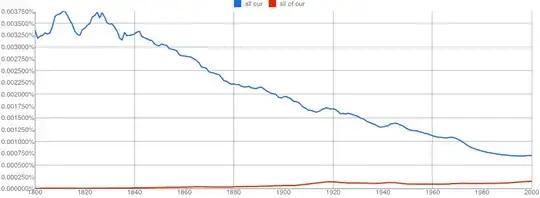
Google NGram showing 'all our' decreasing in usage from approximately 0.0035% in 1800 to 0.00075% in 2000 and 'all of our' slightly increasing from 0% in 1800 to 0.00025% in 2000.

It would seem that the use of "all of our" is growing nowadays.

Also, "all of our" ("all of our delicious") gets 18,200,000 (745) hits on Google Book, while "all our" ("all our delicious") gets 26,500,000 (4,240) hits.

Kit Z. Fox
  • 27,819
  • That's for written language only, of course. In spoken English these are just two points on a long range of possible pronunciations of that particular quantifier phrase. – John Lawler Apr 25 '12 at 15:33
  • 1
    Nice work, Carlo. Personally I would write "Taste our delicious treats". In copywriting, which this is, you want to be as concise as possible. Also, "taste all our delicious treats" carries the unwanted connotation of demanding that the customer taste them all. – Eugene Seidel Apr 25 '12 at 15:37
  • @EugeneSeidel - Wouldn't it more correct to write "...you should be as concise as possible" rather than "...you want to be as concise as possible?" –  Apr 25 '12 at 16:16
  • My version is a bit more colloquial than yours but both are correct. – Eugene Seidel Apr 25 '12 at 16:18
  • This phenomenon, that 'all of NP' is much less common than 'all NP', is very surprising to see in the graph because in current speech they feel equally likely. – Mitch Apr 25 '12 at 17:01
  • I am a web developer and my customer initially provided me with "Click here to See and Taste the Difference of ALL our Bouquets", talking about fruit bouquets, then "corrected" it to "Click here to See and Taste the Difference of ALL of our Bouquets". Both seem clumsy to me, but I certainly didn't think the second "of" was needed. I'll use it as she gave it to me. Thanks. (I like the chart, by the way.) – TecBrat Apr 25 '12 at 17:40
  • 1
    @TecBrat I don’t see that this answer actually answers the question. It doesn’t say which is preferable, or why. – tchrist Apr 25 '12 at 17:46
  • 7
    Of course, it goes without saying that X should be plural, unless it is "base". – Random832 Apr 25 '12 at 18:42
  • @tchrist Both sentences are grammatical. and It would seem that the use of "all of our" is growing nowadays. As well as the chart were satisfactory in answering my question. The philosophical and technical debate that has ensued is more than that for which I bargained. (I'd have said "...more than I bargained for.", but on an Enlish board I'd probably have been chided for ending in a preposition.) – TecBrat Apr 25 '12 at 19:39
  • @Random832, LOL. – TecBrat Apr 25 '12 at 19:40
  • @TecBrat That sort of pedantry is the kind of bloody nonsense up with which I (and probably some others here) will not put. – Random832 Apr 25 '12 at 20:54
  • @TecBrat No, but you might be *chidden* for your unsightly mangling of utterly commonplace syntax. – tchrist Apr 25 '12 at 21:31
  • all of "Not more than": a conversation that took all of five minutes – GJC Jul 27 '20 at 20:06
3

Even though both versions scan as natural English, a copyeditor will always reduce “some/most/many/all/several/few/one/… of the” to remove the of the part. It’s just extraneous baggage. You don’t need it to create a partitive sense in English.

Even here in your example where the determininer is a possessive adjective instead of definite article, one can often reduce it — and should do so. You certainly don’t need the of portion. Your phrase is better without it.

One general guideline is that whenever you can remove a word without changing the sentence’s meaning, that you should do so to tighten the phrasing.

tchrist
  • 134,759
  • 2
    That copyeditor's rule doesn't work all [of] the time - some of* the time* he'll need to be more flexible. – FumbleFingers Apr 25 '12 at 17:54
  • @FumbleFingers That’s why it’s only a general guideline, not a rule. In your second example, though, I’d s/some of the time/sometimes/ myself. – tchrist Apr 25 '12 at 17:56
  • Yeah - we'd all usually go for sometimes given a free choice. But in my "contrastive" construction I think the balance is tipped by the fact that we can't speak of rules that work alltimes (even if they actually do! :) – FumbleFingers Apr 25 '12 at 18:19
  • @FumbleFingers You’re right that sometimes the “all of the” should go to “all the” instead of just to “all”. I don’t think it often needs to keep both words, though. Do you? I think people have begun to stick in the “of” to make it some sort of partitive, and I don’t think they usually need to do that in English. – tchrist Apr 25 '12 at 18:24
  • 1
    Whilst I agree "less is more" is a good default starting position on such issues, I'm mindful that you and I (and many others here on ELU) may be tempted to take that position to extremes. What works for computer languages might not always be best for people. Also, as per my own answer, the fact remains that "of" seems to be always at least valid, and sometimes actually required. Not that I'm seriously advocating using it *all of the time, but you must admit it would represent consistency* - which is much to be sought after, surely! – FumbleFingers Apr 25 '12 at 23:44
  • Copyeditor here. Would not necessarily remove "of" as noted above.

    "One general guideline is that whenever you can remove a word without changing the sentence’s meaning, that you should do so to tighten the phrasing." Disagree with that, too. There's more to a sentence than meaning. Flow is important as well. Removing all "unnecessary" words can lead to choppy sentences that are harder to parse.

    – Rodney Atkins Mar 29 '23 at 20:46
0

Allow me to further explain the grammar in these sentences.

  1. Taste all our delicious treats.
  2. Taste all of our delicious treats.

In 1, "all our delicious treats", "all" is a predeterminer, because "our" is a determiner. A determiner is used before a noun, while a predeterminer is used before a determiner to further specify the noun phrase "delicious treats" in this case.

In 2, "all of our delicious treats", "all" is a pronoun.

The use of "all" as a determiner, a predeterminer, or a pronoun is explained here with more examples: https://jakubmarian.com/is-it-all-the-or-all-of-the-in-english/

TecBrat
  • 3,709
  • 4
  • 24
  • 35
Louis Liu
  • 665
  • 6
  • 21
  • 30
  • Since the corresponding French for both variants is 'Tous/Toutes nos ...' I'd say it makes more sense to see 'all of' as a compound predeterminer here. 'A dozen of ...' is a compound numeral-substitute, 'a third of / 33% of' a partitive, and 'a majority of' a compound quantifier. – Edwin Ashworth Jul 09 '21 at 11:27
0

According to the Random House Unabridged Dictionary of American English

Although some object to the inclusion of of in such phrases as all of the students and all of the contracts and prefer to omit it, the construction is entirely standard.

OED reads (here's the index for the website; if somebody needs to use the cdrom, PM me)

OF: XII. Indicating a quality or other distinguishing mark by which a person or thing is characterized. (For OE. genitive; F. de; = genitive of quality or description.)

b. qualified by all, indicating (temporary) condition:

  • 1849 Thackeray Pendennis xvi, ‘Do you say so?’ Smirke said, all of a tremble

ALL: A. adj. II. absol.

  1. Followed by of: in sing. The entire amount, every part, the whole; in pl. Every individual, all the members or examples. (This const. is comparatively modern, and is probably due to form-assoc. with none of, some of, little of, much of, few of, many of.) Rare, exc. with pronouns, as all of it, of whom, of which, of them. Also, as much as, altogether, quite; for all of (cf. for prep. 26b) U.S., as far as concerns (a person or thing). [See pronominal examples under 2c.]

However, I do not know the reasons behind such objection. There must be some grammar involved though: first the common definite article the in both, and second students/contracts are plural and countable.

GJC
  • 2,491