5

Possible Duplicate:
When is it correct to use “yourself” and “myself” (versus “you” and “me”)?

According to Google Ngram, "I am myself" is more common that "I am I", but which is correct?

Also, the verb "to be" is intransitive. That means a subject must follow the verb. So does this mean "I am I" is more grammatical?

Victor
  • 375
  • 3
  • 6
  • 16
  • 1
    "I am I" is SVS, which doesn't make any sense in English as far as I know. –  May 26 '12 at 01:19
  • What do you mean by "correct"? – Neil Coffey May 26 '12 at 01:24
  • 3
    You don't know how hard it was not to create a bogus id called "Popeye" and reply to this question. – JeffSahol May 26 '12 at 01:36
  • 2
    *♬ I am I, Don Quijote, the Lord of La Mancha! My destiny calls and I go! ♬* – tchrist May 26 '12 at 01:47
  • I'll let others speak to the grammar involved here, but looking at the results of the nGram, it might be the case that "I am myself" is ranked higher than expected because of the dual usage of myself as both an object and as an intensifier. Consider the usages from the first page of results: "I find that I am myself because I teach and write." vs. "In religion, I am myself the relation of the two sides as thus determined." – Cameron May 26 '12 at 01:55
  • Cameron - even disregarding that bias, would you not expect "I am myself" to be ranked hugely humongously colossaly higher than "I am I" in any case?!? – Neil Coffey May 26 '12 at 02:00
  • "I am," I said ♬ To no one there ♬ And no one heard at all ♬ Not even the chair♬ – JeffSahol May 26 '12 at 03:02
  • @Jeff et al.: ♬ Henery the 8th I am I am... ♬ (Second verse same as the first) – J.R. May 26 '12 at 05:09
  • @NeilCoffey I certainly would expect "I am myself" to be ranked much higher, and voted below as such. My point was more that the nGram might not be the best tool to use here for a variety of reasons, one of which I listed. Clearly J.R. did a much better job at getting the point across than I did. – Cameron May 26 '12 at 14:55
  • Ah OK I confess I hadn't actually run the query. I would have expected some noise in "I am I" but didn't realise it would be that bad. But yes, obviously this is the general danger with NGram-- it's a very blunt instrument and doesn't always tell you what you think it's telling you. – Neil Coffey May 26 '12 at 15:11
  • 1
    Why would "I am myself" be used more? The verb "to be" is intransitive. That means a subject pronoun must follow the verb. – Victor May 26 '12 at 16:01
  • "to be" is not intransitive, it is copular. – Mark Beadles Oct 12 '12 at 19:27

2 Answers2

8

Unless I am, I think, missing something completely, this is a classic case where the Ngram is the wrong tool for the job.

"I am myself" sounds rather natural, while "I am I" sounds oddly unfamiliar. As such, I'd expect "I am myself" to completely trounce "I am I", instead of being relatively close like the Ngram shows:
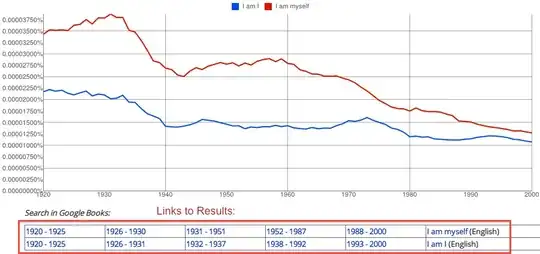
enter image description here

But this is where the data ought to be investigated further. By using the links on the bottom, one can see that "I am myself" is found in several works, in a very natural-sounding context:
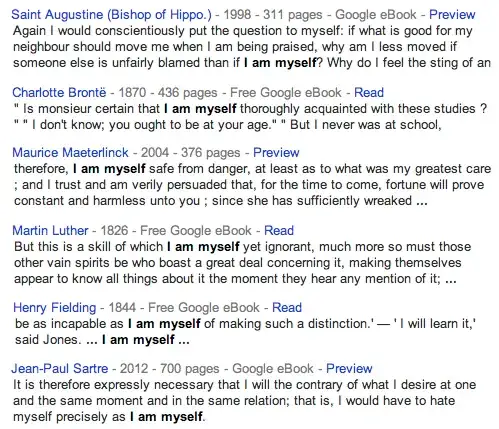
enter image description here

Whereas "I am I", more often than not, is the result of a pure coincidence, such as when one sentence or clause ends with "I am", and the next begins with "I":
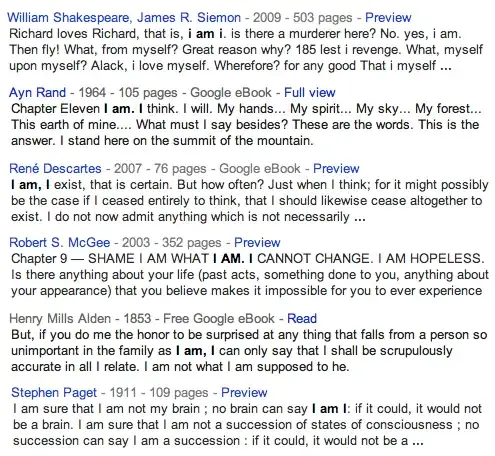
enter image description here

To the O.P.: everything depends on context. That said, most of the time, when you are referring to yourself, you would probably say "I am myself," and not "I am I."

And be very careful with how you use Ngrams. I am myself very leery about looking at the lines, and leaving it at that.

J.R.
  • 58,828
  • 5
  • 95
  • 196
  • 3
    Alas that I have but one vote to give! – tchrist May 26 '12 at 06:07
  • 2
    +1 for the crucial point that 'I am I' can occur in contexts which the OP might not have envisaged. In practice, I think many of us might say 'I am who I am' rather than either of the alternatives. Another point to remember with nGrams is that it covers only printed books. No magazines, no newspapers and, above all, no speech. – Barrie England May 26 '12 at 06:59
  • @Barrie: Thank you for the kind words. Actually, Ngram results can include magazines. The default search is books, but you can change that to include magazines, or be limited exclusively to magazines, by using an option on the left (Magazines/Books/Any document). Here's an example. – J.R. May 26 '12 at 11:12
  • The verb "to be" is intransitive. That means a subject pronoun must follow the verb. So why would you say "I am myself"? – Victor May 26 '12 at 16:01
  • 1
    If I wanted to make a brief self-reference, I'd probably either say "I am me" or "I am who I am", but usually there's more to it than that. If I'm talking about not giving into peer pressure, I might expand it some: "I have to stay true to myself." The phrase "I am myself" is not usually used all by itself, but as a way to add a personal emphasis. "I am a fan of the opera" and "I am myself a fan of the opera" essentially mean the same thing, but the second might be heard in a conversation, just after someone first said, "I really like opera." It's a way to give the expression a "me too" tone. – J.R. May 26 '12 at 17:01
  • 1
    Only the last of your "I am myself" quotes actually asserts identity (and I'm not sure a French existentialist is a good example of English style). The Augustine is a simple shortening of "I am, myself, blamed"; the others are similar. (I think this is a good answer, but your data doesn't support it properly.) – Tim Lymington May 26 '12 at 22:44
  • 1
    @Tim: I concur completely. The main aim of my answer was to show how Ngrams, when not used properly, are a misleading way to determine the "right" way of saying something. – J.R. May 27 '12 at 00:13
  • I've tried to analyze Ngrams like this before, but then I learned that the Google Ngram corpus actually uses different criteria than the Google Books search. So I don't think it works. I still don't know how to explain the commonness of "I am I". – herisson Dec 04 '16 at 22:26
5

The word "myself" should be used when the speaker is both the subject and the object. So I'd consider "I am myself" as the correct option here.

This of course is subject to all the usual provisos about "no single correct answer", "descriptive vs prescriptive", and "correct for my dialect" and so on. But it certainly explains why "I am myself" has a higher Ngram score.

  • 2
    “You are yourself” and “he’s not himself” seem perfectly normal, so I should think “I am myself” would follow. On the other hand, “he’s not him” means something else entirely, as those don’t have the same antecedent. – tchrist May 26 '12 at 01:50
  • 1
    I am he that will be the key to your undoing. – Jim May 26 '12 at 02:01
  • You could invent spurious arguments for why you 'should' use "myself". Or you could invent spurious arguments for why you 'should' use "I". Native speakers say "I am myself" but not "*I am I". To quote myself from various other posts: "Don't invent problems that don't exist". – Neil Coffey May 26 '12 at 02:03
  • 1
    @Jim You’re a that not a who? Sounds grimly depersonalizing to me. Wait, is this Eliza? :) – tchrist May 26 '12 at 03:44
  • @tchrist- Please elucidate your thoughts... (and you are right who works much better- thanks :-)) – Jim May 26 '12 at 03:46
  • 1
    @NeilCoffey It’s interesting that English (“It’s me. I’m myself.”) works like French in this (“C’est moi”, “C’est lui”) rather than Spanish (and Latin), which take a nominative pronoun; “Who’s over there? It’s him.” would answer with “Es él” in Spanish. You wouldn’t even think of using an object pronoun. On the other hand, for “between”, French takes object pronouns but Spanish (strangely?) takes subject pronouns. FR “entre toi et moi” vs ES “entre tú y yo”. I often wonder whether there’s more to the “incorrect” but often-heard English “between you and I” than meets the ahem eye. – tchrist May 26 '12 at 03:50
  • @Jim No great thoughts, sorry. I just wondered whether you were the Eliza program. – tchrist May 26 '12 at 06:05
  • @tchrist In the Spanish case (and indeed this is apparently how Latin worked), the difference is essentially in 'which way round' the language encodes subject/complement (cf "-¿Quien es? -Soy Neil", but not "Es Neil"; "¿Quien lo hizo? Yo fui") and remember that in French, "C'est moi" is really a special construction used for existentials (speakers would also say "Il y a moi", but not e.g. "Il voit moi", "Elle connaît moi" etc). So a conclusion you could draw is simply: "Existential constructions are 'special'". – Neil Coffey May 26 '12 at 08:49
  • Re cases like English "between him and I", you can look at this in a couple of ways. One is simply that English doesn't have case marking in the same way as e.g. German and there's no need to expect to shoehorn English into an overtly case-marked system when that's not how it operates (in Spanish, I think you could either come to a similar conclusion or else say that 'entre' "takes the nominative"). Or... – Neil Coffey May 26 '12 at 08:53
  • ...there are apparently a few languages where in coordinated constructions, the first element carries the case marking. So maybe you could argue that English is tending towards being such a language, hence "between you and I". Personally I'm closer on the side of 'English doesn't have overt case marking'. Either way, there's really no need for the pedant-fabricated controversy! – Neil Coffey May 26 '12 at 08:55
  • (P.S. obviously "Es Neil" is grammatical in Spanish if somebody else is referring to me, but not for me referring to myself. Thought I should clarify in case there are any beginner Spanish learners on here!) – Neil Coffey May 26 '12 at 08:57
  • Also, isn't the verb "to be" intransitive? That means a subject pronoun must follow the verb. – Victor May 26 '12 at 15:57
  • @tchrist- sorry, back when I played with Eliza (late 70's) "Please elucidate your thoughts" was something she said quite often... – Jim May 26 '12 at 19:31
  • 1
    Victor - that's looking at things the wrong way round. You might argue that "be" is a normal intransitive verb if native speakers necessarily followed it with a subject pronoun. But they don't... – Neil Coffey May 26 '12 at 20:20
  • @Victor: That's not what "intransitive" means. – Mechanical snail Oct 12 '12 at 04:56